

- Brave Boar 26 is a multinational exercise involving 6,500 Polish, Lithuanian, and French troops and several hundred vehicles in northeastern Poland near the Suwałki Gap.
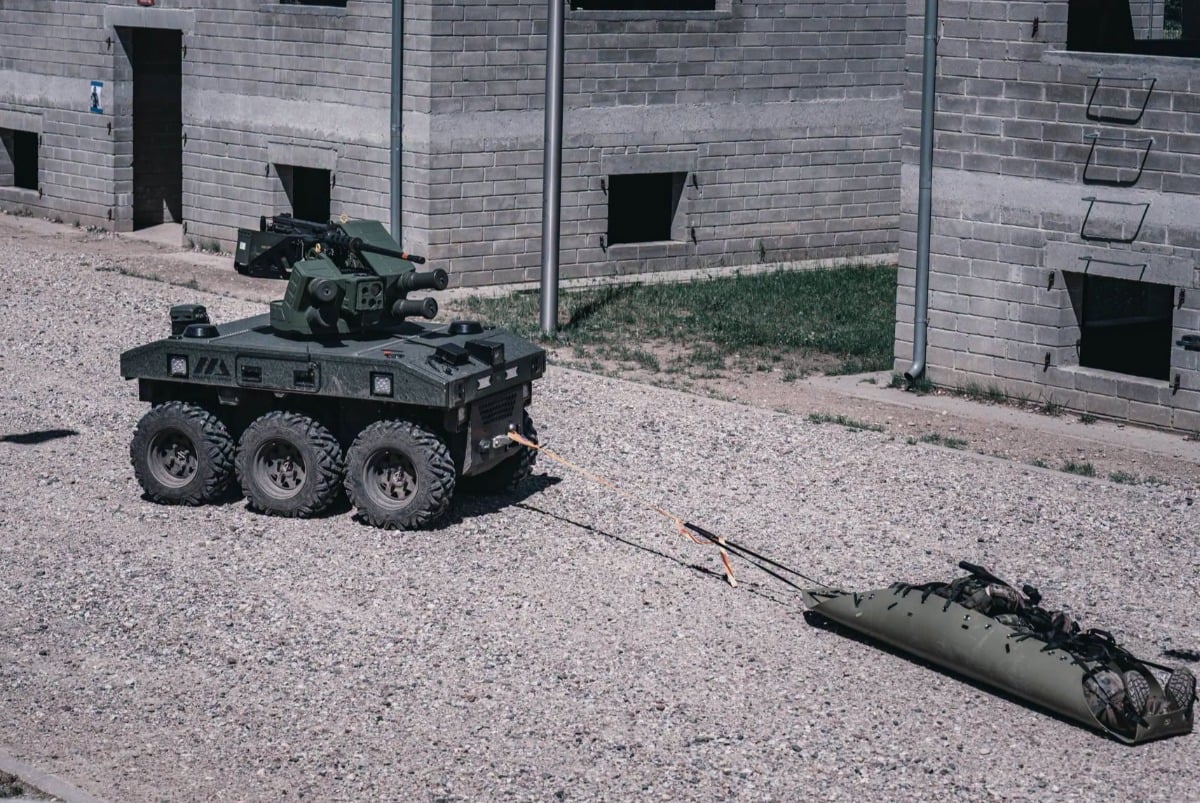
- Polish company Macro-System's GOBLIN unmanned ground vehicle was deployed during the exercise in reconnaissance and casualty evacuation scenarios alongside Borsuk IFVs and Krab howitzers.
Polish, Lithuanian, and French troops are conducting a large-scale military exercise in northeastern Poland focused on defending one of NATO’s most vulnerable geographic chokepoints, deploying unmanned ground robots alongside tanks, artillery, and infantry fighting vehicles in scenarios designed to test whether allied forces can hold a 65-kilometer (40-mile) land corridor that military planners have identified as the single most dangerous potential rupture point on NATO’s eastern flank.
The exercise, called Brave Boar 26, known in Polish as Dzielny Dzik 26, is underway in northeastern Poland with approximately 6,500 troops and several hundred vehicles, making it a substantial combined-arms training event rather than a symbolic demonstration. The training area sits adjacent to the Suwałki Gap, the narrow strip of territory linking Poland to Lithuania and the Baltic states that is pinched between Russia’s Kaliningrad Oblast to the west and Belarus to the east. At its narrowest point, that corridor measures approximately 65 km (40 miles) across, a distance that NATO planners have long identified as the most exploitable geographic vulnerability on the alliance’s eastern flank. A Russian military advance that closed the Suwałki Gap would sever the only land connection between the Baltic states and the rest of NATO, potentially isolating Estonia, Latvia, and Lithuania from allied reinforcement and supply. Defending it is not a Polish or Lithuanian security interest in isolation but a collective alliance requirement that sits near the top of NATO’s contingency planning priorities.
The equipment deployed for Brave Boar 26 reflects the full spectrum of modern Polish land forces capability. Borsuk infantry fighting vehicles, the newest generation of Polish armored carrier designed to replace the aging Soviet-era BMP-1 fleet and currently entering service with the Polish Army, participated alongside Krab self-propelled howitzers, the 155 mm (6.1 in) wheeled artillery system that Poland has produced domestically and supplied to Ukraine in significant numbers since 2022. Aerial drones expanded the reconnaissance picture across the exercise area, while the presence of GOBLIN unmanned ground vehicles added a technology dimension that reflects where Polish defense innovation has been concentrating its energy.
GOBLIN is a Polish-made unmanned ground platform developed by Macro-System, a Warsaw-based research and development company specializing in advanced ground robotics for military applications. The system falls into the category of unmanned ground vehicles designed to perform tasks that expose soldiers to unacceptable risk, operating in scenarios where sending a human forward would likely produce casualties before the mission objective is reached. During Brave Boar 26, GOBLIN was used in reconnaissance roles and casualty evacuation scenarios, two of the most demanding and dangerous tasks that infantry units face in high-intensity combat. Reconnaissance requires moving through terrain that may be covered by enemy observation and fires to gather information that commanders need but cannot safely obtain by exposing soldiers. Casualty evacuation under fire has historically required medics and soldiers to enter the same lethal environment that created the casualty in the first place, a risk that an unmanned platform can absorb without human cost.
The significance of testing these capabilities in the Suwałki corridor specifically, rather than at a generic training ground, lies in the terrain and operational context. The northeastern Poland and Lithuania region is heavily forested, with road networks that constrain armored movement to predictable corridors and terrain that favors defenders who know the ground over attackers who do not. Operating unmanned ground systems in those conditions presents different challenges than open-terrain desert or urban environments where most American and Western unmanned ground vehicle development has been concentrated historically, and the Brave Boar 26 scenarios allow Macro-System and the Polish Armed Forces to verify GOBLIN’s performance against the actual operational environment it would need to function in during a real contingency.
GOBLIN has been developed in cooperation with NATO forces and tested at training grounds across Europe, from France to Estonia, during exercises involving both special operations units and conventional land forces. That geographic breadth of testing reflects a deliberate strategy of verifying the platform across different operational environments and adapting it based on feedback from allied soldiers who represent the eventual user base for the system if it reaches broader fielding. The French participation in Brave Boar 26 adds another allied perspective to that ongoing evaluation, with French troops whose own army has been accelerating unmanned ground vehicle development in parallel bringing operational requirements and training experience that Polish engineers can incorporate into GOBLIN’s continued development.
Poland has been among the most aggressive defense spenders in NATO since 2022, committing defense budgets exceeding four percent of gross domestic product and pursuing simultaneous modernization across every domain of its armed forces. The investment in domestic unmanned ground vehicle development through companies like Macro-System represents a strand of that effort aimed at reducing the human cost of future combat rather than simply increasing the number of conventional platforms available. GOBLIN’s presence at Brave Boar 26 alongside Borsuk fighting vehicles and Krab artillery systems shows how Poland envisions those threads working together: human soldiers supported by unmanned systems that extend their reach and absorb risk, operating within an allied framework that multiplies the capability of any single nation’s contribution.