

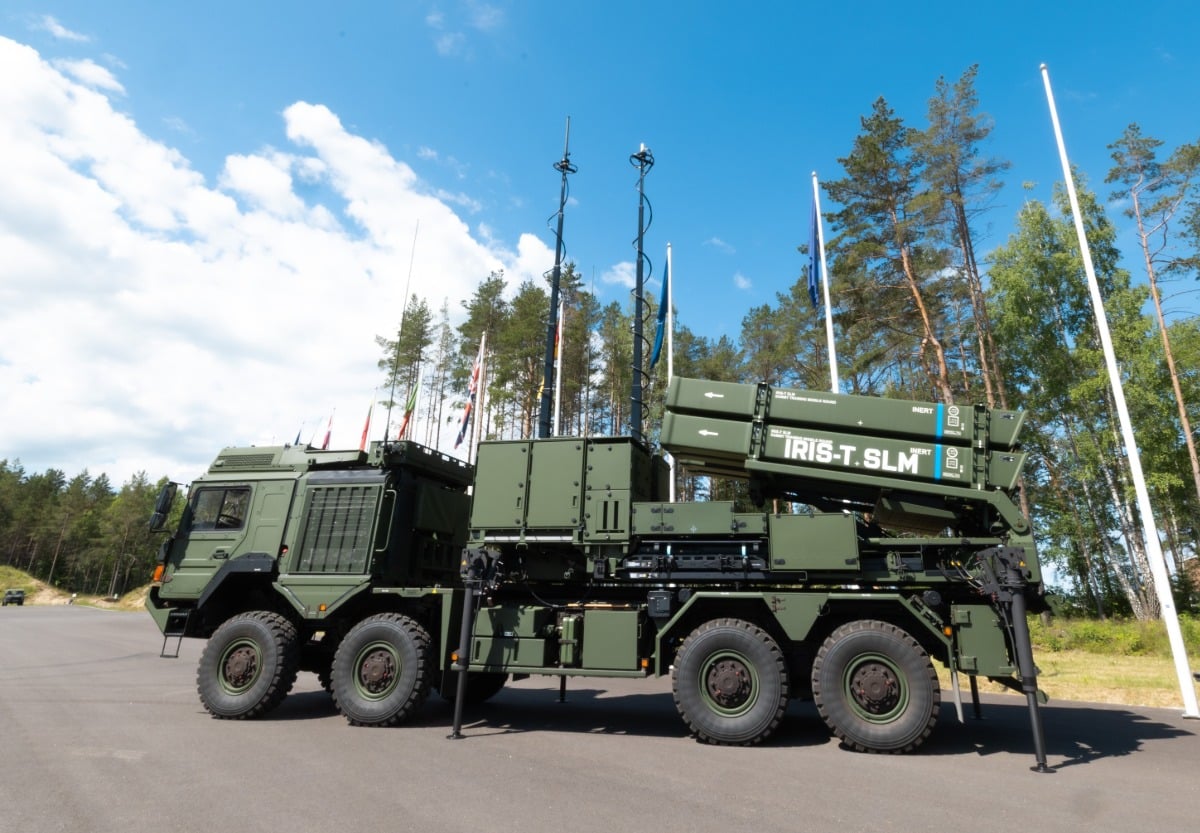
- Estonia received its first IRIS-T SLM medium-range air defense battery at Ämari Air Base on June 22, 2026, procured jointly with Latvia from Germany's Diehl Defence.
- Three fire units were contracted in total; the first arrived June 22 and the remaining two are scheduled to arrive in 2027.
Estonia took delivery of its first medium-range air defense missile system on June 22, 2026, when the Estonian Air Defence Wing received the IRIS-T SLM at Ämari Air Base, giving a NATO member that shares a 294-kilometer (183-mile) border with Russia the ability to engage aircraft, cruise missiles, and helicopters at ranges and altitudes that its existing short-range systems cannot reach.
The IRIS-T SLM, which stands for InfraRed Imaging System Tail/Thrust vector-controlled Surface-Launched Medium range, is a German-made air defense system built by Diehl Defence, a Munich-based defense company that has become one of the most discussed names in European air defense since Ukraine began operating the system in combat operations in late 2022. The missile engages targets at ranges of up to approximately 40 kilometers (25 miles) and altitudes of up to 20 kilometers (65,600 feet), a coverage envelope that sits between the short-range systems Estonia previously operated and the long-range systems that larger NATO members maintain. That middle tier is precisely what Ukraine’s experience demonstrated to be most critical: the altitude band where cruise missiles fly, where attack helicopters loiter, and where aircraft can approach protected areas while staying above the reach of shorter-range defenses.
The procurement was organized jointly with Latvia through the Estonian Centre for Defence Investments, the government agency responsible for coordinating major defense acquisitions, under a joint procurement agreement signed with Diehl Defence in autumn 2023. Three firing units were contracted in total, with the first arriving at Ämari on June 22 and the remaining two scheduled to arrive in 2027. A single IRIS-T SLM fire unit consists of multiple launchers, a radar, and a tactical control center, supplemented by support vehicles for repair, spare parts, and reloading, giving each battery a self-contained capability for sustained operations.
Brigadier General Riivo Valge, Commander of the Estonian Air Force, was direct about both the significance of the delivery and the work that still lies ahead before the system reaches operational readiness.
“This is an important day for the Estonian Defence Forces and for the Estonian Air Force,” Valge said. “We are only beginning our journey in building up our air defence, and although it may take us months to give our operators the necessary training and bring this system to the field, we are still about to have a significant qualitative leap in air defence capabilities.”
Valge also identified the capability the IRIS-T SLM provides that Estonia has never had before, describing it in terms that go directly to the operational logic of air defense geography.
“The greatest advantage of this launch system, which we have not had before, is its engagement altitude, which prevents the enemy from flying over us,” he said. “When this system is deployed in the field, the enemy has to take it into account and find alternative trajectories. And because this system is tactically agile, the enemy has to make those decisions under time pressure, creating conditions for errors that we can exploit.”
The tactical agility Valge described is one of the IRIS-T SLM’s most practically significant characteristics. Unlike fixed or semi-fixed air defense installations, the system can be repositioned rapidly between firing positions, which means an adversary cannot simply map its location and plan routes around it once. A mobile system that can move after each engagement, or in anticipation of a targeting strike, forces a persistent planning burden on any force attempting to suppress it. Ukraine has exploited exactly this characteristic in its own IRIS-T SLM operations, with Ukrainian crews regularly moving batteries after engagements to avoid Russian counter-battery strikes, a practice that has contributed to the system’s survival rate in one of the world’s most heavily contested air defense environments.
Estonia’s Defence Minister Hanno Pevkur connected the delivery explicitly to what Ukraine’s experience has demonstrated about the centrality of air defense in modern warfare.
“IRIS-T is a medium-range air defence system that has proven itself in Ukraine, and it brings our air defence to a new level, giving us the ability to engage an adversary from significantly greater distances and altitudes than with our existing short-range systems,” Pevkur said. “The war in Ukraine has clearly shown that a strong air defence is a central part of national defence, essential for protecting our people, our defence forces’ units, and critical infrastructure.”
Estonia, a country of 1.4 million people whose capital Tallinn sits approximately 180 kilometers (112 miles) from the Russian border and roughly 80 kilometers (50 miles) from the Russian exclave of Leningrad Oblast, has been among the most consistent advocates within NATO for taking the Russian military threat seriously, both before and after February 2022. The country spends well above the NATO target of 2 percent of gross domestic product on defense, allocating approximately 3.7 percent in 2026, a level matched by only a handful of alliance members. Its air defense architecture before the IRIS-T SLM arrival consisted primarily of short-range systems including the Mistral and Piorun man-portable missiles and the MANPADS that Estonian units operate, capable of engaging low-flying threats but unable to contest the medium-altitude corridors that cruise missiles and strike aircraft use. The arrival of a system that fills that gap changes the air defense geometry over Estonian territory in a way that every aircraft approaching from the east must now account for.
The IRIS-T SLM’s combat record in Ukraine is the most operationally significant verified background context for understanding why Estonia prioritized this system. Germany provided Ukraine with its first IRIS-T SLM battery in October 2022, and Ukrainian operators subsequently used it to intercept Russian cruise missiles, Shahed attack drones, and aerial bombs, with Ukrainian officials crediting the system with achieving interception rates against incoming threats that exceeded initial expectations. The system uses an imaging infrared seeker that can discriminate a target’s heat signature against background clutter, giving it capability against the slow, low-signature threats like cruise missiles and drones that radar-guided systems sometimes struggle to engage reliably at medium ranges.
Helmut Rauch, Chief Executive Officer of Diehl Defence, acknowledged the market pressure the company is operating under as European air defense demand surges across NATO following Russia’s invasion of Ukraine.
“The delivery to Estonia shows that we are able to deliver even under the significant pressure that the European air defence market is currently experiencing,” Rauch said. “With every system we deliver, we strengthen our partners’ defence capabilities, make a measurable contribution to the NATO alliance’s security architecture, and thereby also help protect the Estonian people.”
The Air Defence Wing that received the IRIS-T SLM was itself only established within the Estonian Air Force on July 1, 2023, making it a relatively new formation that is building its institutional knowledge and trained workforce alongside the hardware it is receiving. The first conscripts assigned specifically to the Air Defence Wing will begin their service in July 2026, the same month the wing is absorbing its first medium-range missile battery. That parallel development of people and equipment is the reality of a small nation building a credible air defense capability from a relatively low baseline, and it is why Valge was careful to note that months of training lie between the June 22 delivery and the day the system deploys to a field position.