

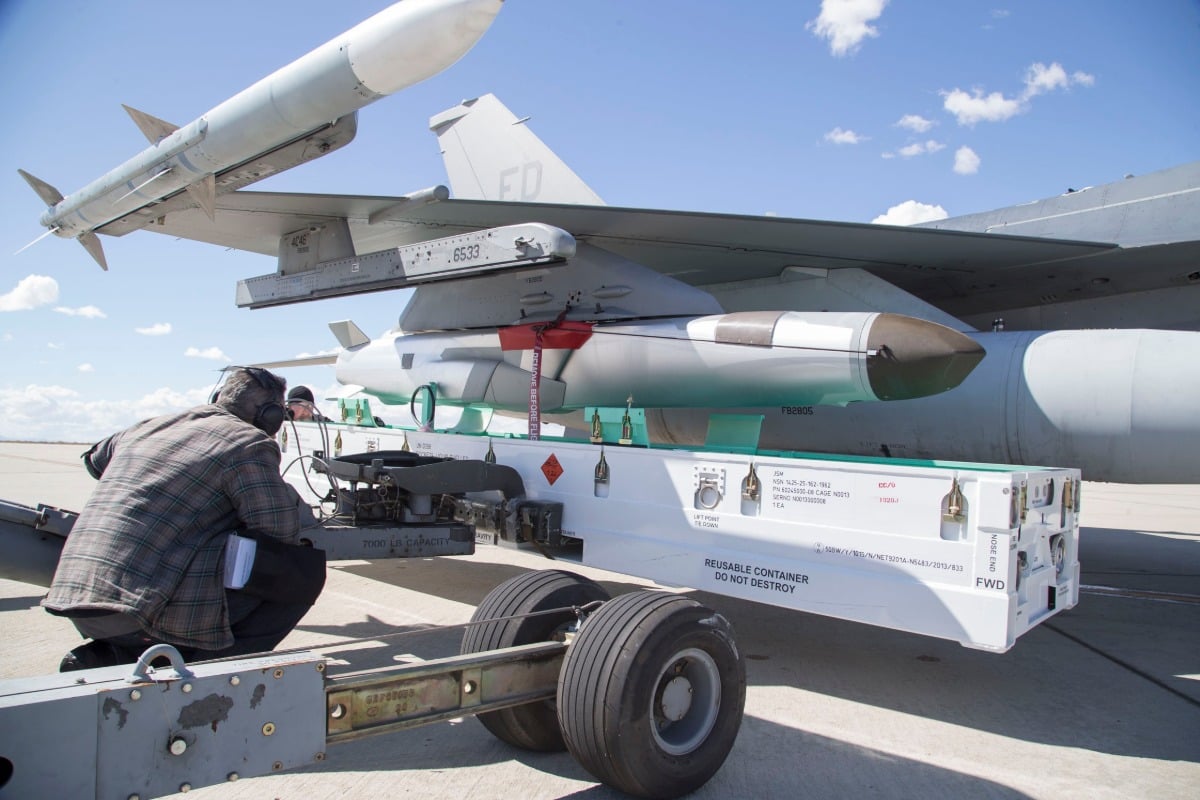
- The U.S. Air Force awarded Kongsberg Defence and Aerospace a $241 million sole-source contract on June 5, 2026, for Joint Strike Missile Lot Two production.
- Work will be performed in Kongsberg, Norway, with completion expected by November 30, 2028, funded by fiscal year 2024 and 2025 procurement appropriations.
Norway has built one of the most capable stealth, anti-ship missiles in the Western arsenal, and the United States Air Force ordered another batch of them for $241 million, deepening a transatlantic weapons partnership that has become increasingly central to American plans for fighting a war in the Pacific or the North Atlantic against a peer adversary with a serious naval force.
The Air Force Life Cycle Management Center at Eglin Air Force Base, Florida, awarded Kongsberg Defence and Aerospace, the Norwegian state-controlled defense company headquartered in the city of Kongsberg, a $241 million firm-fixed-price contract on June 5, 2026, for Lot Two production of the Joint Strike Missile, covering complete ready-to-fire rounds with containers, test hardware, and associated support items. Work will be performed at Kongsberg’s facilities in Norway and is expected to be completed by November 30, 2028. The contract was awarded on a sole-source basis, reflecting Kongsberg’s unique position as the only manufacturer of the Joint Strike Missile, a weapon for which no American or other allied equivalent exists at the same combination of range, stealth, and multi-platform compatibility.
The Joint Strike Missile, known universally as JSM, is a precision-guided cruise missile, a self-propelled weapon that flies at low altitude to its target using GPS and terrain-following navigation, developed specifically to fit inside the internal weapons bays of the F-35 Joint Strike Fighter. That internal carriage requirement is the engineering detail that defines everything else about the weapon. An F-35 carrying missiles on external wing pylons loses most of its stealth advantage because those pylons are visible to radar. A weapon that fits inside the sealed weapons bay allows the aircraft to remain fully stealthy throughout the entire mission, approaching defended targets without announcing its presence until the bay doors open and the missile drops free. Kongsberg designed the JSM from the outset to meet that constraint, giving it a distinctive cranked-arrow wing shape and a relatively narrow body that fits within the F-35A’s internal bay geometry.
The JSM traces its lineage to the Naval Strike Missile, another Kongsberg product that has been adopted by the U.S. Navy and multiple allied navies as a ship-launched anti-ship weapon. The two missiles share a common seeker and guidance architecture but differ significantly in airframe design, with the JSM optimized for air launch from high-performance aircraft and the Naval Strike Missile designed for surface ship and coastal defense launchers. The shared seeker technology means that both weapons benefit from the same ongoing improvements to target recognition software, allowing the guidance system to identify and home on specific ship types based on their radar and infrared signatures even in cluttered maritime environments with multiple vessels present.
The JSM’s range has not been officially confirmed by either the U.S. Air Force or Kongsberg, but open-source analysis of the weapon’s fuel capacity and aerodynamic configuration consistently places it in the range of approximately 280 km (174 miles) or more when launched from altitude, giving an F-35 pilot the ability to release the weapon well outside the effective range of most shipboard air defense systems before the target has any indication of the incoming threat. That standoff capability is precisely what makes the weapon valuable against adversaries operating modern warships equipped with long-range surface-to-air missiles, where closing to shorter-range weapons release distances would put the launching aircraft at serious risk.
The funding structure of the contract reflects multi-year planning that spans two fiscal years. Fiscal year 2024 procurement funds cover $138 million of the total, with fiscal year 2025 procurement funds covering the remaining $103 million, a split that reflects the advance planning required to commit to a production run of this scale and the contractual mechanics of how multi-year missile procurement is structured in American defense budgeting. The Lot Two designation indicates this is the second production batch of JSMs procured under this acquisition framework, building on an earlier Lot One order that established the production baseline with Kongsberg.
The United States and Norway have deepened their defense industrial relationship substantially over the past decade, with Norway purchasing F-35s and the U.S. reciprocally integrating Norwegian weapons into its own inventory. That relationship has taken on added strategic weight as NATO has refocused on high-end conventional deterrence following Russia’s full-scale invasion of Ukraine in 2022 and as the United States has expanded its attention to the Pacific theater, where anti-ship capabilities capable of operating in contested airspace are among the most urgently needed weapons in the American arsenal. China’s naval buildup, which has produced the world’s largest fleet by vessel count, has made ship-killing precision missiles a procurement priority across multiple service branches, and the JSM’s combination of stealth compatibility and long range makes it directly relevant to that requirement.

Norway designed a missile so good that America keeps buying it. That is a sentence that would have seemed implausible twenty years ago, when the European defense industry was still largely viewed as a tier below American capability in the most demanding weapon categories.