

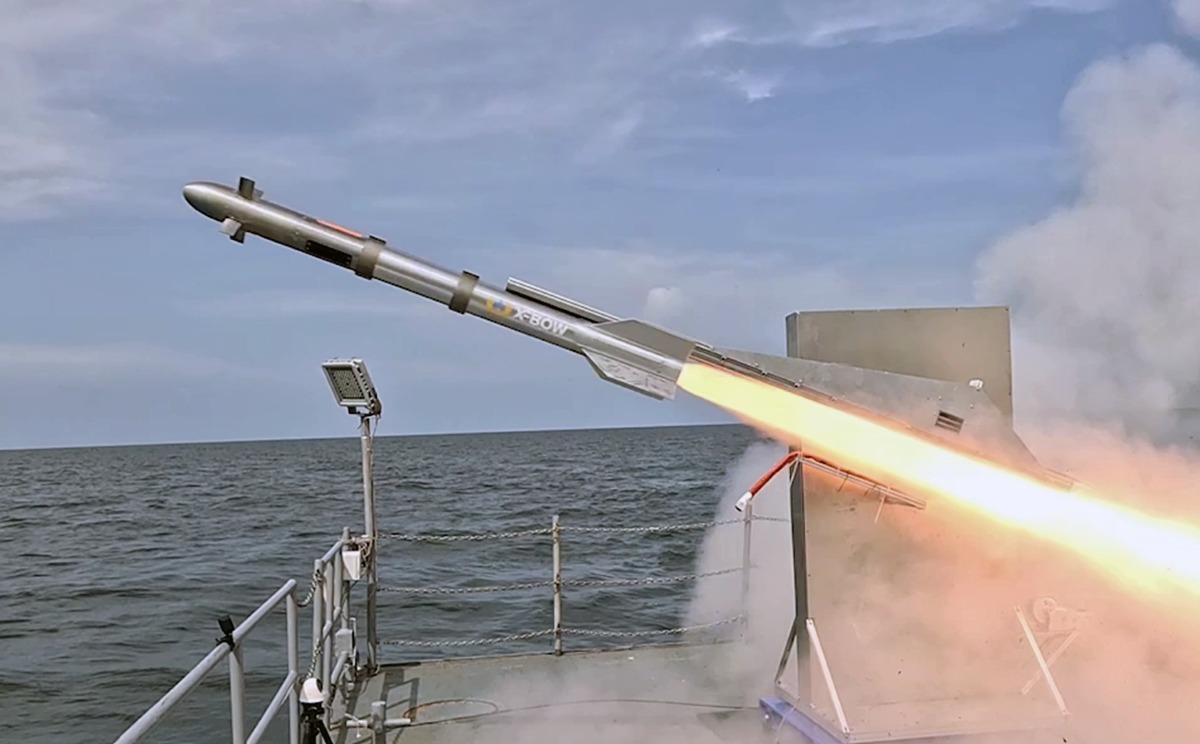
- X-Bow Systems unveiled Buckler, a flight-tested interceptor priced under $100,000 designed to defeat Group 3 drones at supersonic speeds.
- The company builds Buckler's airframe, solid rocket motor, and propellant entirely in-house rather than relying on outside suppliers.
X-Bow Systems unveiled Buckler, a flight-tested interceptor built to shoot down Group 3 drones at supersonic speeds, with the company pricing the weapon below $100,000 per unit, a fraction of what traditional air defense missiles cost to defeat the exact same kind of threat.
Group 3 drones sit in the middle of the military’s five-tier weight classification system, covering unmanned aircraft weighing less than 1,320 pounds (599 kilograms), a category that has become nearly synonymous with Iran’s Shahed-136 attack drone, the cheap, mass-produced weapon Russia has rebranded domestically as the Geran-2 and fired into Ukraine by the thousands since 2022. That category of threat has exposed a brutal mismatch in modern air defense economics, since intercepting a drone that costs a few thousand dollars to build with a traditional missile costing a million dollars or more is a trade no military can sustain indefinitely, especially when an adversary can launch dozens or hundreds of drones in a single wave specifically to overwhelm exactly that kind of expensive defense.
Jason Hundley, X-Bow’s founder and chief executive officer, framed Buckler as a direct response to that unsustainable math.
“You can’t win a war of attrition trading million-dollar interceptors against thousand-dollar threats,” Hundley said. “Buckler has flown, it comes in under US$100,000, and we build its airframe and propulsion ourselves, the part of the industrial base that is so stressed by today’s munitions demands. This is our answer to the call from the U.S. and its allies: affordable capability, at scale.”
What separates Buckler’s pitch from a typical low-cost interceptor announcement is where X-Bow says the savings actually come from. The company designs and manufactures Buckler’s airframe and its own solid rocket motor and propellant entirely in-house, tackling directly what defense officials have repeatedly identified as the single biggest bottleneck constraining how fast the American defense industry can scale interceptor production. Solid rocket motors, the propulsion systems that power everything from small tactical missiles to intercontinental ballistic missiles, have historically come from just two major American suppliers, Northrop Grumman and L3Harris-owned Aerojet Rocketdyne, a concentration former Pentagon acquisition chief William LaPlante warned Congress in 2023 could take five to ten years to fully resolve at existing production rates. By building its own propulsion rather than depending on that constrained supply chain, X-Bow argues it can control cost, quality, and production speed in a way companies buying motors from outside vendors simply cannot.
X-Bow runs what it calls a Rocket Factory in a Box, a containerized, deployable production system certified by the Air Force Research Laboratory under a process the company calls AMSP, and the company has already delivered combat-ready rocket-assisted takeoff motors and propulsion systems for other government programs, giving Buckler a manufacturing pathway that isn’t starting from scratch. X-Bow said Buckler recently completed a successful flight test demonstrating its propulsion and flight performance, supported by separate motor static-fire and igniter testing, evidence the company says puts the interceptor well beyond the concept stage at a moment when the Department of War and allied militaries are actively searching for affordable interceptors they can field in real volume rather than small demonstration batches.
X-Bow chose the name Buckler deliberately, according to the company’s own explanation to the outlet Axios, referencing the small, round shield medieval soldiers once carried, a nod to the interceptor’s role as a cheap, close-in defensive tool rather than an expensive, exquisite weapon meant for every possible threat. The company unveiled the interceptor on the opening day of the Farnborough International Airshow in England, where X-Bow is exhibiting at Stand 3545 in Hall 3 through July 24, with a second public appearance planned at the Space and Missile Defense Symposium in Huntsville, Alabama, in August.
For a company built explicitly around solving the rocket motor bottleneck that has slowed nearly every other American interceptor program in recent years, showing up at Farnborough with a flown, priced, and manufacturable product gives X-Bow a considerably stronger opening argument than most drone-defense startups have managed to make this early in their own development timelines.