

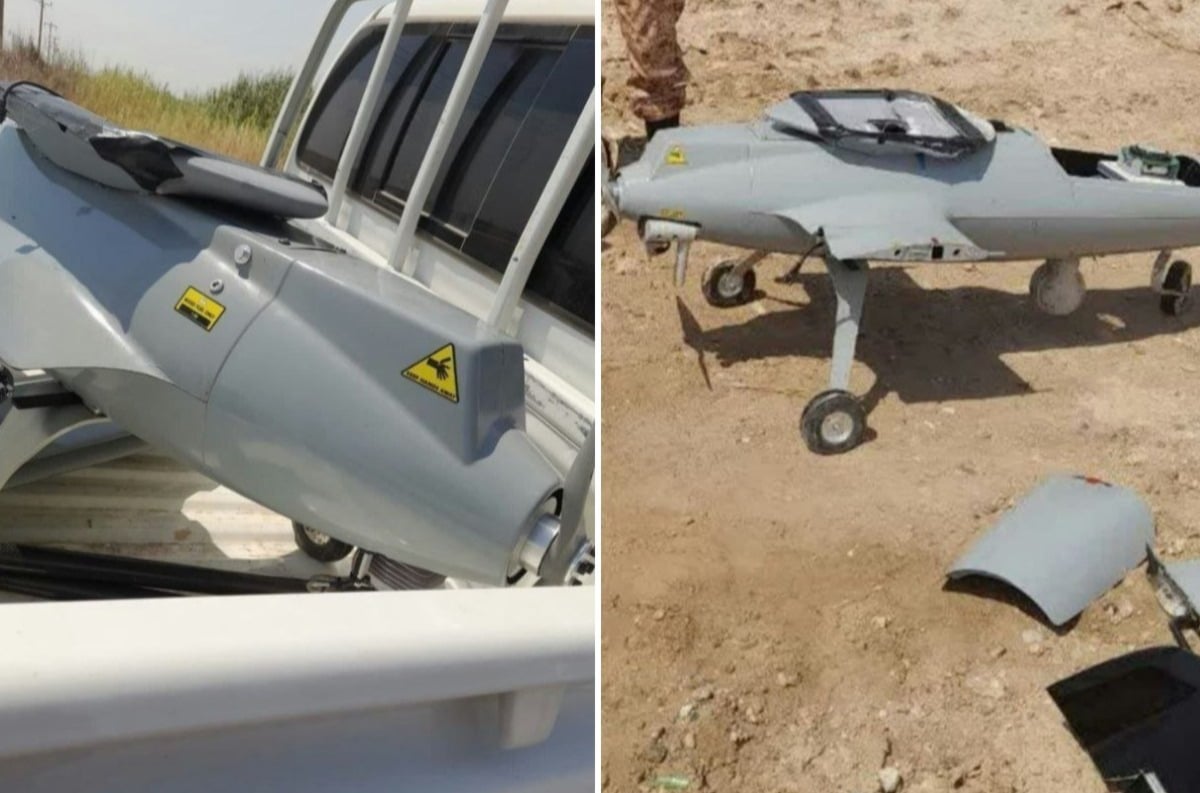
- Iran's IRGC released images claiming its 48th Fath Brigade shot down a U.S.-operated Tiguar M drone in Kohgiluyeh and Boyer-Ahmad Province.
- U.S. Army Green Berets from the 1st Special Forces Group tested Tiguar M drones during Exercise Balikatan 2026 in the Philippines in April.
Iran’s Islamic Revolutionary Guard Corps released photographs Sunday of a downed drone its Ground Forces say they shot out of the sky over southern Iran, and the aircraft in the photos traces back to a U.S. Army Special Forces exercise conducted thousands of miles away in the Philippines just three months earlier.
Babak Taghvaee, an analyst who publishes under the account The Crisis Watch, reported that the IRGC identified the aircraft as a Polish-manufactured Tiguar-M unmanned aerial vehicle, allegedly operated by the U.S. Army and brought down by the IRGC’s 48th Fath Brigade in Kohgiluyeh and Boyer-Ahmad Province, a claim later carried by the Polish defense outlet Defence24. Neither the United States military nor any independent Western source has confirmed the IRGC’s account, and the claim should be treated as an Iranian government assertion made in the middle of an active, ongoing war rather than a verified loss.
That war provides the essential backdrop for why this specific claim matters. The United States resumed military strikes against Iran on July 8, and U.S. Central Command confirmed it completed a seventh consecutive night of strikes on July 17, hitting what it described as surveillance sites, military logistics infrastructure, underground weapons storage, and maritime capabilities using fighter aircraft, drones, and warships, while continuing to enforce a naval blockade against Iranian ports. Iran has separately claimed several drone shootdowns of its own during this period, including an MQ-9 Reaper the IRGC Aerospace Force said it downed over Ahvaz using what it called an advanced new air defense system, according to Iran’s Tasnim News Agency, part of a broader pattern of both sides publicizing claimed successes as the conflict has escalated into its second week.
The Tiguar-M itself is a light tactical unmanned aircraft designed and built by uAvionics, a Polish drone manufacturer that had drawn little attention from American defense watchers until earlier this year. In late April, soldiers from the U.S. Army’s 1st Special Forces Group, the Green Beret unit based at Joint Base Lewis-McChord, flew Tiguar-M drones during Exercise Balikatan 2026 in Laoag, Philippines, an annual joint training exercise between American and Filipino forces, with the training specifically focused on testing the aircraft’s long-range communications capabilities in an environment with limited existing infrastructure. That exercise marked the platform’s first widely reported operational use by American forces, and it introduced the Tiguar-M to open-source defense analysts who had previously associated Green Beret unmanned systems almost exclusively with established American manufacturers rather than a relatively unfamiliar Polish company.

The photographs of the aircraft recovered in Iran appear to show a modification consistent with that earlier communications testing. According to the images circulating alongside the IRGC’s claim, the downed drone’s fuselage carries what looks like a Starlink or Starshield satellite terminal installed in an improvised configuration, a setup that would let the aircraft maintain contact with its operators well beyond direct line of sight, the same beyond-line-of-sight communications problem the Green Berets were specifically testing the Tiguar-M against during the Philippines exercise. Standard production versions of the Tiguar-M have separately been displayed with a conventional satellite communications antenna, suggesting the improvised Starlink-style terminal seen in the Iran photos may represent a field modification rather than the aircraft’s stock configuration, though that detail alone does not establish who was actually operating the specific airframe recovered in Iran.
Visual identification of a drone model is not the same as confirming which country, unit, or operator was flying that specific aircraft on the day it went down, and Iran has a documented history of publicizing captured or downed Western drones as propaganda victories during periods of heightened tension with Washington, dating back to a 2019 incident when the IRGC shot down an American RQ-4 Global Hawk over the Strait of Hormuz and used the incident to send what its Aerospace Force commander at the time called a deliberate message to the United States. Whether this Tiguar-M genuinely belonged to American Special Forces, a coalition partner also testing the Polish platform, or represents a different chain of custody entirely remains unconfirmed, and the Defense Department has not issued any statement addressing the IRGC’s claim as of this reporting.