


Amid the ongoing war in Ukraine, Russia is accelerating efforts to transform Iranian-designed Shahed drones into jet-powered, remotely controlled weapons aimed at devastating cities and overwhelming air defenses, according to a new report from UNITED24.
The Shahed drone, first developed in Iran and transferred to Russia in 2022, has become one of the Kremlin’s most relied-upon strike systems. For Tehran, the arrangement provided financial inflows and possible access to sensitive nuclear expertise through cooperation with Moscow. For Russia, the drones offered ready-made strike platforms without the delays of domestic development.
Since their first appearances over Ukrainian cities in the fall of 2022, Shaheds have undergone sweeping modifications.
UNITED24 noted that “the drones that began striking Ukrainian cities… have little in common with the versions Russia is deploying today.”
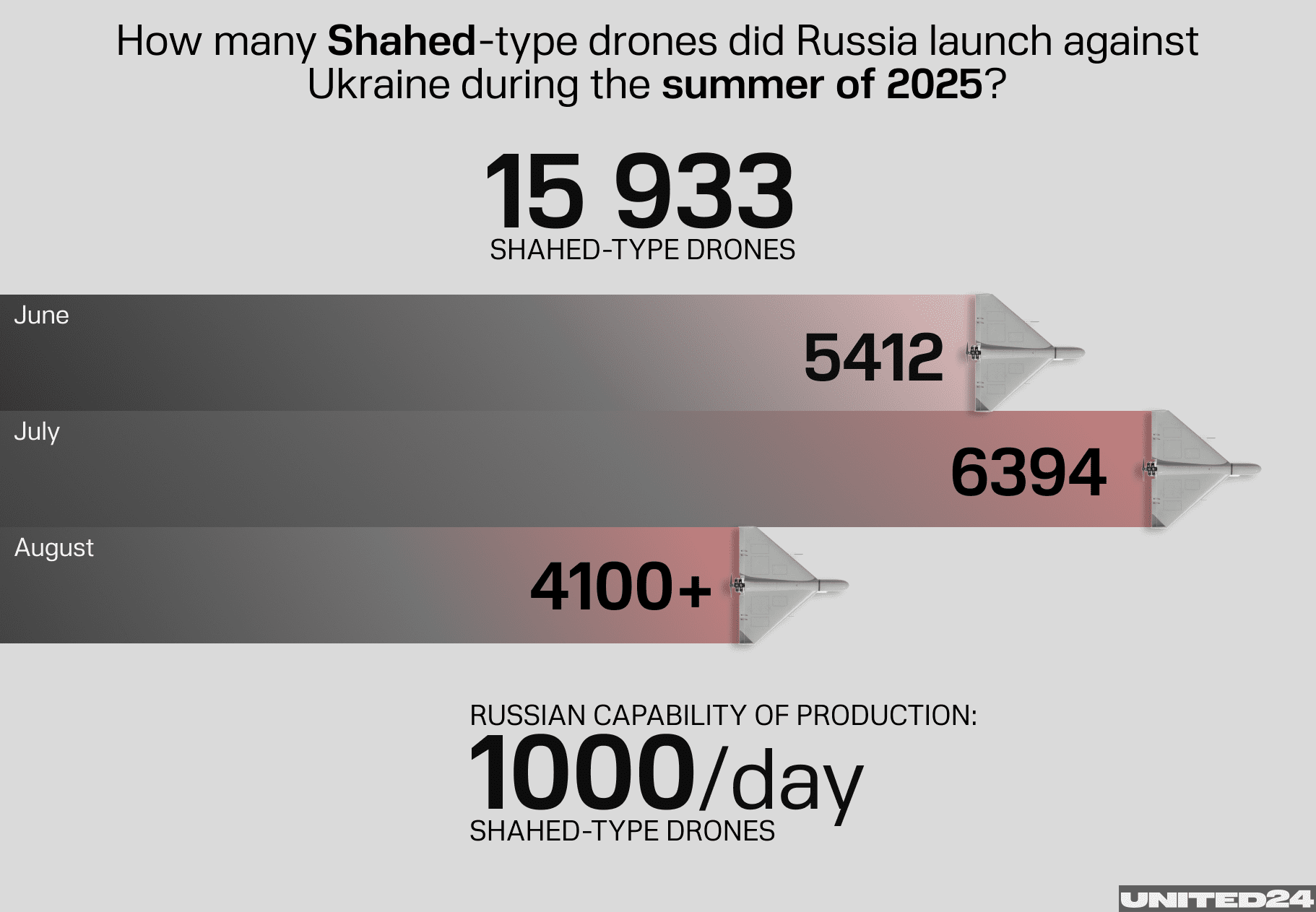
The most important shift is production scale. Russia has moved to mass production levels capable of turning out more than 200 drones per day, with output expected to reach 1,000 daily in the near future. The volume of attacks has surged accordingly.
UNITED24 reported that in just three summer months, Russia launched 15,933 Shaheds against Ukraine. In July alone, 6,394 drones were recorded; in June, 5,412; and in August, just over 4,100—numbers reflecting both production surges and tactical adjustments.
These drones are not being used in isolation. Strikes involving 500 to 700 drones are now often paired with cruise and ballistic missiles, designed to saturate Ukrainian defenses.
UNITED24 highlighted that warhead size nearly doubled last year, and recent evidence indicates Russia is fielding jet-powered versions. The new engines push speeds from 170–200 kilometers per hour to nearly 500 kilometers per hour, making them far harder to intercept.
This development directly challenges Ukraine’s layered defense. Mobile fire teams with heavy machine guns cannot engage drones flying at these speeds and altitudes, while stocks of inexpensive surface-to-air missiles remain limited. Ukrainian engineers had previously responded with interceptor drones, but the Shahed’s new performance may reduce their effectiveness.
The innovations, UNITED24 noted, are not entirely original. In 2024, Ukrainian engineers unveiled the “Palianytsia” rocket drone, a jet-powered platform faster than conventional drones. Moscow appears to have adapted the concept to its Shahed line, demonstrating what Kyiv has described as a pattern of technological imitation.
Photos taken during recent attacks revealed two further upgrades: onboard cameras and modem antennas. UNITED24 assessed this as evidence that Shaheds are now capable of remote piloting. Previously, the drones operated only on preprogrammed routes. Real-time monitoring now allows operators to adjust attack strategies mid-flight, avoid defenses, or redirect drones toward fresh targets.
The implications are severe. With cameras, remote piloting, and higher speeds, Shaheds are no longer limited to striking fixed positions. They could be redirected against vehicles, artillery, or even helicopters. “Practically anything short of airplanes, which typically fly faster, is now vulnerable,” the report said.
These advances mark a sharp escalation in Russia’s drone warfare capabilities. For Ukraine, it poses new challenges at a time when its own air defense resources remain stretched by relentless bombardment. For NATO, the rapid transformation of Shaheds underscores the evolving threat posed by cheap, mass-produced drones when coupled with continuous technological upgrades.
As UNITED24 concluded, Russia’s new jet-powered, remotely controlled Shaheds represent a “highly dangerous” shift in the battlefield dynamic—an adaptation that could define the next phase of the drone war in Ukraine.