

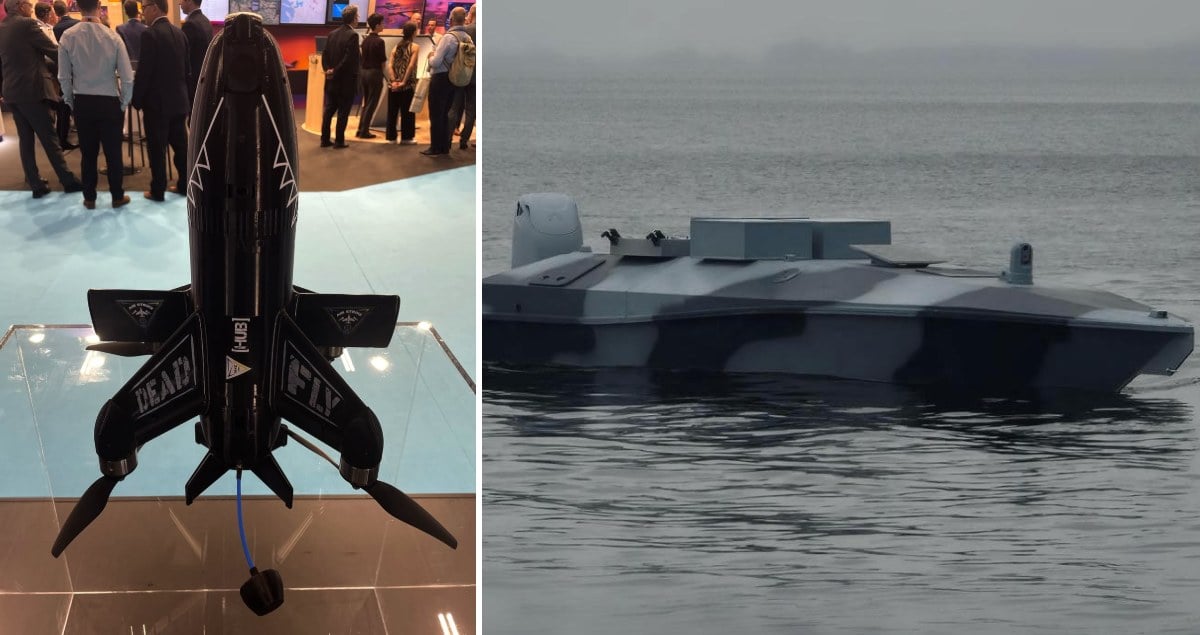
- Paramount Greece and MAC HUB expanded their partnership at Eurosatory 2026 to include the MAC Dead Fly interceptor drone and KATRAN unmanned surface vessel.
- Both systems made their international exhibition debut at the show, building on the companies' earlier MAC OWL armored vehicle, which Paramount says Ukraine's Ministry of Defence certified this month.
Ukraine’s most demanding combat laboratory just produced two more weapons that a Greek defense company wants to sell to the rest of the world. Paramount Industries Innovation Systems Greece and Ukrainian defense technology firm MAC HUB announced an expansion of their strategic partnership at the Eurosatory defense exhibition in Paris, extending a relationship that previously focused on armored vehicles into counter-drone systems and unmanned maritime technology.
The new agreement covers two MAC HUB systems making their international debut at the show, the MAC Dead Fly interceptor drone and the KATRAN unmanned surface vessel, with the companies planning to jointly develop and market the systems for international customers.
The MAC Dead Fly addresses a problem that has become one of the defining features of the war in Ukraine: cheap, mass-produced drones overwhelming traditional air defenses built to stop expensive missiles, not swarms of small, slow-moving threats. It’s a tactical interceptor quadcopter built specifically to chase down and destroy Shahed-type attack drones, FPV drones, and other small aerial targets, equipped with a thermal imaging camera that lets it find targets in total darkness. Speed reporting on the system varies by source: coverage linked to Welt reported speeds up to 380 km/h (236 mph), while other Ukrainian reporting has listed a figure of 300 km/h (186 mph), and MAC HUB has said it’s working to push performance toward 450 km/h (280 mph) at the Ukrainian military’s request. MAC HUB-linked reporting says Dead Fly uses onboard AI to detect and pursue targets, and the company has marketed the system on a simple economic logic: a single Dead Fly interceptor costs a fraction of what a surface-to-air missile costs, making it viable to launch dozens of them against a wave of similarly cheap incoming drones without the math turning into a losing proposition.
What makes the Dead Fly genuinely novel isn’t the interceptor alone but how Ukraine has chosen to deploy it. During tests on the Dnipro River, a KATRAN X1.2 was shown carrying 27 MAC Dead Fly interceptors, according to Welt-linked reporting, though other Ukrainian reporting has listed a lower figure of up to 23, demonstrating a floating launch platform that can carry an interceptor swarm directly into position along the river corridors that Shahed drones routinely follow on their way toward Kyiv and other Ukrainian cities. The KATRAN itself stretches roughly 9 meters (30 ft), runs on a 350-horsepower engine, and has a declared range up to 1,600 kilometers (994 miles), figures that put it well beyond a simple harbor patrol boat and into genuinely long-range naval drone territory. Beyond carrying interceptors, the vessel is built to be reconfigured for other missions, including operating as a one-way attack craft, mounting short-range air-to-air missiles, and ferrying smaller strike drones to extend its reach even further, all coordinated through a system MAC HUB calls Mission Control that links the boat and its airborne interceptors into a single network operators can run from a mobile command post on shore.
A spokesperson for Paramount Greece framed the expanded partnership as proof that Ukrainian battlefield innovation has matured into something the rest of the world’s militaries now need. “Our partnership with MAC HUB demonstrates the power of combining operational experience, technological innovation and industrial capability,” the spokesperson said. “By expanding our cooperation to include the KATRAN and Dead Fly systems, we are bringing some of the most relevant and combat-tested technologies developed during the Ukraine conflict to European and African markets. These systems address critical capability requirements that armed forces around the world are now confronting, particularly in the areas of autonomous systems, maritime security and counter-drone operations.”
A MAC HUB spokesperson echoed that framing from the Ukrainian side, describing the war itself as an accelerant for technology that wouldn’t otherwise exist in its current form. “The expansion of our partnership with Paramount Greece represents an important step in bringing Ukrainian-developed defence technologies to a global audience,” the spokesperson said. “The battlefield has become one of the world’s most demanding innovation environments, forcing rapid adaptation and the development of entirely new categories of capability.” T
The path these two systems take from Eurosatory display to actual foreign military inventories will run through Paramount’s portable production model. Whether European or African customers ultimately want locally assembled Dead Fly interceptors and KATRAN vessels of their own, or simply want to buy finished units, remains an open question the partnership has yet to answer publicly. But the underlying pitch is straightforward enough: technology forged under the most demanding combat conditions either side has access to, now available to militaries that would rather buy something proven than spend years discovering its flaws themselves.