

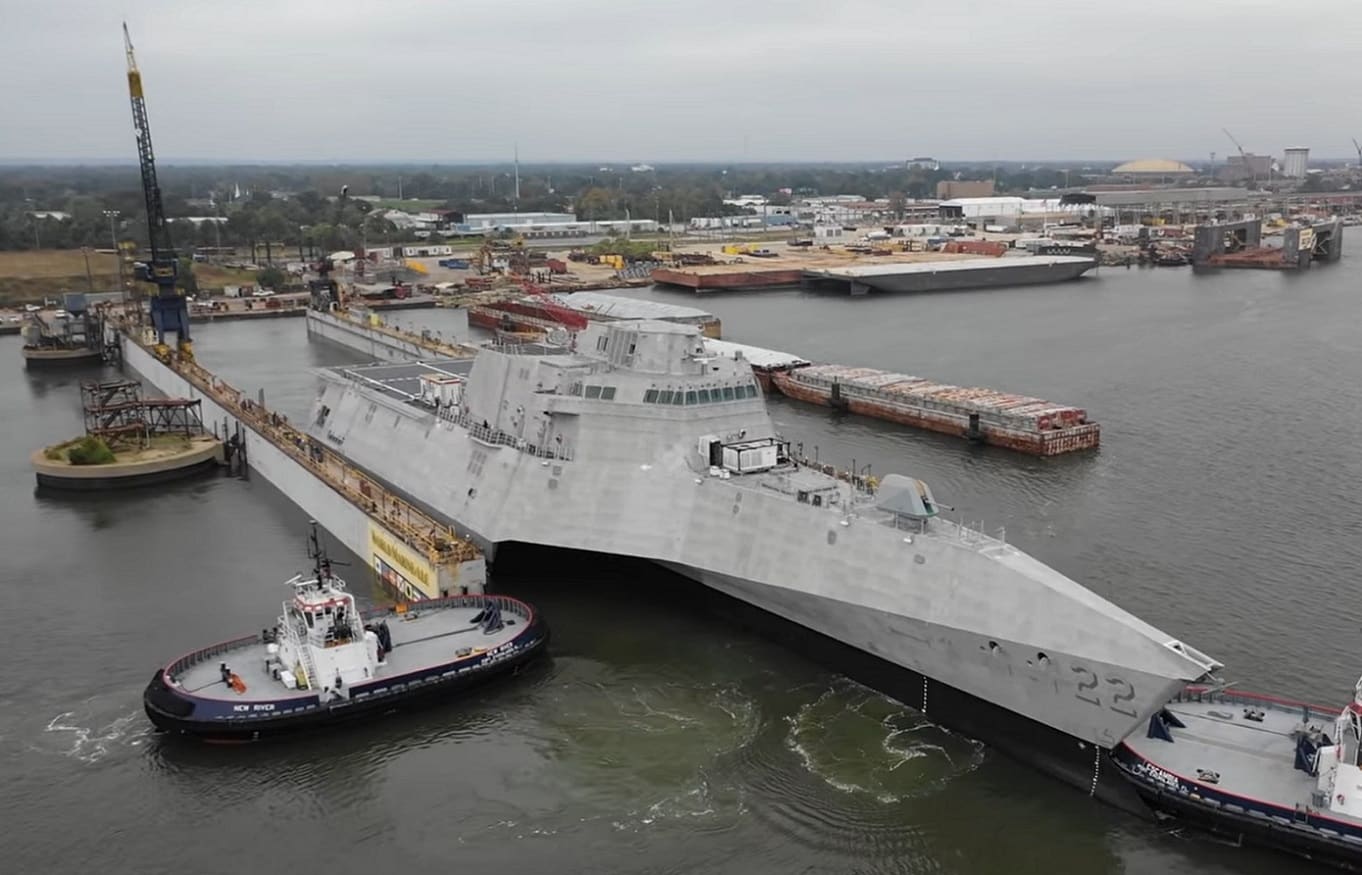
The future littoral combat ship USS Kansas City (LCS 22), the 11th Independence-variant littoral combat ship to enter the fleet, successfully concluded acceptance trials in the Gulf of Mexico after a series of in-port and underway demonstrations.
“This level of performance is among the best I’ve seen for this class. We continue to see improvements in cost, initial quality and schedule, ship after ship,” said Capt. Mike Taylor, littoral combat ship (LCS) program manager.
Acceptance trials are the last significant milestone before the ship’s planned delivery to the Navy in early December. During trials, the Navy conducted comprehensive tests of LCS 22’s systems, which spanned multiple functional areas essential to a ship being able to perform at sea — main propulsion, auxiliaries and electrical systems. The ship also performed demonstrations of its capability, including a full-power demonstration, steering and quick reversal, anchor drop test and combat system detect-to-engage sequence.
Kansas City approximately 418 feet in length, with a width of nearly 104 feet. This is modular, reconfigurable ship designed to host interchangeable mission packages onto the seaframe in support of surface warfare, mine countermeasures and anti-submarine warfare.
Following delivery and commissioning, Kansas City will be homeported in San Diego with sister ships USS Independence (LCS 2), USS Coronado (LCS 4), USS Jackson (LCS 6), USS Montgomery (LCS 8), USS Gabrielle Giffords (LCS 10), USS Omaha (LCS 12), USS Manchester (LCS 14), USS Tulsa (LCS 16), USS Charleston (LCS 18) and USS Cincinnati (LCS 20).
Four additional Independence-variant ships are under construction at Austal USA in Mobile, Alabama. Final assembly is well underway on the future USS Oakland (LCS 24). All modules for the future USS Mobile (LCS 26) have been erected, and the modules for the future USS Savannah (LCS 28) are under construction. Additionally, Austal is fabricating modules for the future USS Canberra (LCS 30) and is preparing for construction of the future USS Santa Barbara (LCS 32), USS Augusta (LCS 34), USS Kingsville (LCS 36) and USS Pierre (LCS 38).
LCS is a highly maneuverable, lethal and adaptable ship designed to support focused mine countermeasures, anti-submarine and surface warfare missions. The Independence-variant LCS integrates new technology and capability to affordably support current and future mission capability, from deep water to the littorals.
LCS is now the second-largest surface ship class in production. Five LCSs delivered in 2018. The Navy plans to deliver another three ships in 2019.