

- The Air Force Research Laboratory awarded Booz Allen Hamilton a contract worth up to $25.3 million for quantum information science research and development.
- The competitively awarded contract runs through July 9, 2031, with work performed at Booz Allen's facility in McLean, Virginia.
The next major shift in military technology might not look like a stealth fighter or a hypersonic missile. It could look like a laboratory full of scientists trying to control particles so small and so strange that they can exist in two states at once, and the U.S. Air Force just paid one of its top consulting firms more than $25 million to help make that happen.
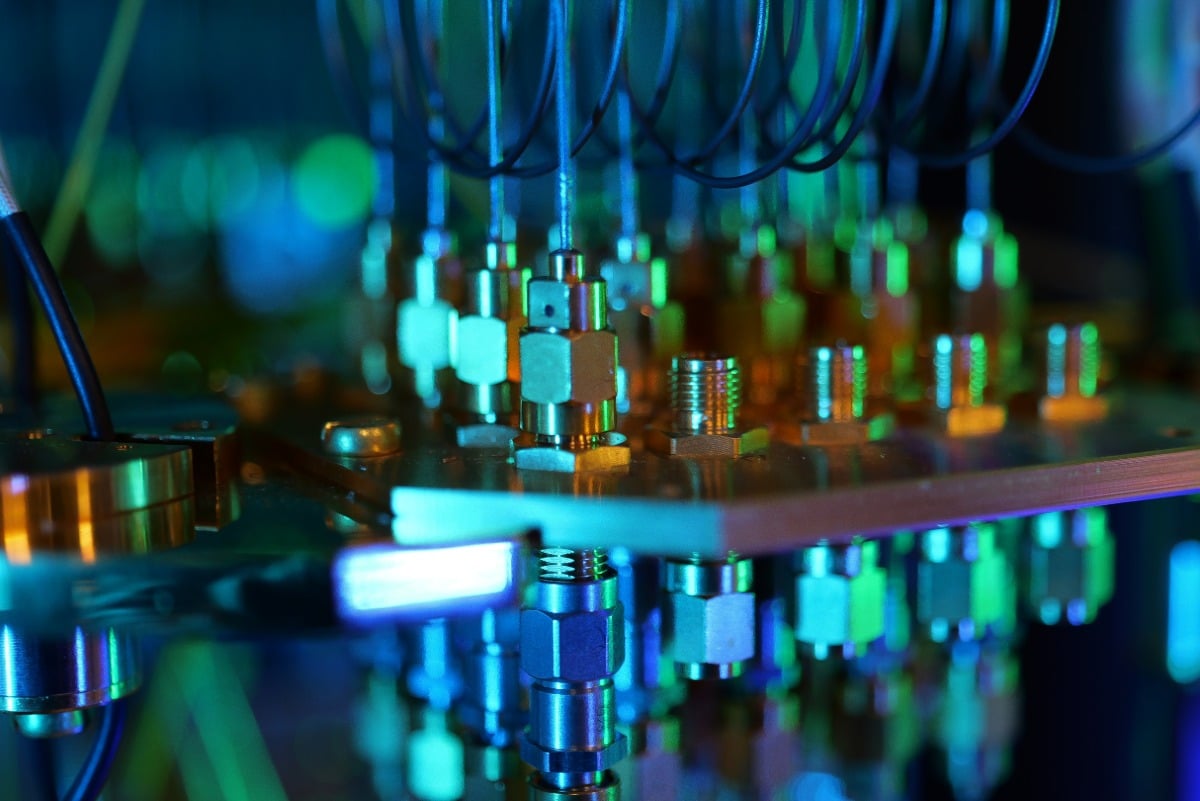
The U.S. Air Force Research Laboratory, the Air Force’s primary science and technology arm, awarded Booz Allen Hamilton, the McLean, Virginia-based consulting and technology firm, a contract worth up to $25.3 million to advance what the government calls quantum information science, a field built around harnessing the bizarre behavior of particles at the atomic and subatomic scale to build computers, sensors, and communication systems that operate in ways ordinary electronics simply cannot. A conventional computer processes information as a series of ones and zeros, but a quantum computer relies on particles that can represent both values simultaneously, a property that in theory allows certain calculations to run dramatically faster than anything a traditional machine could manage, along with sensors precise enough to detect subtle changes in gravity or magnetic fields and communication links that are far harder to intercept without detection.
Structured as what the government calls a cost-plus-fixed-fee contract, the arrangement reimburses Booz Allen for its actual research costs plus an agreed profit margin on top, a payment structure the Pentagon commonly uses for cutting-edge research work where the final cost of getting a breakthrough is genuinely hard to predict in advance. The contract covers what the announcement describes as research, development, test and evaluation of quantum information science technology, the standard government label for the full pipeline of work that takes an idea from a laboratory concept through prototype testing to something closer to a usable capability, all performed at Booz Allen’s own McLean, Virginia facility, with the contract’s period of performance running until July 9, 2031, giving the company roughly five years to deliver results.
Unlike a lot of large defense awards that go to a single contractor without competition, this one went through an open bidding process, and the Air Force received two offers before selecting Booz Allen, according to the contract notice. The Air Force initially obligated $55,000 in fiscal 2026 research funding at the time of award, a modest opening installment that will grow as the Air Force releases additional funding tied to specific project milestones over the life of the contract, a common practice for research awards where the government pays incrementally rather than committing the full contract value up front.
The award traces back to a broader Air Force effort called the Quantum Information Sciences Broad Agency Announcement, a funding mechanism managed through the Air Force Research Laboratory’s Information Directorate in Rome, New York, that lets companies, universities, and research organizations pitch their own ideas for quantum research rather than responding to a single, narrowly defined government requirement. Under that announcement, interested organizations first submit short white papers outlining their proposed approach, and only the strongest submissions get invited to write full, detailed proposals, a two-step filtering process meant to save both the government and industry the effort of writing exhaustive proposals for ideas that were never going to be funded. The broad agency announcement identified individual awards potentially ranging from roughly $500,000 up to $27 million, with a total ceiling across the entire program of $99.9 million, which places Booz Allen’s $25.3 million award among the largest single efforts the Air Force has funded through the initiative so far.
Rome, New York, might seem like an unlikely epicenter for cutting-edge quantum research, but the Air Force Research Laboratory’s Information Directorate there has spent years building out dedicated quantum labs focused on quantum networking and computing, including work on trapped ion systems, quantum algorithms, superconducting and hybrid quantum hardware, and integrated photonics, the branch of quantum engineering that manipulates individual particles of light to carry and process information. That research base did not appear overnight. Congress passed the National Quantum Initiative Act in 2018, establishing a coordinated, government-wide push to keep the United States ahead in quantum science, and subsequent defense policy legislation along with the 2022 CHIPS and Science Act have continued funneling resources toward the field, driven partly by the recognition that China has been investing heavily in its own quantum research, including publicized work on quantum radar systems that Chinese state media has claimed can help detect stealth aircraft, a claim that remains unverified by independent testing but has nonetheless sharpened the Pentagon’s sense of urgency around the technology.
Nobody knows yet which country will be first to build a quantum computer capable of breaking modern encryption or a quantum sensor sensitive enough to detect a submarine from the air, and that uncertainty is exactly why the Air Force keeps writing checks like this one, betting incrementally on a technology that could either fizzle out as an academic curiosity or fundamentally rewrite the rules of military advantage within a decade.