

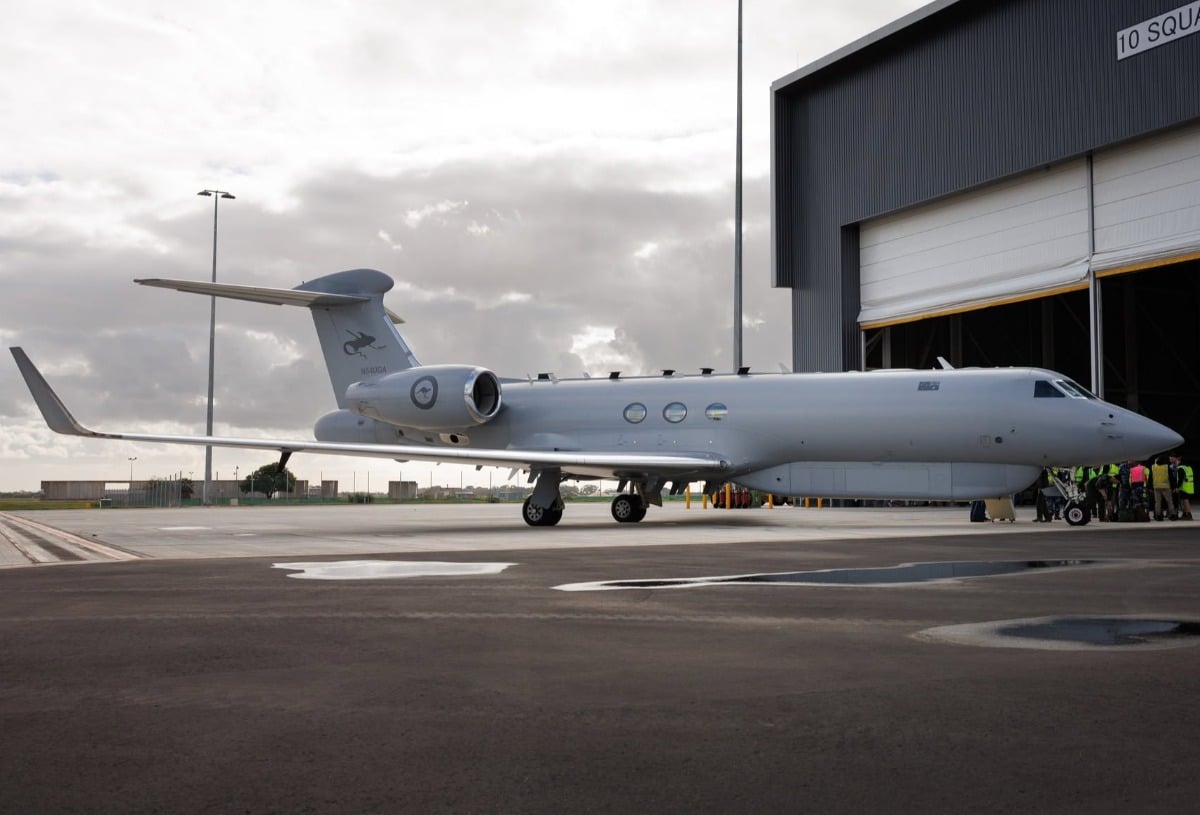
- The Royal Australian Air Force's third MC-55A Peregrine has arrived at RAAF Base Edinburgh, South Australia, bringing three of the planned four aircraft to Australia.
- The RAAF confirmed the fleet is on track to achieve full operational capability by 2028, with all four aircraft to be operated by No. 10 Squadron.
Australia’s fleet of advanced electronic surveillance jets is nearly complete, with the Royal Australian Air Force confirming the arrival of its third MC-55A Peregrine at RAAF Base Edinburgh in South Australia. Three of the four aircraft in the planned fleet have now been delivered, bringing three of the planned four aircraft to Australia, with one still to come before the country fields its most capable airborne intelligence collection capability in history.
Built on the airframe of a Gulfstream G550, the same aircraft type used as a corporate and government transport jet around the world, the Peregrine has been rebuilt by American defense technology company L3Harris Technologies into a flying signals intelligence and electronic warfare platform. The aircraft can detect, characterize, and precisely locate radar systems, communications networks, and other electronic emitters across a wide area, building a detailed picture of what adversary forces are doing, where they are, and what equipment they are using, while collecting intelligence from standoff ranges. Australia’s defence ministry has described it as a system that can “detect, disrupt, deter, and if necessary defeat threats.”
All four Peregrines will operate with No. 10 Squadron, the Royal Australian Air Force unit based at Edinburgh that has been Australia’s primary airborne signals intelligence operator for decades. The squadron previously flew a pair of heavily modified AP-3C Orion maritime patrol aircraft, converted in the 1990s under a classified project called Peacemate into dedicated signals collection platforms. Those two aircraft flew for the last time on December 5, 2023, following a commemorative farewell flight along the South Australian and Victorian coastlines before retirement. The MC-55A replaces the AP-3C(EW) Orion with a newer ISREW capability based on the Gulfstream G550 airframe.
The delivery timeline for the fleet has moved quickly. The first MC-55A arrived at Edinburgh in January 2026, the second followed in March 2026 after a ferry flight from Texas that stopped in Hawaii and Guam, and the third has now joined them. L3Harris performs the mission system integration and airframe modification work for the Peregrine program at Greenville Majors Airport in Texas, where the aircraft undergo the lengthy process of converting a business jet into one of the most capable airborne intelligence platforms in the Indo-Pacific. Sierra Nevada Corporation provides additional support in Australia as the aircraft enter service. A Defence spokesperson confirmed in May 2026 that the MC-55A fleet was still conducting training, testing, and evaluation work before full integration into operational service.
The aircraft was acquired through the U.S. Foreign Military Sales program, the formal government-to-government mechanism through which American allies purchase U.S. military equipment, under a project designated AIR 555 Phase 1. That acquisition pathway means Australia bought the aircraft through the U.S. Air Force rather than directly from L3Harris, a common approach for sensitive intelligence systems where the U.S. government maintains oversight of how the technology is used and with whom it is shared.
At RAAF Base Edinburgh, the Peregrine sits alongside the P-8A Poseidon, the Boeing-built maritime patrol and anti-submarine aircraft that Australia operates in significant numbers, and the MQ-4C Triton, the Northrop Grumman high-altitude unmanned surveillance drone that provides persistent wide-area maritime observation. Together the three platforms form an integrated surveillance architecture designed to give Australia and its allies comprehensive visibility over the maritime and electromagnetic environment stretching across the Indo-Pacific, the vast ocean region that connects the Pacific and Indian Oceans and through which an extraordinary share of global trade and military activity flows.
The Royal Australian Air Force confirmed the fleet’s contribution to national strategy directly in its announcement of the third arrival, stating that the MC-55A Peregrine “enhances ADF capability by delivering critical intelligence in support of operations, strengthening Australia’s ability to monitor its strategic area of interest, including key maritime approaches, an enduring priority under the National Defence Strategy.”