

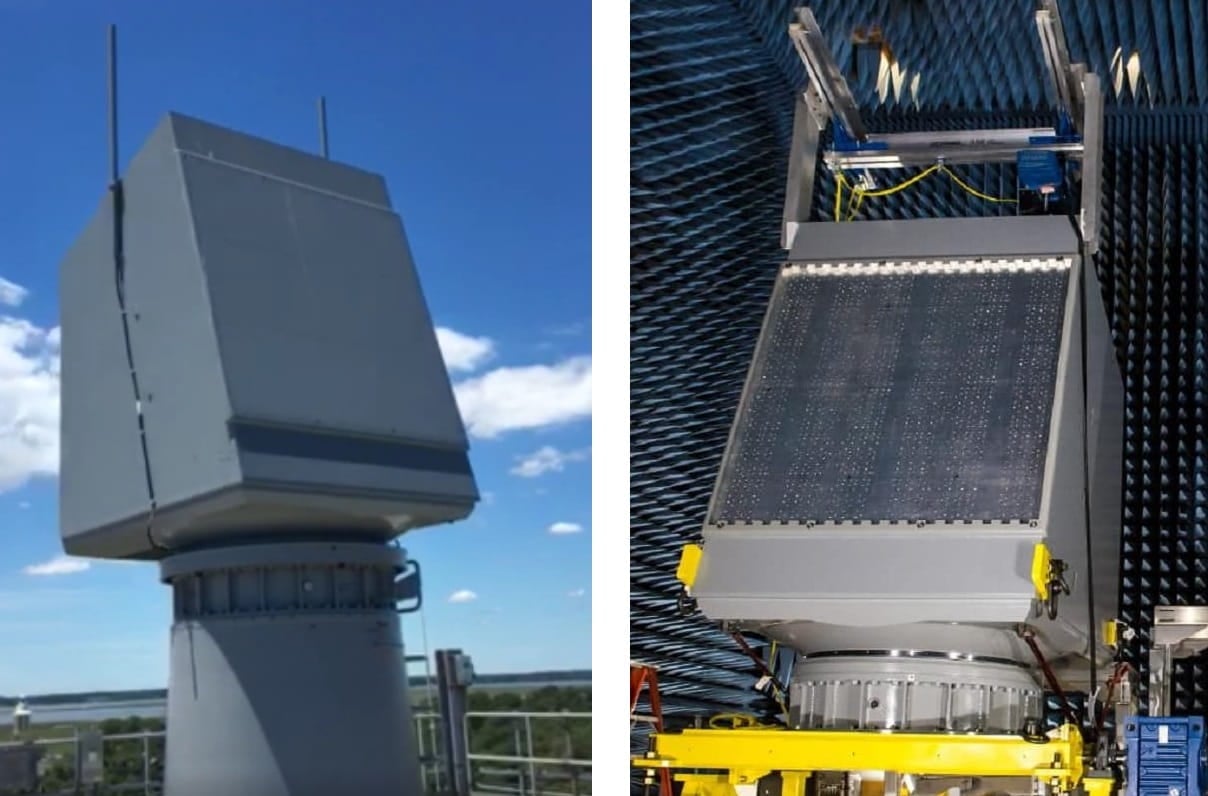
The U.S. Navy successfully completed the first system-level tests of the newest Raytheon’s radar for aircraft carriers and amphibious warfare ships.
The first tests of next generation SPY-6(V)2, the Enterprise Air Surveillance Radar, was conducted at U.S. Navy’ facilities in the Surface Combat System Center at Wallops Island, VA.
In the first test the radar searched for, detected, identified and tracked numerous targets – including commercial aircraft. In a second exercise, the maturity of EASR integration enabled the radar to track multiple targets continuously for several hours during a test event involving another system, according to a news release put out by Raytheon.
EASR, the newest sensor in the Navy’s SPY-6 family of radars, provides simultaneous anti-air and anti-surface warfare, electronic protection and air traffic control for aircraft carriers and amphibious warfare ships.
“Moving quickly from radar installation at Wallops Island to ‘tracks on glass’ in less than three months is a major accomplishment,” said U.S. Navy Captain Jason Hall, Program Manager for Above Water Sensors, Program Executive Office Integrated Warfare Systems. “The EASR program is progressing extremely well. We are now one step closer to production and delivering the radar’s unmatched capability to the surface fleet.”
Two variants of EASR are being built: a single-face rotating array designated AN/SPY-6(V)2 for amphibious assault ships and Nimitz class carriers, and a three fixed-face array designated AN/SPY-6(V)3 for Ford class aircraft carriers and the future FFG(X) guided missile frigates.
Both versions of EASR are built on scalable Radar Modular Assembly, or RMA, technology as well as a software baseline that has been matured through development and test successes of AN/SPY-6(V)1, the U.S. Navy’s program of record for the DDG 51 Flight III destroyers. Each RMA is a self-contained radar in a 2′ x 2′ x 2′ box. These individual radars can integrate together to form arrays of various sizes to address any mission on any ship. EASR also adds air traffic control and weather capabilities to the mature SPY-6 software baseline.
Upon completion of system-level testing in Q4 2019, EASR will shift from the engineering and manufacturing development phase to the production phase. The 1st delivery of AN/SPY-6(V)2 will be to LHA-8, the America Class Amphibious Assault Ship.
U.S. Navy completed the first system-level tests of SPY-6(V)2 radar pic.twitter.com/w0k2Px2wKj
— Dylan Malyasov (@DylanMalyasov) August 21, 2019