

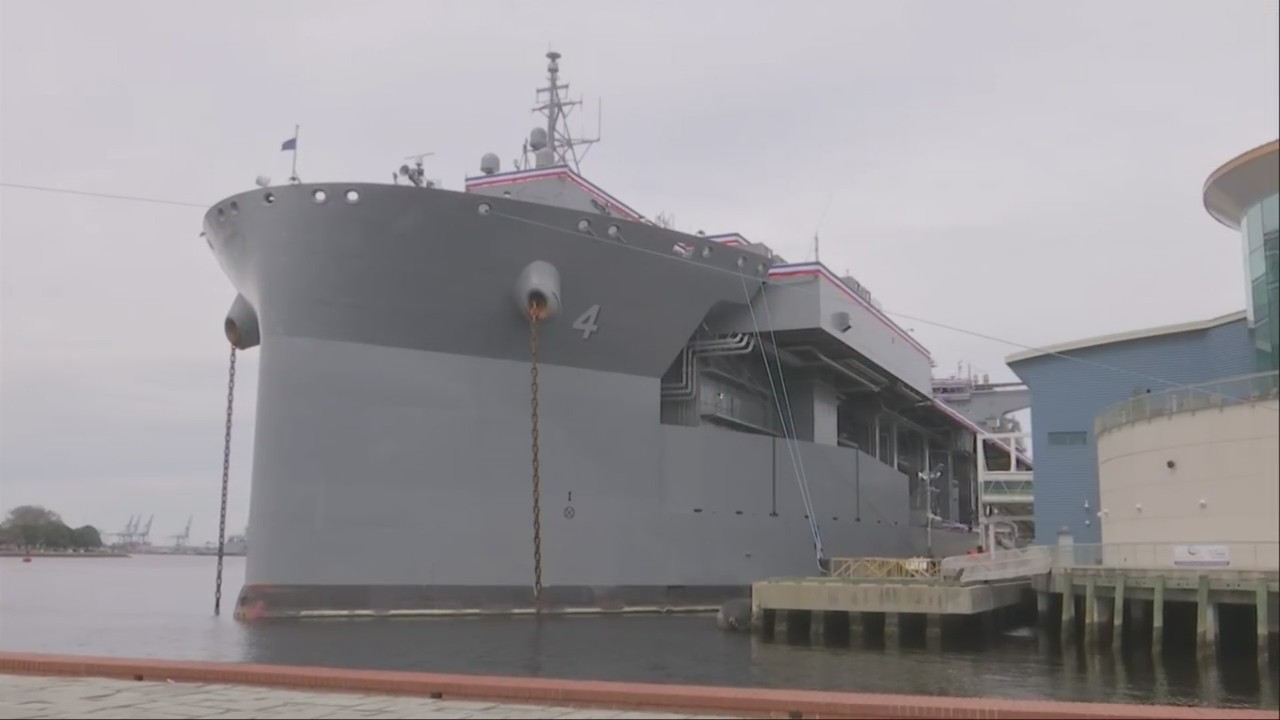
The U.S. Navy commissioned its newest Expeditionary Sea Base, USS Hershel “Woody” Williams (ESB 4), during a ceremony in Norfolk, Virginia.
The 784-foot long vessel features a 52,000 square-foot flight deck that can land up to four aircraft – helicopters and Ospreys – at one time, is the first ship to bear the name of Marine Corps Chief Warrant Officer Four Hershel Woodrow Williams, the last surviving Medal of Honor recipient recognized for heroism at the Battle of Iwo Jima during World War II.
The future Hershel “Woody” Williams is the first ship to bear the name of Marine Corps Chief Warrant Officer Four Hershel Woodrow Williams, the last surviving Medal of Honor recipient recognized for heroism at the Battle of Iwo Jima during World War II.
The Hershel “Woody” Williams is optimized to support a variety of maritime-based missions and designed around four core capabilities: aviation facilities, berthing, equipment staging support, and command and control assets. ESBs can be enhanced to meet special operations force missions through increased communications, aviation and unmanned aircraft system support.
Built by General Dynamics NASSCO, the Montford Point class is comprised of five ships across two variants: Expeditionary Transfer Docks and Expeditionary Sea Bases. Acting as a mobile sea base, ESBs are part of the critical access infrastructure that supports the deployment of forces and supplies to provide prepositioned equipment and sustainment with flexible distribution.
The platform has an aviation hangar and flight deck that include four operating spots capable of landing V-22 and MH-53E equivalent helicopters, accommodations, work spaces, and ordnance storage for an embarked force. The platform will also provide unmanned aviation vehicle operations, enhanced command and control, communications, computers, and intelligence capabilities to support embarked force mission planning and execution. The reconfigurable mission deck area can store embarked force equipment including mine sleds and rigid hull inflatable boats.