

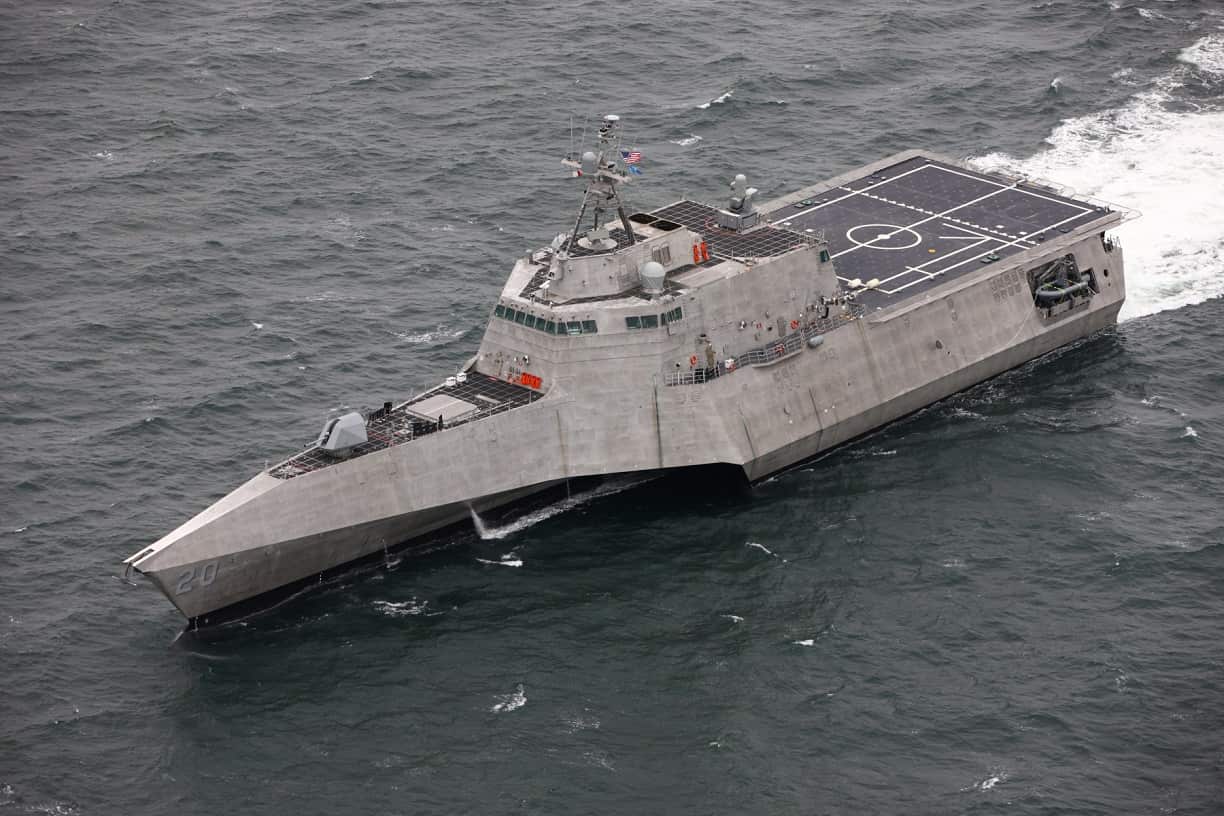
The newest Independence-class littoral combat ship joins the U.S. Navy fleet during a June 21 ceremony at Austal USA in Mobile, Alabama.
The future USS Cincinnati is the 18th littoral combat ship (LCS) delivered to the Navy and the 10th of the Independence variant to join the fleet. Delivery marks the official transfer of the ship from the shipbuilder, Austal USA, to the Navy. It is the final milestone prior to commissioning, which is planned for this fall in Gulfport, Mississippi.
“This is a great day for the Navy and our country with the delivery of the future USS Cincinnati,” said Capt. Mike Taylor, LCS program manager. “I look forward to celebrating the commissioning of this great ship alongside the crew later this year. This ship will play an essential role in in carrying out our nation’s maritime strategy.”
Five additional Independence-variant ships are under construction at Austal USA: the future USS Kansas City (LCS 22) is expected to be delivered to the Navy this fall, and the future USS Oakland (LCS 24), Mobile (LCS 26), Savannah (LCS 28) and Canberra (LCS 30) are all in various stages of construction. Four more ships are awaiting the start of construction following LCS 30.
Five other naval vessels have honored the city of Cincinnati. The first, an ironclad river gunboat, was commissioned in 1862. Although sunk twice in battle, it was raised each time. Another ship — USS Queen City, named for Cincinnati, the Queen City of Ohio —was commissioned in April 1863 and was ultimately destroyed by Confederate forces. There was also a protected cruiser in service from 1894 to 1919 that enforced neutrality laws during the Cuban Revolution and served during the Spanish-American War. A light cruiser was commissioned in 1924 that patrolled the Atlantic during World War II, and a Los Angeles-class nuclear attack submarine (SSN 693) was in service from 1978 to 1996.
The Independence-variant Littoral Combat Ship is a high-speed, agile, shallow draft, focused-mission surface combatant designed to conduct Surface Warfare, Anti-Submarine Warfare, and Mine Countermeasures missions in the littoral region. With its open architecture design, the LCS can support modular weapons, sensor systems and a variety of manned and unmanned vehicles to capture and sustain littoral maritime supremacy.
In addition to being in full rate production for the LCS program, Austal is also the Navy’s prime contractor for the Expeditionary Fast Transport (EPF) program.