

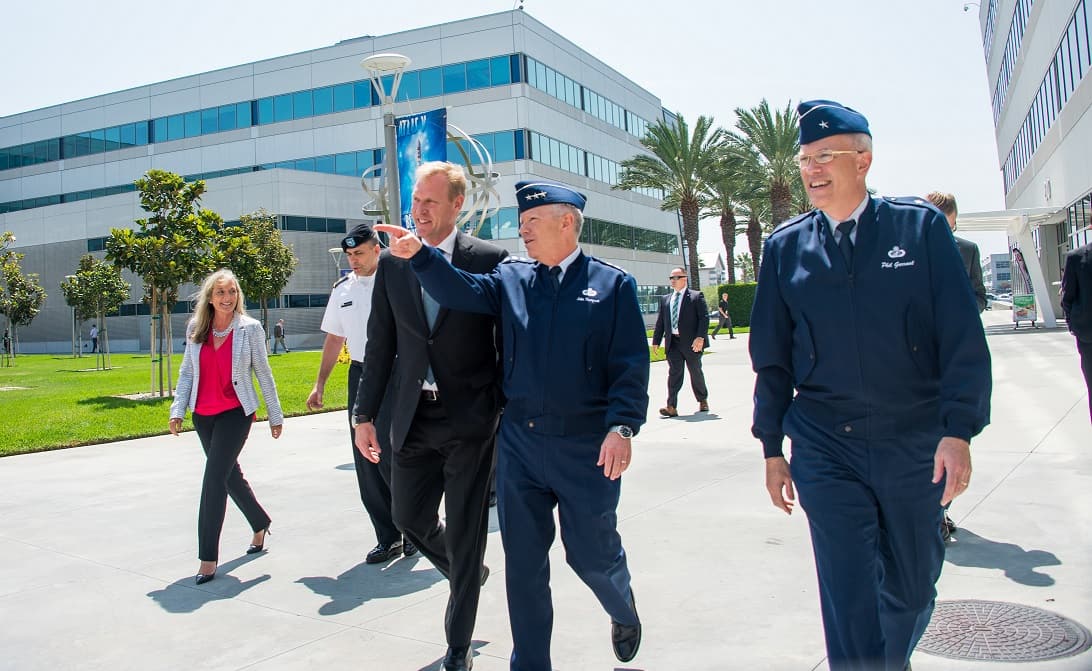
Space is a contested environment, and the United States must deploy new tools, new capabilities and the right leadership to ensure dominance in that environment , Deputy Defense Secretary Patrick M. Shanahan said recently.
The deputy secretary spoke Aug. 27 to airmen, civilians and contractors at Los Angeles Air Force Base’s Space and Missile Systems Center in El Segundo, California. The SMC, a subordinate unit of Air Force Space Command, is the center of technical excellence for developing, acquiring, fielding and sustaining military space systems.
“We’ve got a president who says space is no longer a sanctuary,” he added. “We need to defend our economy. We need to put in place the authorities and the capabilities [in space] to protect our way of life — period.”
Shanahan said in his corporate experience, he’s been through a transformation similar to what SMC is undertaking. “The first law of transformation is, do no harm. Our missions are too important. That doesn’t mean we don’t take calculated risks or we don’t move quickly,” he said.
“But, from the Pentagon’s standpoint we’re not going to do harm, and that’s why I wanted to come out here and spend some time with you,” the deputy secretary added.
During the course of the next year, a lot of changes will take place in terms of technology, roles and responsibilities, he said.
“If we don’t choose the right technical solution, we lose. This … is about physics. It’s about capability. And when you pick the wrong product, no matter how talented the team or how many resources there are, you lose,” Shanahan said.
“This is about development and programmatics. Acquisition is a huge enabler, but getting the product right is, in my mind, the most important thing we can do,” he added.
It’s also vital to put a plan in place that achieves performance, the deputy secretary said. “We have to have clear goals. Without clear goals, the team can’t practice what I call ‘selectful neglect.’ We have — in large organizations like this — competing priorities, and if the goals aren’t clear, then it just creates too much confusion.”
Having the right leaders in place also is critical, he said. “There are so many great people that work in the Department of Defense, so we have the talent. We just need to put them into the right roles.”
And, Shanahan said, “the hidden secret sauce is engagement of the team. When the team is engaged, they reward you with discretionary effort. And when you have that kind of environment, it is really fun and energizing to come to work.”
As for innovation, he noted, “you find the really great leaders, because they’ll put the project or the program ahead of their own careers, and that’s the kind of culture we want at the end of the day — [the] people who are mission-oriented, first and foremost.”
Organizations should be centered around the capability DoD wants to deploy and the resources it needs to deploy them, the deputy secretary noted.
“If you want to know what I think about the Space Force [it’s this]: How do we deliver warfighting capability more quickly?” Shanahan said.
Other key priorities, he said, are how to give the Missile Defense Agency more capability to do “birth-to-death tracking” of ballistic missiles and other cold objects in space, and how to operate in a GPS-denied environment.
“If we’re really serious about being combat credible, forward-deployed, you’re going to have to operate in GPS-denied environments. We have to get after that capability,” Shanahan added.
The deputy secretary said DoD also can go a lot faster with dynamic space situational awareness. “We’re standing on the air hose with technology that can be readily deployed. We can go faster.”