


In a move reflecting rapid battlefield adaptation, the U.S. Army has conducted its live grenade drop using a drone, drawing on lessons learned from Ukrainian forces in their war with Russia.
According to the Army, UAS operators with the 173rd Airborne Brigade, carried out the grenade drops from a Skydio X10 drone at the Grafenwoehr Training Area in Germany on June 25, 2025.
The exercise involved the coordinated effort of Soldiers from the 7th Army Training Command, the Joint Multinational Training Group–Ukraine, and the 173rd Airborne Brigade.
The test used an M67 fragmentation grenade, with the drone flown by a frontline UAS specialist during a live-fire training scenario.
U.S. military officials noted that the exercise reflects a shift toward low-cost, practical combat solutions observed in Ukraine, where soldiers have successfully adapted commercial and tactical drones for grenade and munition delivery across the battlefield. These improvised air-delivery tactics have become a mainstay of Ukrainian defense efforts in trench and urban warfare, providing affordable and mobile strike options with limited risk to operators.
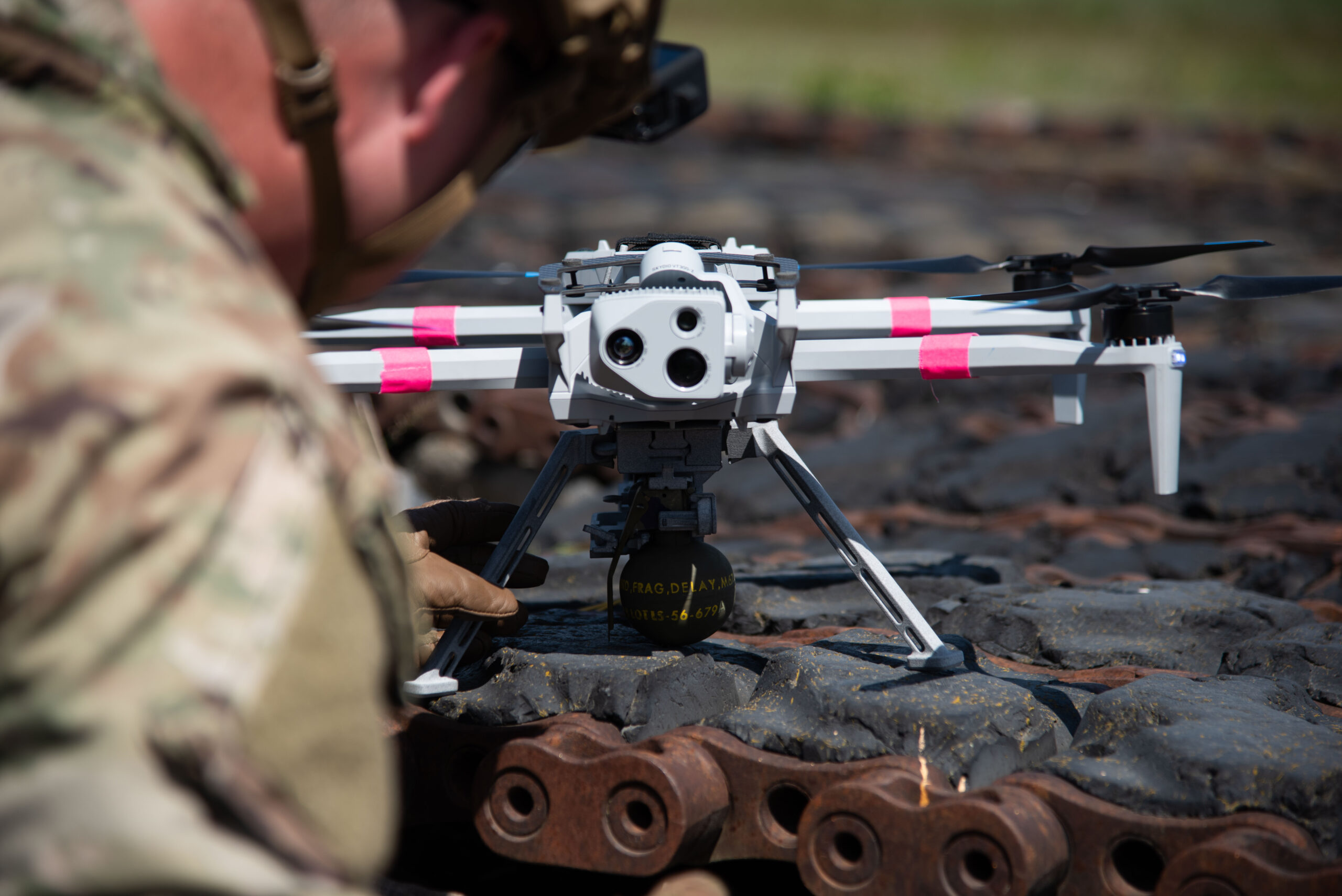
While not formally attributed, the training appears modeled on widely circulated footage and documented tactics employed by Ukrainian units, where quadcopters and small reconnaissance drones routinely deliver grenades and modified munitions with notable precision.
The drone used for the exercise, the Skydio X10, is part of a new generation of small UAS platforms already in use by the U.S. military for reconnaissance. The live munition deployment suggests a broader role for these drones as the Army explores scalable strike capabilities for small units.
In a statement, Army personnel involved in the test described the trial as a milestone. Officials emphasized the value of integrating real-world combat lessons from U.S. partners and allies into evolving doctrine and training practices.
The use of drones in combat roles has surged globally, with conflicts in Ukraine and the Middle East serving as a proving ground for rapid, inexpensive UAS innovation. The Pentagon has increasingly acknowledged the need to adapt, citing both the cost-efficiency and tactical flexibility of these platforms.
The 173rd Airborne Brigade and associated units are expected to continue refining the technique, testing it under various operational conditions as part of a broader push to modernize small-unit combat capabilities.
The U.S. Army has not confirmed whether it will formalize drone-delivered munitions into its standard tactics, techniques, and procedures. However, the successful trial signals a growing willingness to adopt unconventional methods that have proven effective in active war zones.