

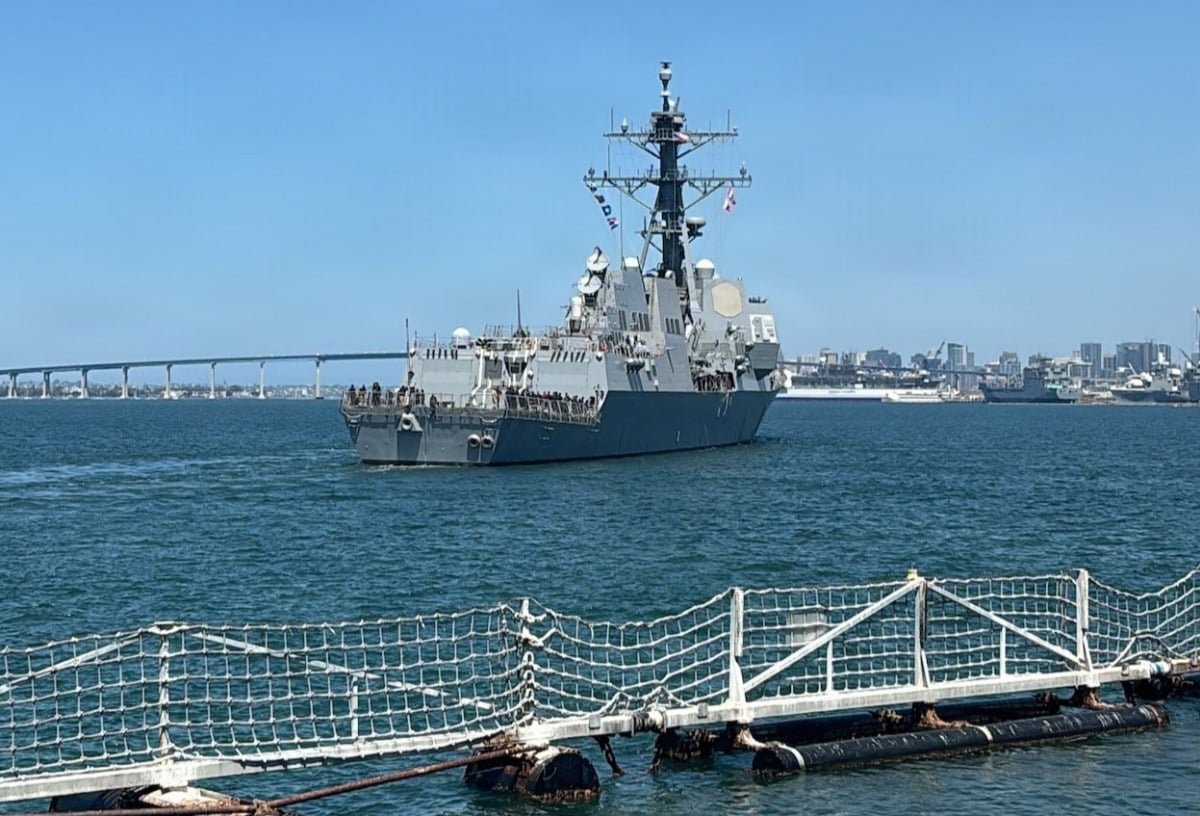
- The Navy completed DDG Modernization 2.0 overhauls on USS Chung-Hoon (DDG 93) and USS James E. Williams (DDG 95), integrating the AN/SLQ-32(V)7 SEWIP Block III electronic warfare system.
- Work was led by General Dynamics NASSCO with oversight from the Mid-Atlantic and Southwest Regional Maintenance Centers.
Two U.S. Navy guided-missile destroyers have completed a comprehensive mid-life modernization that gives them the most advanced shipborne electronic warfare capability the Navy has ever fielded, making them significantly harder to kill with anti-ship missiles and dramatically more capable of disrupting enemy radar and communications at the same time.
The Navy confirmed the completion of major overhauls on USS Chung-Hoon (DDG 93) and USS James E. Williams (DDG 95), both Arleigh Burke-class destroyers, as part of the DDG Modernization 2.0 program, with the upgrades centered on the integration of the AN/SLQ-32(V)7 Surface Electronic Warfare Improvement Program Block III system, the Navy’s most capable shipborne electronic attack suite.
The AN/SLQ-32(V)7, known in the fleet as SEWIP Block III and built by Northrop Grumman, represents a generational leap over the electronic warfare systems these ships previously carried. The original SLQ-32 family, which entered service in the early 1980s, was fundamentally a threat warning receiver: it could detect the radar emissions of incoming anti-ship missiles and alert the crew, but its active jamming and electronic attack capabilities were limited. SEWIP Block III replaces that architecture entirely with a system built around active electronically scanned array transmitters that can simultaneously detect and jam multiple threats across a wide range of radio frequencies, suppressing the guidance radars of incoming missiles while also attacking enemy sensor and communications systems at ranges the legacy suite could not approach. The physical evidence of how serious this upgrade is visible from the outside: installing SEWIP Block III required building massive sponsons on both sides of the ship’s superstructure, two-deck-tall structural additions to the hull that house the new antenna arrays.
USS Pinckney (DDG 91) was the first Arleigh Burke to receive the full DDG Modernization 2.0 package, completing its overhaul before Chung-Hoon and Williams, and the Navy has been explicit that Pinckney’s work provided the learning baseline the subsequent ships built upon. Capt. Tim Moore, the program manager for DDG Modernization 2.0, described the accelerated pace of Chung-Hoon and Williams as a direct result of that institutional learning, with planning and execution milestones deliberately shifted earlier to get the upgraded ships back to the fleet faster.
“This destroyer modernization effort is the cornerstone of increasing service life and delivering decisive combat power to the US Navy via our Flight IIA destroyers,” said Capt. Tim Moore. “We focused on opportunities to shift milestones supporting acquisition, planning and execution left to provide these game-changing capabilities to the operators sooner. The DDG MOD 2.0 program remains a top priority as the Navy continues to build and sustain a lethal, resilient, and rapidly adaptable force.”
The two ships belong to the Flight IIA sub-variant of the Arleigh Burke class, the most numerous and operationally active destroyer type in the U.S. fleet, displacing approximately 9,200 tonnes (10,141 tons) fully loaded and carrying a combat system centered on the AN/SPY-1D(V) phased-array radar, the Aegis combat management system, and the Mk 41 Vertical Launch System with up to 96 cells for a mix of Standard Missiles, Tomahawk cruise missiles, and anti-submarine rockets. Flight IIA destroyers were built without a helicopter hangar magazine, a weight trade-off that made room for two helicopter hangars, giving them persistent rotary-wing aviation capability but leaving them reliant on aging electronic warfare equipment until this modernization program began addressing the gap.
The SEWIP Block III system that Chung-Hoon and Williams now carry integrates active electronically scanned array technology whose precise specifications remain classified, but Navy and industry reporting consistently describes it as capable of detecting and electronically attacking multiple targets simultaneously across both passive and active modes, providing what the Navy characterizes as a decisive advantage in the modern electromagnetic environment. A March 2026 contract modification for additional SEWIP Block III units, worth approximately $334 million with options pushing cumulative program value toward $783 million, signals that the Navy intends to expand this capability well beyond the initial four destroyer conversions, with Northrop Grumman now under contract to deliver nine additional systems from 2028 onward.
Anti-ship missiles fired by adversaries from ships, aircraft, submarines, and land-based launchers guide themselves to targets using radar seekers in their terminal phase, locking onto the electromagnetic signature of a ship and using it to steer their warhead into the hull. A ship that can detect that seeker radar the moment it activates, and immediately transmit jamming energy that corrupts the missile’s ability to see its target, creates a defensive layer that no amount of missiles, guns, or decoys can fully replicate on its own. SEWIP Block III adds that layer across multiple simultaneous threats, meaning a ship facing a salvo of anti-ship missiles can respond electronically to all of them at once rather than sequentially.
The work on both ships involved deep structural modifications beyond the electronic warfare installation, with General Dynamics NASSCO serving as lead maintenance activity for the overhauls and the Mid-Atlantic Regional Maintenance Center and Southwest Regional Maintenance Center providing supervisory oversight across the extensive government and industry team required to complete the modernization.
“The teamwork, technical expertise, and disciplined execution demonstrated by MARMC, SWRMC and our industry partners were essential to delivering these advanced capabilities to the Fleet,” said Rear Adm. Dan Lannamann, commander, Navy Regional Maintenance Center. “Their efforts ensure our Sailors have more capable, combat-ready ships prepared to operate in an increasingly challenging maritime environment.”
USS Halsey (DDG 97) is identified in prior Navy reporting as the fourth ship in the initial DDG Modernization 2.0 sequence, with its overhaul expected to follow the completions now confirmed for Pinckney, Chung-Hoon, and Williams. The Navy’s broader plan envisions eventually applying elements of this modernization across the wider Flight IIA fleet, which numbers more than 30 ships and represents the bulk of the destroyer force that would be committed to any high-end conflict in the Pacific or Atlantic. Each ship that completes this upgrade enters the fleet as a qualitatively different asset from the one that went into the shipyard, carrying electronic attack capability that its adversaries must now account for in every engagement scenario they plan.