

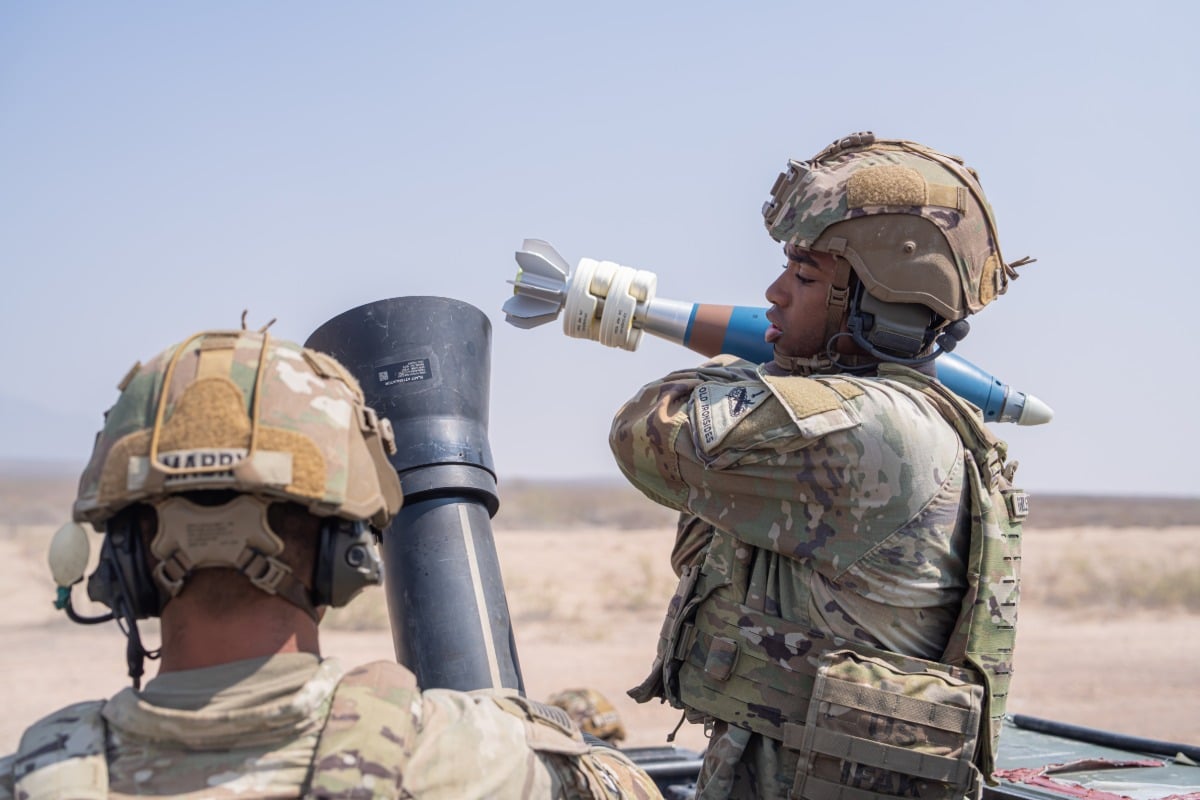
- The U.S. Army awarded a $212 million contract to Machining Technologies Inc. and Globe Tech LLC for 60 mm, 81 mm, and 120 mm mortar tail fins through June 2031.
- Both firms will compete for individual delivery orders under the dual-vendor contract, which was awarded following a solicitation that received four bids.
Every mortar round fired by an American soldier depends on a small set of metal fins at the back of the shell to spin it into stable flight, keep it on course, and make sure it lands where the gunner intended. Without those fins, a mortar round tumbles, loses accuracy, and becomes a danger to everyone in the area. The U.S. Army has committed $212 million to ensure it has a reliable supply of them, awarding a dual-vendor contract to two small American manufacturers that will compete for orders over the next five years.
Army Contracting Command at Newark, New Jersey, awarded the contract on June 5, splitting the work between Machining Technologies Inc., based in Salisbury, Maryland, and Globe Tech LLC, based in Plymouth, Minnesota, both of which qualified through a competitive solicitation that drew four bids. The total contract ceiling is $212 million, structured as a firm-fixed-price indefinite-delivery vehicle, meaning the Army pays a set price per unit and places individual orders as needed rather than committing to a fixed quantity upfront. Both companies will compete for each delivery order placed under the contract, keeping price pressure on both suppliers throughout a performance period running to June 4, 2031.
The contract covers mortar tail fins across three calibers: 60 mm (2.4 in), 81 mm (3.2 in), and 120 mm (4.7 in), the three standard mortar sizes currently in service with the U.S. Army and Marine Corps. Each caliber serves a distinct tactical role. The 60 mm mortar is a lightweight system typically carried and operated by infantry squads, firing rounds that weigh roughly 1.8 kg (4 lb) and reach out to approximately 3.5 km (2.2 miles), providing close-in fire support that does not require calling on heavier artillery assets. The 81 mm mortar is a medium system operated at the company or battalion level, with rounds weighing around 4.5 kg (10 lb) and a range extending to roughly 5.6 km (3.5 miles), filling the gap between the light 60 mm and the heavier weapons that require vehicle transport. The 120 mm mortar is the heaviest of the three, firing rounds that weigh approximately 13 kg (29 lb) to ranges of up to 7.2 km (4.5 miles), delivering explosive effects comparable to light artillery from a system that can still be transported and set up by a small crew.
The tail fin assembly is the precision component that transforms a mortar round from a simple explosive projectile into an accurate weapon system. Mortar fins are not simple sheet metal pieces stamped out on a punch press. They must be machined to precise tolerances, balanced to ensure consistent spin characteristics, heat-treated to withstand the thermal stresses of propellant ignition, and finished to resist corrosion across the full range of climatic conditions in which the Army operates. A fin assembly that is even slightly asymmetric, unbalanced, or dimensionally out of specification produces a round that deviates from its intended trajectory, reducing accuracy and potentially creating safety hazards for the firing crew and friendly forces nearby.
The dual-vendor structure of the contract is a deliberate supply chain resilience measure that the Army has been applying increasingly to munitions components following hard lessons learned since Russia’s full-scale invasion of Ukraine began in 2022. When Ukraine’s artillery consumption revealed the extent to which Western stockpiles had been drawn down during three decades of reduced threat assumptions, procurement officials across the Department of War began re-examining single-source dependencies throughout the munitions supply chain. A contract that qualifies two competing manufacturers for the same component ensures that if one supplier experiences a production disruption, a facility fire, a workforce shortage, or any other event that interrupts output, the other can absorb additional orders without the Army facing a gap in supply.
Machining Technologies Inc. of Salisbury, Maryland, is a precision machining company operating in the defense sector on Maryland’s Eastern Shore. Globe Tech LLC of Plymouth, Minnesota, is a manufacturing firm in the Minneapolis suburban area with experience in defense components production. Both are small businesses by federal contracting standards, a designation that carries significance in this context because the Army’s mortar fin requirement demands precision manufacturing capability but does not require the massive production infrastructure of a large defense prime contractor. Small specialized machine shops with the right equipment, quality systems, and workforce can compete effectively for this kind of component work, and the competitive structure of the contract rewards efficiency and quality over institutional scale.
Mortars occupy a specific and enduring place in ground combat that more sophisticated weapons have not displaced. They provide indirect fire, meaning they shoot projectiles in a high arc that can reach targets behind cover, buildings, or terrain features that block direct line-of-sight weapons, and they can be set up and firing within minutes of arriving at a position. American ground forces, from light infantry operating in mountains or jungles to airborne units that must carry everything they need to a drop zone, depend on mortars as a foundational fire support capability that requires no vehicle, no established supply line, and no special facilities to operate.