

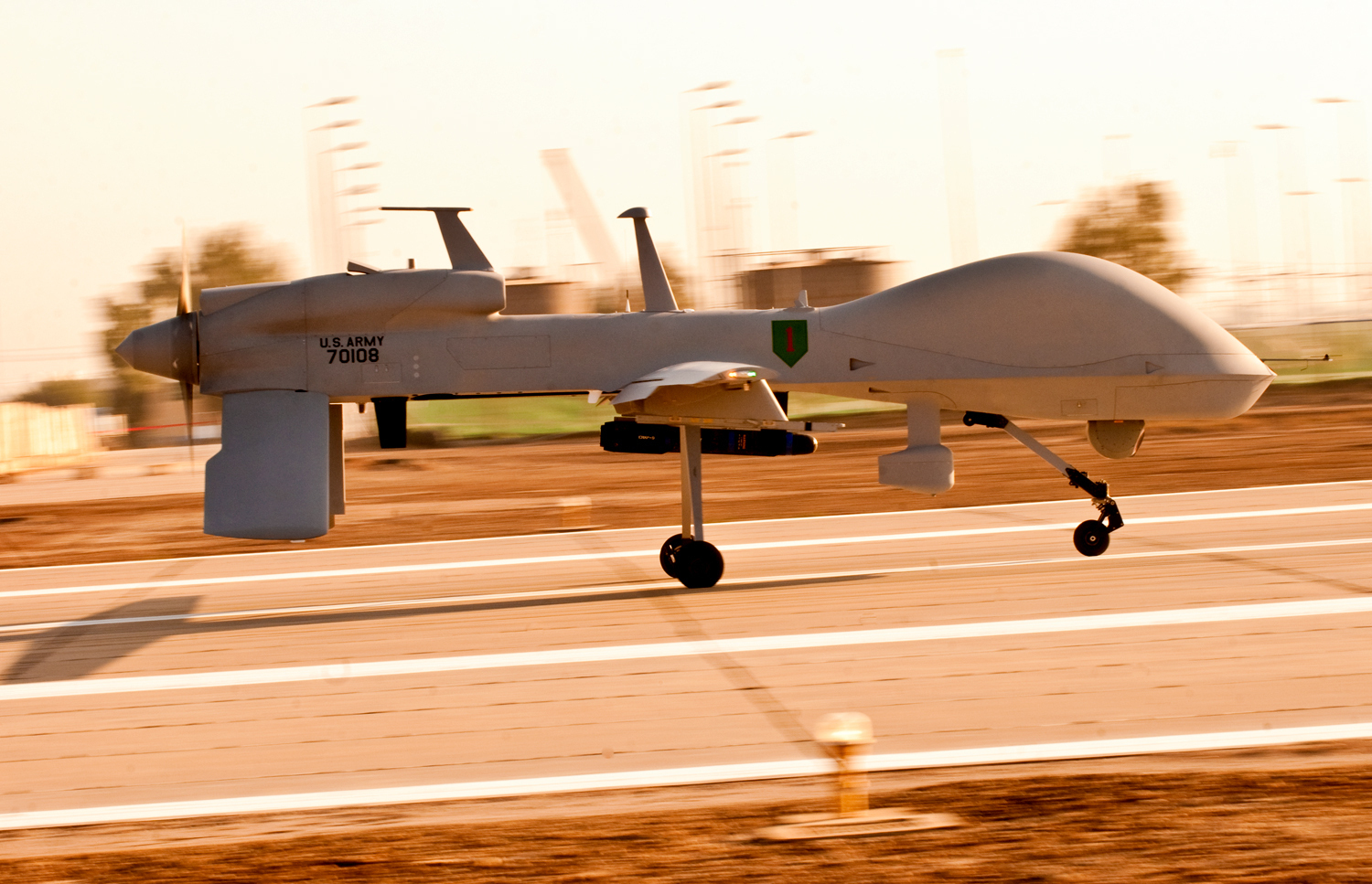
The U.S. Army has plans to improve capabilities MQ-1C Gray Eagle unmanned aerial system, is expected to play a big role in the future of Army aviation.
In a notice posted on the U.S. government’s main contracting website, the Army Futures Command is soliciting industry for information on emerging technologies in radar equipment and airborne radars to enhance the capabilities of MQ-1C Gray Eagle drones.
The Gray Eagle is manufactured by General Atomics Aeronautical Systems (GA-ASI). It is cheaper to purchase and maintain than a helicopter and it can stay in the air for longer stretches of time. Essentially, the Gray Eagle is the latest version of the Predator series of drones, retooled and upgraded for Army-specific needs.
According to a recently published request for information, Army Futures Command has identified a future fight in an Integrated Air Defense Systems-rich environment where platforms must be survivable, attritable, or expendable to deliver sensing capabilities effectively.
As noted by the Army Futures Command, the MQ-1C Gray Eagle flies racetrack patterns tangential to the Integrated Air Defense Systems (IADS) threat, at 80 km distance and Air-Launched Effects deploy from the MQ-1C Gray Eagle as the forward most element of the advanced team in areas of expected enemy contact in order to detect, identity, location and report (DILR) and attack/disrupt/decoy threat assets to initiate dis-integration of the IADS. 2b).
Also, the electronic intelligence sensor system detects IADS threat, gathers geo-location data, and then transfers the threat Target Location Error ellipse coordinates to the SAR sensor system, The SAR sensor system acquires SAR Spot Scan imagery using the threat coordinates, performs Automatic Target Recognition (ATR), enables threat Cursor on Target (COT) designation, and then TLE category 1 circular error at the 90th percentile (CAT 1 CE90) threat coordinates to long-range fires.
The Army Futures Command is requesting information survey precedes a potential Fiscal Year (FY) 2022 Gray Eagle sensor payload Joint All Domain Operations (JADO) demonstration where systems will be quantitatively compared to identify the highest performer and best value based on Technology Readiness Level (TRL) and production unit cost.