

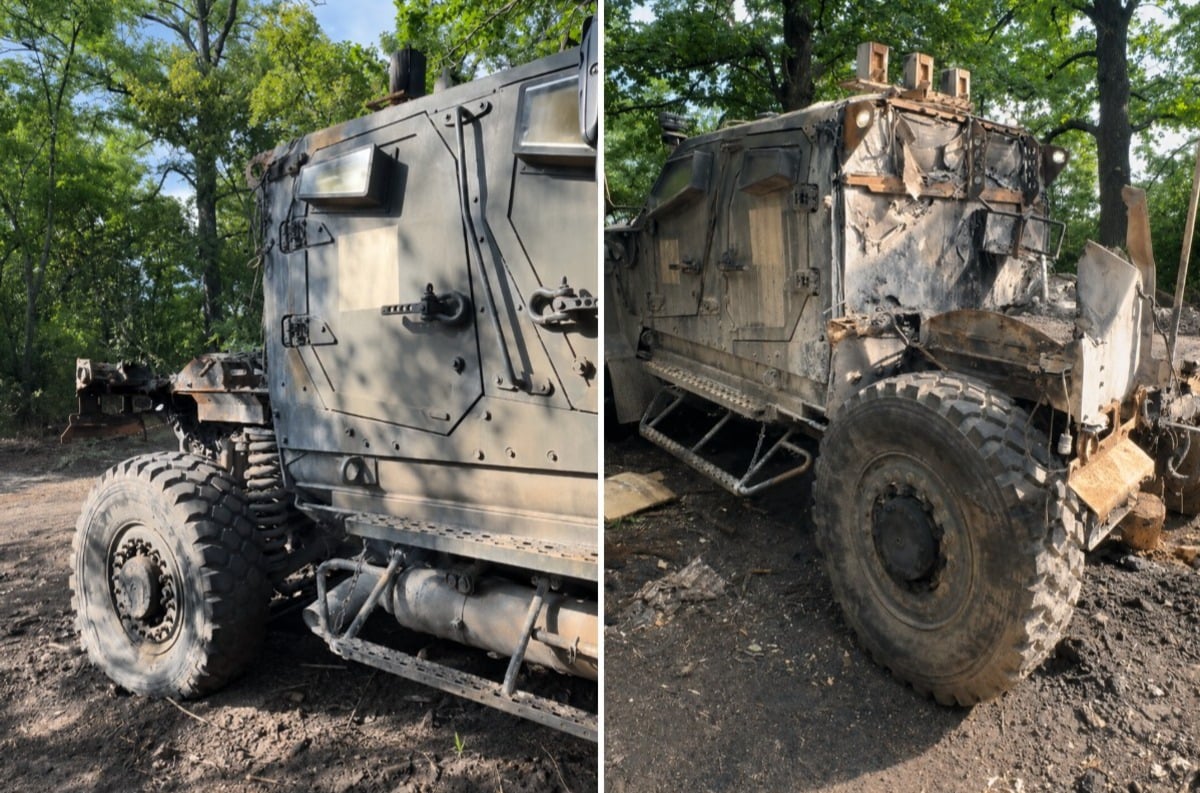
- Ukrainian forces released video showing an Oshkosh M-ATV struck by a Russian fiber-optic FPV drone, with the rear cargo section destroyed.
- The armored crew compartment remained intact and the soldiers inside survived, though they likely sustained injuries and concussions, per Ukrainian forces.
A Ukrainian military video published this week shows the aftermath of a Russian fiber-optic FPV drone strike on an American-supplied Oshkosh M-ATV armored vehicle, with Ukrainian forces reporting that the armored crew compartment held and the soldiers inside survived the impact, though the vehicle itself suffered serious damage.
The footage, released by Ukrainian military personnel, documents what the crew described in their own words: “The explosion destroyed the vehicle’s rear cargo section, but the armored crew compartment protected the soldiers inside.”
The crew and passengers are reported to have survived, though Ukrainian forces acknowledged they likely sustained injuries and concussions from the blast, an expected consequence of a direct drone strike even when armored protection performs as designed. The vehicle’s rear cargo section was destroyed entirely, while the protected cab section, the portion engineered to keep occupants alive in exactly this kind of attack, remained structurally intact.
The Oshkosh M-ATV, which stands for Mine-Resistant Ambush Protected All-Terrain Vehicle, is one of the most capable protected mobility platforms the United States has transferred to Ukraine since the full-scale invasion began in February 2022. Built by Oshkosh Defense, a Wisconsin-based manufacturer that has produced thousands of armored vehicles for the U.S. military and allied partners, the M-ATV was specifically designed to survive improvised explosive device blasts and direct attacks in environments where road conditions, terrain, and threat density make lighter vehicles unsuitable. The vehicle weighs approximately 14,500 kilograms (32,000 pounds) in standard configuration and sits on a V-shaped hull, a design that deflects blast energy outward and away from the crew compartment rather than allowing it to travel directly upward through the floor. That hull geometry, developed during the Iraq and Afghanistan wars when roadside bombs were killing soldiers at an alarming rate, is a significant part of why the armored cab survived a direct drone strike where a conventional vehicle would not have.
The drone that struck it represents a different and increasingly dangerous category of threat, one that the M-ATV was not originally designed to defeat but is now routinely encountering on Ukrainian battlefields. Fiber-optic FPV drones, where FPV stands for first-person view, are piloted by an operator watching through a camera mounted on the drone in real time, guided by a thin fiber-optic cable that spools out behind the aircraft as it flies toward its target. That cable connection is the key tactical innovation that separates these systems from conventional radio-controlled FPV drones, because it renders them immune to electronic jamming, GPS spoofing, and radio frequency interference, the standard suite of countermeasures that Ukrainian and Russian forces have both deployed extensively to defeat drone threats. A jammer that blocks radio signals has no effect on a drone receiving its commands through a physical wire, which means fiber-optic FPV systems can fly through the most heavily contested electronic warfare environments on the modern battlefield and still hit their targets with precision.
Russia has accelerated the development and deployment of fiber-optic FPV drones throughout 2024 and into 2025 and 2026, recognizing their ability to defeat the electronic countermeasures that Ukraine has installed on armored vehicles and that Ukrainian electronic warfare units have deployed at the unit level. The range of these systems is constrained by the length of the fiber-optic cable they carry, typically several kilometers at most depending on the spool size, which limits them to relatively close-range engagements rather than the deep-strike roles filled by longer-range loitering munitions. Within that range, however, they are among the most difficult drone threats to defeat using current Ukrainian countermeasures, because the standard electronic warfare response simply does not apply to a wired guidance system.
The fact that the M-ATV’s armored cab survived a direct hit from one of these systems is operationally significant, even accounting for the variables that determine how much damage any single drone strike inflicts, including the size of the warhead, the angle of impact, and the precise point on the vehicle where the drone connected. FPV drones typically carry warheads derived from rocket-propelled grenade rounds or repurposed anti-tank munitions, with shaped charges designed to penetrate armor by focusing explosive energy into a high-velocity jet of metal. The M-ATV’s cab is constructed with ballistic steel and composite armor rated to defeat small-arms fire and fragment threats, though it was not designed as a main battle tank and does not carry the same level of protection as a Bradley infantry fighting vehicle or an Abrams tank. That the crew compartment held under a direct strike by a shaped-charge warhead suggests either that the angle of impact reduced penetration effectiveness, that the warhead detonated against the cargo section rather than the cab, or that the vehicle’s armor performed at or above its rated parameters under real combat conditions.
Ukrainian forces have released similar post-strike documentation in previous incidents involving American-supplied vehicles, a pattern that serves both a domestic communications purpose, showing that Western equipment is saving Ukrainian lives, and a broader information function, providing open-source data on how specific platforms perform against specific threat types in real combat. That data is valuable not only to Ukrainian commanders making equipment decisions but to the defense industries and military planners in NATO countries watching how their vehicles perform in the first large-scale combined-arms war in Europe since 1945.