

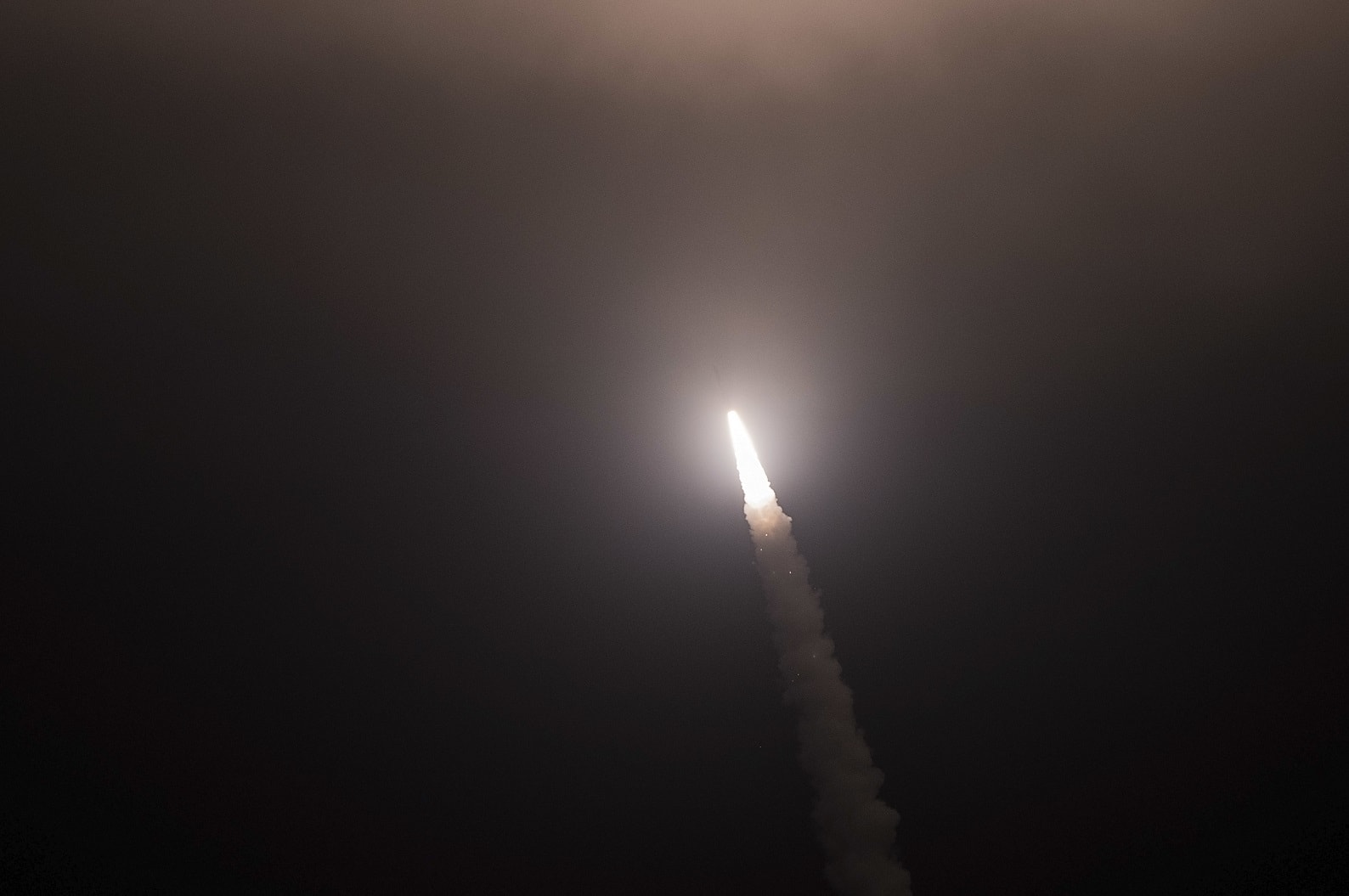
The U.S. Air Force Global Strike Command has announced that for the second time in just over a week, was conducted unarmed Minuteman III intercontinental ballistic missile launches during an operational test.
A team of Air Force Global Strike Command Airmen from the 90th Missile Wing at F.E. Warren Air Force Base, Wyoming, launched an unarmed Minuteman III intercontinental ballistic missile equipped with a test reentry vehicle on May 9, 2019 at 12:40 a.m. Pacific Time from Vandenberg Air Force Base, California.
The test demonstrates the United States’ nuclear deterrent is modern, robust, flexible, ready and appropriately tailored to deter twenty-first century threats and reassure our allies. Test launches are not a response or reaction to world events or regional tensions.
The ICBM’s reentry vehicle, which contained a high-fidelity package used for operational testing, traveled approximately 4,200 miles to the Kwajalein Atoll in the Marshall Islands. These test launches verify the accuracy and reliability of the ICBM weapon system, providing valuable data to ensure a continued safe, secure and effective nuclear deterrent.
“These ICBM professionals always make the difficult look easy! This culminates months of effort that began in the missile fields where they removed this hardware from its alert mission, cataloged every piece and part, and shipped it to California for this test,” said Col. Dave Kelley, 576th Flight Test Squadron commander. “This wouldn’t have happened without the tireless efforts of personnel from the 90th Missile Wing, the 576th Flight Test Squadron, the 30th Space Wing and the Air Force Nuclear Weapons Center.”
F.E. Warren AFB is one of three missile bases with crew members standing alert 24 hours a day, year-round, overseeing the nation’s ICBM alert forces.
“The opportunity for a Task Force to execute multiple launches in a week doesn’t happen very often, and this has been a tremendous experience for our team,” said Maj. Travis Hilliard, 90 MW Task Force Commander. “Ultimately, these launches demonstrate America’s capability to deter our adversaries and assure our allies through a safe, secure and effective ICBM force.”
The ICBM community, including the Department of Defense, the Department of Energy, and U.S. Strategic Command uses data collected from test launches for continuing force development evaluation. The ICBM test launch program demonstrates the operational capability of the Minuteman III and ensures the United States’ ability to maintain a strong, credible nuclear deterrent as a key element of U.S. national security and the security of U.S. allies and partners.
The launch calendars are built three to five years in advance, and planning for each individual launch begins six months to a year prior to launch.
As a prime systems integrator and original equipment manufacturer, Boeing created, tested and deployed every Minuteman ICBM for the U.S. Air Force – over 1,800 Minuteman-series missiles. This, while beating accelerated schedules to deliver an ICBM that has far exceeded its expected lifespan of 10 years. Decades later, Boeing remains integral to keeping the Minuteman III going strong, with an average alert rate of 99.7 percent.\
Boeing announced on its Twitter account that: “We were there to support both tests, just as we’ve supported every Minuteman flight test in the last 58 years.”