

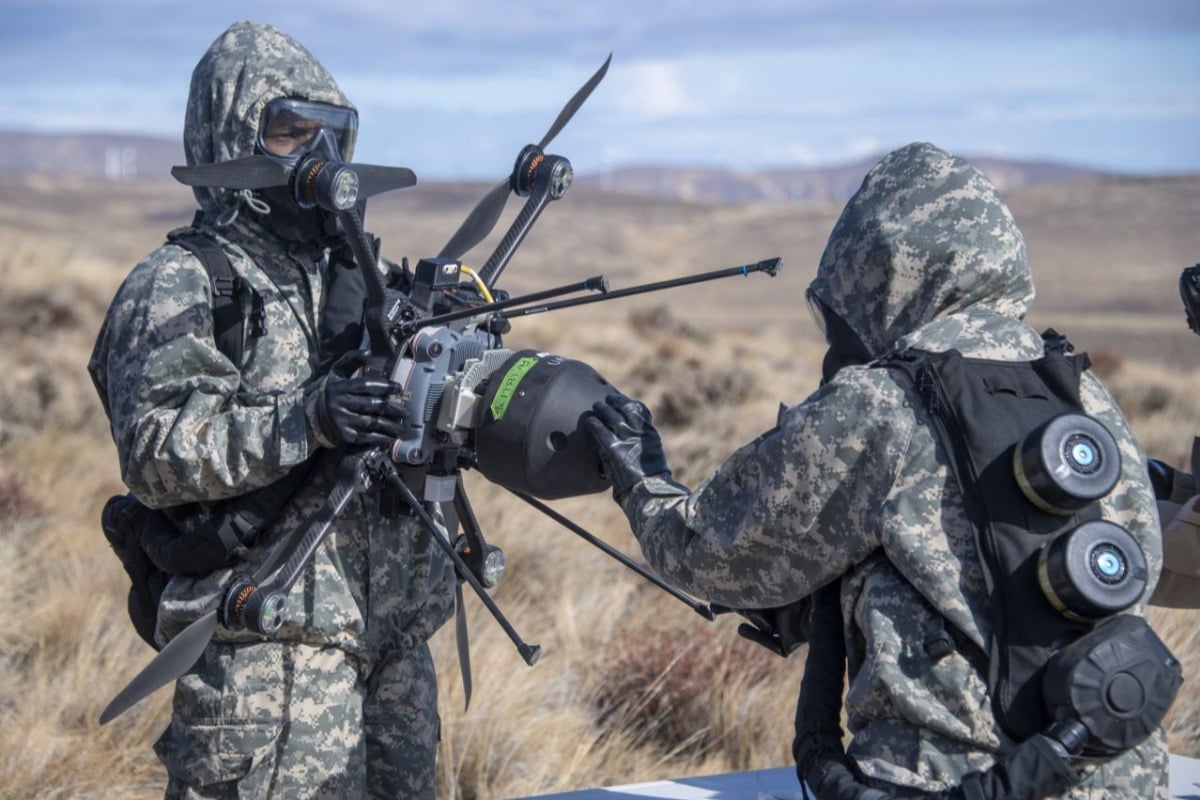
- Teledyne FLIR Defense won an $11.2 million U.S. Army contract on June 4, 2026, to deliver more than 45 R80D SkyRaider-based CBRN sensor drone kits under the CSIRP program.
- The kits integrate chemical, biological, and radiological detection payloads including the MUVE B330 sensor, with deliveries expected to begin in the second quarter of 2026.
The U.S. Army has awarded an $11.2 million contract to Teledyne FLIR Defense to deliver more than 45 drone kits capable of flying into chemical, biological, radiological, and nuclear contamination zones and mapping hazards in real time, keeping soldiers out of environments that can kill within seconds of exposure.
Teledyne Technologies announced the contract award on June 4, 2026, with deliveries expected to begin in the second quarter of 2026. The systems will be built at Teledyne FLIR Defense facilities in Elkridge, Maryland, and West Lafayette, Indiana, with additional engineering work performed in Stillwater, Oklahoma. The contract flows through the Army’s Capability Program Executive for Chemical, Biological, Radiological and Nuclear Defense, and the kits were developed under the Army’s CBRN Sensor Integration on Robotic Platforms program, known as CSIRP, which focuses on rapidly prototyping and fielding modular sensor solutions that integrate advanced sensing, artificial intelligence, machine learning, autonomy, and communications technologies onto unmanned platforms.
At the center of each kit is the Teledyne FLIR R80D SkyRaider, a multi-rotor unmanned aerial system configured specifically for CBRN search and survey operations. The SkyRaider is an established platform in the U.S. military’s inventory, already used for reconnaissance and targeting missions by dismounted infantry units, and the CSIRP-derived configuration adds a suite of modular detection payloads including the Teledyne FLIR MUVE B330 biological sensor alongside chemical and radiological detection packages. Once deployed into a potentially contaminated area, the SkyRaider can autonomously locate and characterize CBRN threats, transmitting real-time hazard data through mapping, targeting, and communications tools that operators access from a safe distance. The semi-autonomous capability means the drone can conduct systematic search patterns and report back without requiring the operator to continuously fly it manually through the hazard zone, a distinction that matters when the area being surveyed may be laced with nerve agents, biological agents, or radioactive contamination.
The operational problem this system addresses is one of the most dangerous reconnaissance tasks any soldier faces. When a chemical or biological weapon has been employed, or when a radiological dispersal device has been detonated, someone has to go find out exactly what was used, where the contamination boundary lies, and how concentrated the hazard is before commanders can make decisions about routes, protective equipment requirements, and medical response. Historically that assessment required soldiers in full mission-oriented protective posture gear, the sealed suits and respirators that provide protection against known chemical agents, to physically enter the contaminated area and take readings. That process exposes personnel to residual hazard even in full protective equipment, creates a significant physical burden that degrades performance over time, and takes considerably longer than an autonomous aerial survey can accomplish. Chemical agents like VX or novichok-class nerve agents can incapacitate or kill within minutes of skin contact at very low concentrations, which means even a brief exposure during a manual survey carries life-threatening risk.
The drone-based approach inverts that risk calculus entirely. The SkyRaider enters the contamination zone while the operator remains outside it, mapping the hazard boundary and concentration gradients in real time without any human exposure. That capability has direct relevance not only to declared chemical and biological weapon employment, but to industrial accident scenarios, improvised radiological threats, and the kind of mixed-hazard environments that are increasingly characteristic of complex urban battlefields where industrial facilities may have been struck or deliberately compromised. The R80D’s payload modularity, the ability to swap different sensor packages depending on the specific threat being investigated, means the platform can be configured for the hazard type suspected rather than carrying every possible sensor on every mission, keeping weight and endurance competitive with the operational requirement.
“Safe-guarding soldiers from weapons of mass destruction is at the core of our mission,” said Dr. JihFen Lei, President of Teledyne Defense and Aerospace Group and Senior Vice President of Teledyne Technologies. “These SkyRaider-based sensor kits dramatically improve how units can detect and map CBRN hazards without exposing warfighters to dangerous environments.”
The contract builds on Teledyne FLIR Defense’s existing role as lead integrator for the Army’s Nuclear Biological Chemical Reconnaissance Vehicle Sensor Suite Upgrade program, a separate effort to modernize the sensing and autonomy capabilities of the Army’s dedicated CBRN reconnaissance vehicles. The NBCRV Sensor Suite Upgrade received a $74.2 million contract award previously, making the $11.2 million CSIRP kit contract a complementary capability that extends CBRN detection to dismounted units operating away from vehicle-mounted systems. Together, the two programs suggest the Army is pursuing a layered approach to CBRN reconnaissance, with vehicle-mounted systems providing deep survey capability and drone kits giving frontline infantry units organic detection capability at the squad and platoon level.