

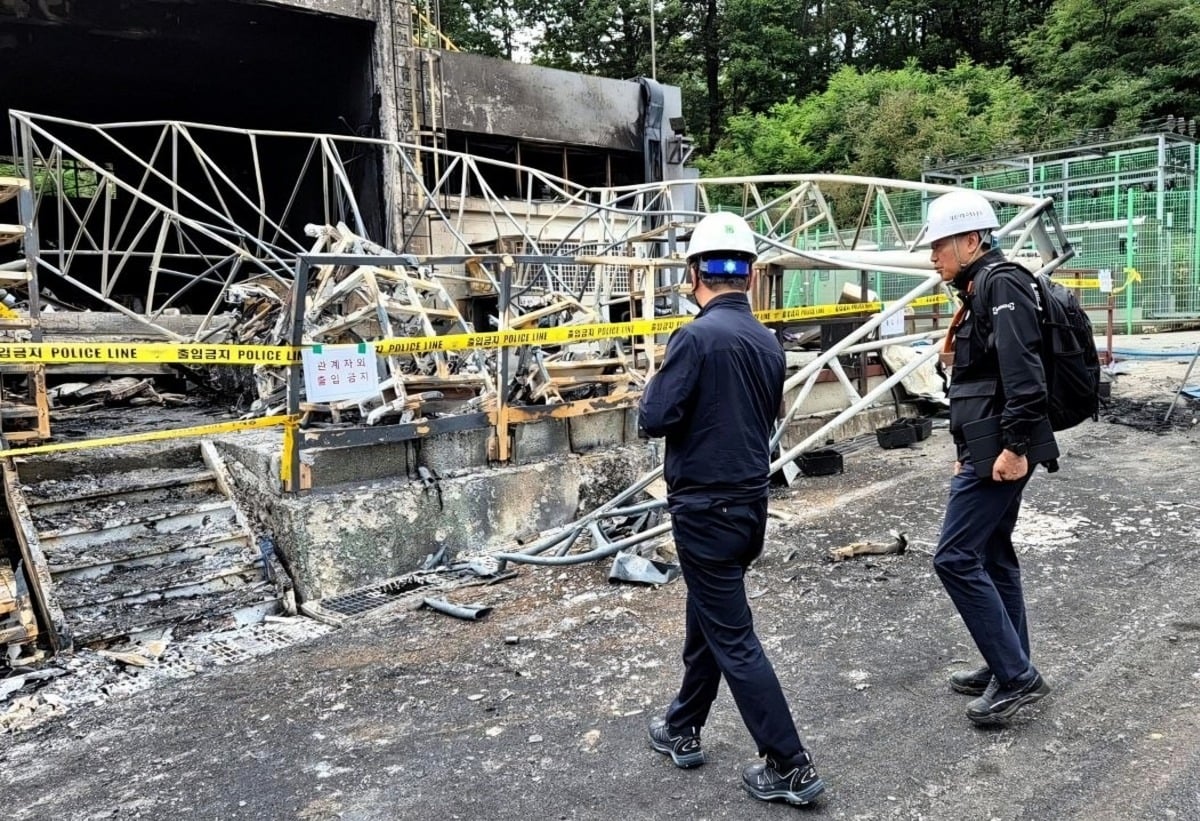
- An explosion at Hanwha Aerospace's Daejeon missile plant on June 1, 2026 killed five workers and injured two others.
- The Daejeon facility produces the Chunmoo rocket system, L-SAM missile and Cheongeom guided missile, and part of its production remains suspended.
A single explosion at one South Korean missile factory has exposed just how fragile the supply chain behind the country’s booming arms export business really is, since many of the components that go into a guided missile can only be built by one qualified company in the entire nation.
The Korea Times reported that the June explosion at Hanwha Aerospace’s missile production facility in Daejeon has raised fresh questions about that resilience, with defense officials and industry sources telling the outlet the accident exposed a long-standing vulnerability just as Korea’s defense exports are growing faster than ever.
The June 1 blast killed five workers and injured two others at the Daejeon facility, which produces the Chunmoo multiple rocket launch system, the long-range L-SAM surface-to-air missile, and the Cheongeom air-to-ground guided missile, three of the systems underpinning Hanwha’s rapid international sales growth. Hanwha Aerospace CEO Son Jae-il told reporters the blast likely occurred during a routine cleaning process meant to remove explosive residue from tools used in rocket propellant production, and South Korea’s Daejeon Regional Employment and Labor Office ordered part of the facility’s production suspended while investigators, including the National Forensic Service and Korea’s labor ministry, work to determine the exact cause. Authorities have not confirmed any impact on export deliveries as a result of the accident, according to The Korea Times.
What makes this single facility so consequential is how South Korea’s missile supply chain is actually structured. Guided missiles require components built by a network of specialized manufacturers responsible for propulsion systems, warheads, fuzes and guidance equipment, and because many of those parts depend on proprietary technology, dedicated production lines and years-long qualification processes, swapping in a replacement supplier isn’t something that can happen quickly, if it can happen at all.
“If one supplier stops production, another company cannot simply step in and make the same component,” an industry source told The Korea Times. “This accident isn’t the real issue. The risk has always been there.”
A Defense Acquisition Program Administration official, speaking to The Korea Times, tied the vulnerability directly to how technically demanding missile manufacturing actually is rather than to any flaw in how Korea awards defense contracts.
“Guided weapons require a high level of technical expertise because even a single defective component can affect the performance of the entire weapons system,” the DAPA official said.
“Given the required technology, production facilities and qualification process, it is difficult for another company to immediately take over production,” the official said.
That single-supplier structure isn’t an accident of bad planning so much as a byproduct of how small Korea’s defense market used to be. The same DAPA official explained that companies naturally specialized in different technical niches over the decades because domestic demand simply wasn’t large enough to support multiple competing suppliers for the same component, leaving Korea with a system built for a much smaller, steadier era of defense production than the one the country finds itself in now.
That era ended abruptly. Industry sources told The Korea Times that Korean defense manufacturers have spent the past several years racing to expand production capacity and build in operational flexibility as export orders have surged well beyond anything the industry originally planned for, a shift one source tied directly to the war in Ukraine.
“Before the Ukraine war, one or two production sites were enough. That’s no longer the case,” the source said.
“Export demand has grown much faster than anyone expected, so companies have continued expanding production capacity,” the source said.
Hanwha Aerospace has spent the past two years signing major export deals for its Chunmoo rocket system with Poland, including local production arrangements with Poland’s WB Group, alongside a February 2026 contract to supply Norway with the same system, and it has separately proposed building an automated, company-owned propellant plant inside the United States capable of producing 1.5 million modules for 155mm artillery charge systems annually, backed by roughly $1 billion in planned investment. Major Korean contractors including Hanwha now operate production lines across multiple sites specifically to build in redundancy, giving them a way to shift manufacturing internally if one facility runs into trouble, though The Korea Times reported that certain highly specialized processes still remain concentrated at individual suppliers and are difficult to duplicate given how technically complex they are.
This isn’t the first time a Hanwha Aerospace accident has actually disrupted deliveries rather than just raising theoretical concerns about them. A 2019 fire at a different Hanwha Aerospace facility forced South Korean labor authorities to suspend operations there for roughly 181 days, a shutdown that delayed deliveries of missile fuzes and explosive charges for artillery shells and prompted DAPA to deduct about 9.87 billion won, roughly $7.1 million, from the company in liquidated damages. Hanwha challenged that penalty in court, arguing the delays stemmed from a government-ordered work stoppage rather than any negligence on the company’s part, and the courts ultimately agreed to return about 20% of the penalty, a decision South Korea’s Supreme Court later upheld. That precedent shows how a single facility going offline, whether from a fire, an explosion, or a government safety order, can ripple straight through to contractual penalties and delivery timelines months or years later, exactly the kind of downstream disruption industry sources now worry could follow this latest accident even without confirmation that it already has.
Hanwha Aerospace said in a statement that it is “closely reviewing all aspects of the situation to ensure timely deliveries and the smooth execution of all projects,” language that acknowledges the stakes without confirming whether any specific export order has actually been delayed. For a country whose defense industry has transformed itself in just a few years from a modest regional supplier into one of the fastest-growing arms exporters in the world, the real test won’t be whether this particular explosion disrupts deliveries, but whether Korea’s manufacturers can build the kind of redundancy into their supply chains that this accident has shown, once again, they still largely lack.