

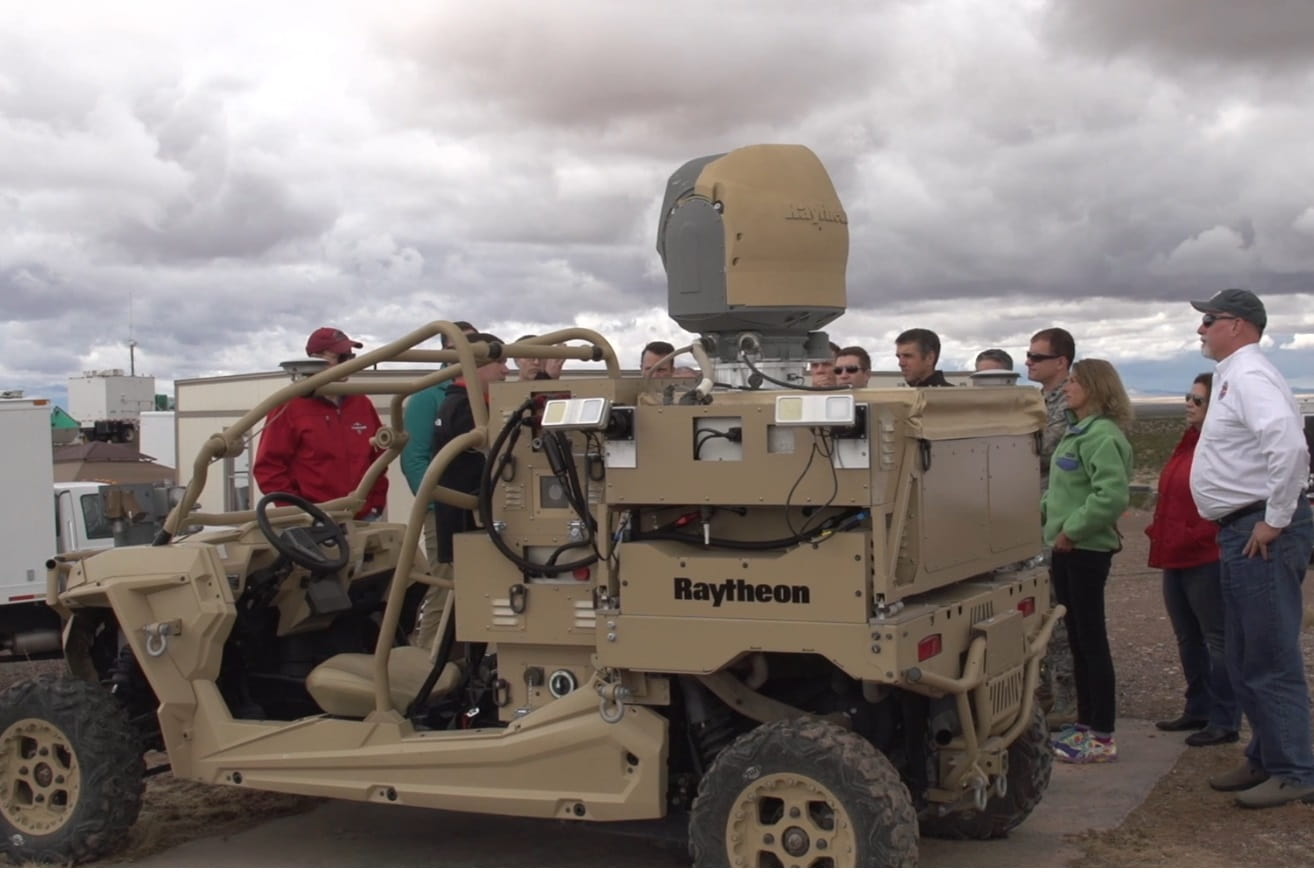
Raytheon releases details of Air Force’s advanced laser system contract

U.S. weapons maker Raytheon Co on Monday has released details of the contract from the U.S. Air Force Research Laboratory to develop and supply two prototypes of High Energy Laser Weapon Systems (HELWS).

The deal worth  $23,8 million and covers the deployment of two prototype High Energy Laser Weapon Systems (HELWS) to troops overseas under a U.S. Air Force contract. The Air Force experimentation includes 12 months of in-field operation against unmanned aerial systems and operator training.

Raytheon’s HELWS uses pure energy to detect, identify and instantly take down drones. It can target a single drone with precision. The HELWS is paired with Raytheon’s Multi-spectral Targeting System. It uses invisible beams of light to defeat hostile UASs. Mounted on a Polaris MRZR all-terrain vehicle, the system detects, identifies, tracks and engages drones.

- ADVERTISEMENT - CONTINUE READING BELOW -

“Every day, there’s another story about a rogue drone incident,” said Stefan Baur, vice president of Raytheon Electronic Warfare Systems. “These threats aren’t going away, and in many instances, shooting them with a high energy laser weapon system is the most effective and safest way to bring them down.”

The contract follows successful demonstrations of Raytheon’s directed energy systems for the Air Force and the U.S. Army.

The new laser system would receive a signal from a separate sensor scanning the environment, and then acquire and positively identify the target. A human operator would be responsible for verifying the information provided by the sensor system and then ultimately firing the laser.

Readers who wish to follow our weekly coverage can subscribe to the Weekly Defense Roundup.

If you wish to report a grammatical or factual error in this article, please let us know by using the online form.

Executive Editor
  • In this story
  • USA

Support The Defence Blog

Independent reporting takes resources. Join us on Patreon.

Become a patron

More Like This

U.S. Army Reserve tests Pyka’s autonomous cargo aircraft in live exercise

Pyka's autonomous cargo aircraft DropShip flew a 32 km (20-mile) resupply mission entirely without a human pilot from Gulfport to Diamondhead, Mississippi, then executed...

Mayman Aerospace CEO: autonomous drones must replace helicopters in contested battlespace

At 3 a.m. in a contested forward operating base, a patrol thirty kilometres out is taking casualties. They need blood, plasma, and ammunition, not...

U.S. Army buys more of its toughest Arctic combat vehicle

The U.S. Army awarded BAE Systems Land and Armaments a $35 million contract modification on June 30, 2026, for additional production of the general-purpose...

AEVEX wins $50M deal for GPS-resistant strike drones

AEVEX Corp. secured a $50 million contract from the United States Air Force on June 30, 2026, to continue expanding unmanned mission-support capabilities for...

U.S. Air Force spends $471M to fix tanker parts supply problem

The U.S. Air Force awarded a combined $471 million in contracts to 28 different companies on a single day, spreading the work of exchanging...

U.S. Marines deploy Iron Dome-based missile system to Guam

U.S. Marines from III Marine Expeditionary Force were photographed calibrating and evaluating the Medium-Range Intercept Capability system on Mason Range, Guam, on June 24,...