


Poland’s defense industry has taken a bold step into the future of land warfare with the development of GNOM, an innovative wheeled loitering munition designed to deliver precision strikes against armored targets.
Developed by MACRO-SYSTEM and tested during the recent “Iron Gate 25” exercise with the 18th Mechanized Division, GNOM is emerging as one of Europe’s most promising ground-launched robotic strike systems — a potential game-changer in stopping advancing armored vehicle columns before they reach the frontline.
In an interview with Defence Blog, Mateusz Ciepliński, President of the Management Board of MACRO-SYSTEM, said the system’s performance during the drills validated its role as a precision weapon capable of operating in the most challenging conditions.
“During the Iron Gate 25 exercise, both MACRO-SYSTEM unmanned land platforms performed a number of tasks specified in the exercise scenario,” Ciepliński said. “The main phase was preceded by a week-long training course for military operators, conducted in difficult conditions in mountainous terrain. This enabled an effective transition to the implementation of tasks at the training ground in Orzysz.”
Unlike conventional loitering munitions that rely on aerial deployment, GNOM operates as a small, wheeled ground-based system, able to navigate terrain close to the surface and deliver its payload with speed and precision. Its low profile, stealth characteristics, and compact size make it an ideal tool for ambush operations against armored vehicles, command posts, and critical infrastructure.

“GNOM is an overall unique design. It combines speed, manouverability and powerful warheads in a very small vehicle,” Ciepliński explained. “This makes it a perfect tool for ambush or surprise attacks on high value targets, as well as support role for ground troops.”
During the Iron Gate 25 exercise, GNOM conducted reconnaissance, kinetic strikes, and command post raids, including the use of fiber-optic guidance for precision control in contested environments. It simulated the destruction of armored vehicles, including a Rosomak and a Ford Ranger, and executed diversionary missions beneath stationary targets — illustrating its capacity to penetrate enemy formations undetected and strike at their most vulnerable points.
What sets GNOM apart is its ground-hugging profile and tactical intent: it is built specifically to counter one of the most serious threats on the modern battlefield — large, fast-moving armored assaults. Traditional anti-tank weapons often require close-range deployment or expensive aerial platforms. GNOM, however, offers a low-cost, reusable, and highly mobile solution that can operate autonomously or under direct control, providing persistent battlefield presence.
Its stealth approach and small radar signature make it exceptionally hard to detect, while its warhead — optimized for anti-armor strikes — is designed to disable or destroy tanks and armored personnel carriers before they breach defensive lines.
This capability transforms GNOM into more than just a support asset: it becomes a force multiplier for mechanized and infantry units, enabling them to shape the battlefield and disrupt enemy momentum long before direct contact occurs.
Electronic warfare remains one of the primary challenges for any unmanned system, but GNOM was engineered to operate effectively even in contested electromagnetic environments.
“The vehicle operates at a very low level above ground, which makes jamming mostly ineffective,” Ciepliński said. “For contested environment the platform operates using fiberoptic cable with up to 5 km range. That capability has also been used during the exercise.”
This dual-mode control — remote link or fiber-optic tether — provides operators with secure command options and ensures that GNOM remains operational even against advanced electronic countermeasures.

The recent Iron Gate 25 drills placed GNOM in a series of complex operational scenarios, many of which replicated conditions expected in real conflicts. Its missions included:
- Precision strikes on armored targets simulating tank and vehicle destruction.
- Command post raids using fiber-optic control for silent approach.
- Diversionary operations under enemy vehicles.
- Reconnaissance and observation missions to support advancing units.
These scenarios demonstrated GNOM’s flexibility and its integration potential with conventional forces. It was not only effective in direct strike roles but also proved valuable as a surveillance and early-warning asset, capable of tracking enemy movements before launching coordinated attacks.
As warfare evolves, the ability to counter armored breakthroughs with precision and agility is becoming a strategic necessity. Systems like GNOM represent a shift in how militaries might address large-scale armored threats — not through sheer firepower alone, but through distributed, stealthy, and precise loitering weapons that can operate independently or in swarms.
“We are continously getting more and more interest from foreign customers,” Ciepliński confirmed. “We are present in Denmark targeting Scandinavian markets, as well as already performed demonstrations in France, the Baltics and couple of other European countries. Recent MSPO fairs in Kielce brought us heavy interest from Asian customers, with proposals of establishing local production.”
With offers to localize production and increasing inquiries from Asia and Europe, GNOM’s potential market could expand rapidly. Its simplicity, versatility, and battlefield relevance make it a compelling option for countries seeking affordable counter-armor capabilities.
While GNOM captured attention as a precision anti-armor weapon, it was not the only unmanned system MACRO-SYSTEM fielded during Iron Gate 25. The company also deployed GOBLIN, a larger, multipurpose unmanned ground vehicle designed for reconnaissance, logistics, and support roles.
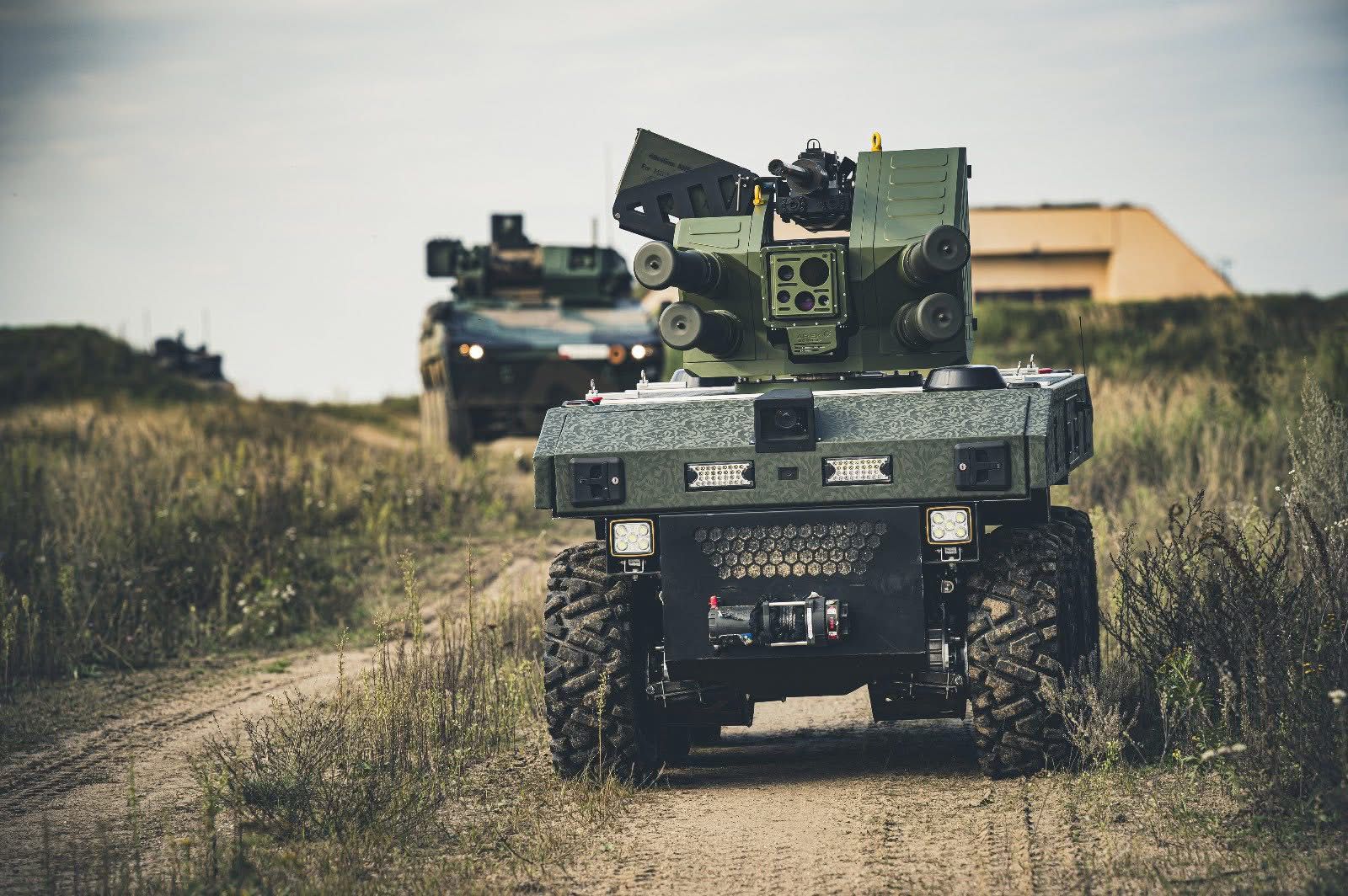
GOBLIN’s tasks during the exercise included manned-unmanned teaming with Rosomak armored personnel carriers, route reconnaissance, medical evacuation, and towing vehicles and trailers up to 16 tons. It also conducted imaging reconnaissance, casualty evacuation during MASCAL drills, and provided combat security during counterattack scenarios.
Capable of operating continuously for around 20 hours on a single battery charge, GOBLIN demonstrated high mobility, adaptability, and logistical value. Its ability to integrate with crewed platforms and carry out a wide range of missions underscores MACRO-SYSTEM’s broader approach: combining specialized strike systems like GNOM with multi-role robotic support platforms to create a layered unmanned capability on the battlefield.
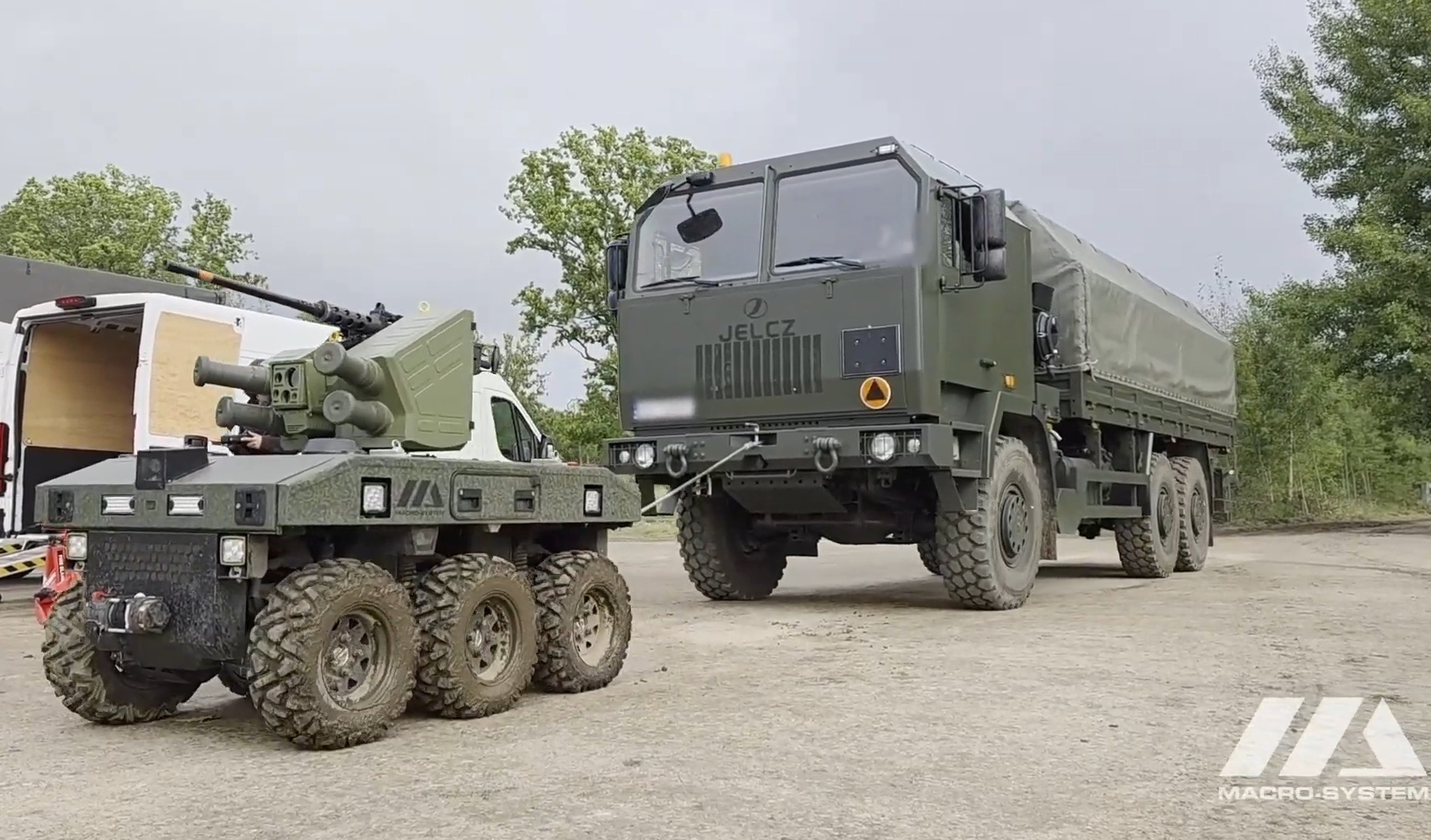
The field performance of GNOM and GOBLIN during “Iron Gate 25” illustrates how unmanned systems are reshaping land warfare. GNOM’s stealth, precision, and anti-armor capabilities offer ground forces a powerful new tool to disrupt enemy offensives before they reach critical positions. Combined with GOBLIN’s logistical and reconnaissance support, these platforms demonstrate how robotics can expand the reach, speed, and survivability of mechanized units.
As militaries confront the prospect of future conflicts involving massive armored thrusts and dense electronic interference, systems like GNOM point toward a new doctrine — one where small, smart, autonomous munitions can halt tank columns and redefine how wars on land are fought.