

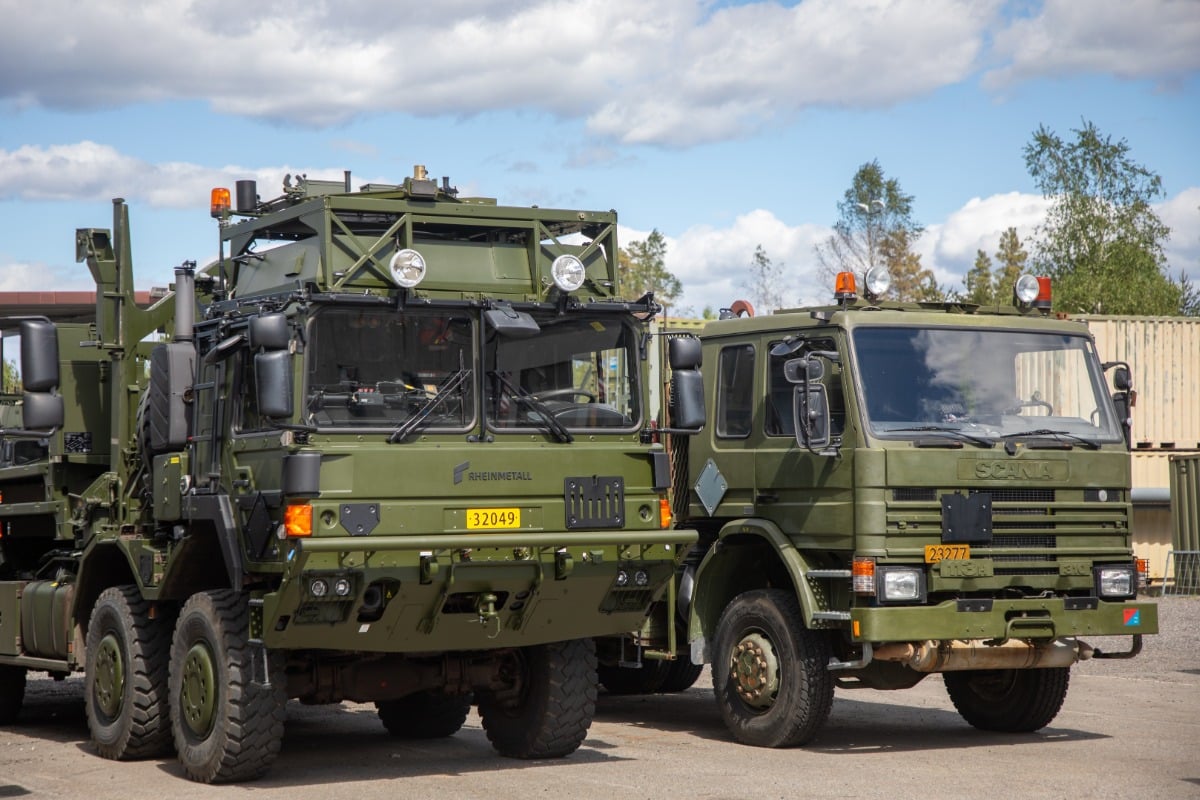
- Norway's Army completed delivery of 113 Rheinmetall MAN HX armored logistics trucks, with the final 25 vehicles recently driven north to Brigade North by Combat Train Battalion personnel.
- The new trucks replace Scania vehicles from the mid-1980s and were procured through a joint Norwegian-Swedish project, with additional unarmored variants planned for future delivery.
Norway’s Army has completed delivery of its final batch of new armored trucks from German manufacturer Rheinmetall MAN Military Vehicles, bringing the service’s total fleet of the new vehicles to 113 and drawing the curtain on a decades-long reliance on Cold War-era Scania logistics trucks.
The Norwegian Army announced the arrival of the last 25 vehicles in the delivery program, which have been stored at Sessvollmoen before being driven north by personnel from the Combat Train Battalion in Brigade North. The acquisition brings the total fleet of Rheinmetall MAN HX-series armored logistics trucks to 113 vehicles in varying configurations, with additional unarmored truck variants also planned for future delivery. The program has been structured as a joint Norwegian-Swedish procurement project, leveraging combined purchasing to reduce unit costs and standardize logistics support across two closely aligned Nordic militaries.
The trucks being replaced are Scania vehicles dating from the mid-1980s, meaning Norway’s Army has been operating logistics trucks for roughly four decades, an age at which maintenance costs typically escalate sharply, spare parts availability narrows, and the vehicles’ survivability characteristics fall far short of what modern operational environments demand. Logistics vehicles have historically received less attention in defense modernization debates than combat platforms, but their operational significance is considerable. An army that cannot move ammunition, fuel, food, and medical supplies to forward positions cannot sustain combat operations regardless of how capable its fighting vehicles are. The vulnerability of logistics convoys has been one of the defining lessons of the war in Ukraine, where Russian and Ukrainian forces alike have suffered significant losses in supply vehicles to drone strikes, artillery, and mines on routes that were previously considered relatively permissive.
The Rheinmetall MAN HX family, built by the RMMV joint venture between Rheinmetall and MAN Truck and Bus, is one of the most widely deployed military logistics vehicle platforms in European NATO forces. The platform is in service with Germany, Australia, New Zealand, Denmark, and multiple other nations, and its cross-country performance and protection levels represent a substantial generational advance over commercial truck derivatives that formed the backbone of many NATO logistics fleets through the 1990s and 2000s. The HX series features all-wheel drive, high ground clearance, and a central tire inflation system that allows the driver to adjust tire pressure while moving to optimize traction across different terrain types, from paved roads to soft ground to snow-covered terrain in the Arctic conditions that Norway’s Brigade North regularly operates in.
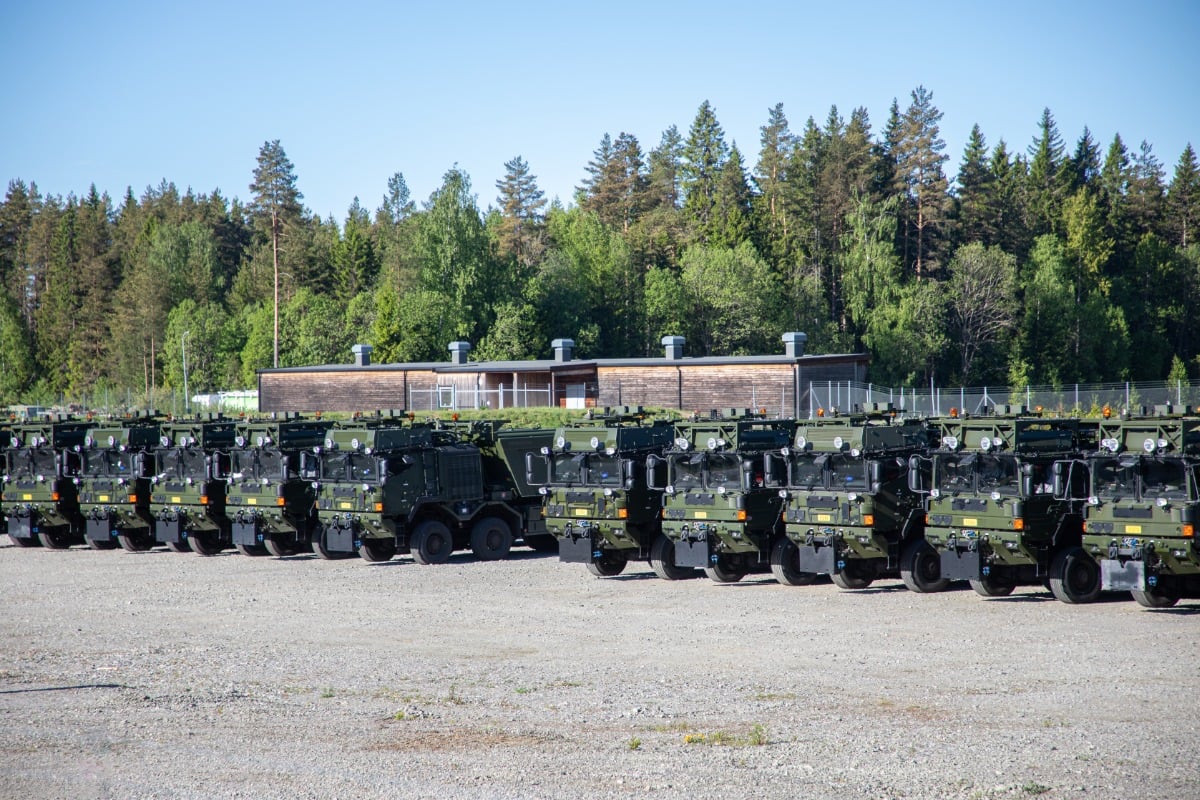
The armor protection incorporated into the vehicles addresses a threat that barely featured in logistics planning when Norway’s outgoing Scania trucks were procured. Mine-resistant and ambush-protected vehicle design, which became a major focus of Western military procurement during the conflicts in Iraq and Afghanistan, prioritizes blast deflection from improvised explosive devices and mines through V-shaped hull geometry, reinforced cab structures, and energy-absorbing seating. Operations Officer Åge Gjengedal Sætre of the Combat Train Battalion highlighted this dimension directly. “They are well armored and have better protection against explosives in the roadway,” Sætre said, underscoring that the primary operational significance of the new vehicles is not simply their cargo capacity or mobility but the survivability of the drivers and crew operating them in contested environments. “And in the terrain, this is a major upgrade,” he added.
Norwegian Army Chief Major General Lars Lervik placed the delivery in the context of overall force modernization. “This is a good day for both the Army and the Defense Forces. We are very pleased with this renewal, and these vehicles are better adapted and will give us a few more tools in the toolbox,” Lervik said.
The completion of the HX truck deliveries is one component of a broader Norwegian defense investment surge that has accelerated since Russia’s full-scale invasion of Ukraine in 2022. Norway has committed to significant increases in defense spending as a percentage of GDP, with particular emphasis on ground force readiness and Arctic defense infrastructure. The joint procurement structure with Sweden, formalized before Sweden’s NATO accession in 2024, reflects the growing practical integration of Nordic defense planning, where shared platforms and interoperable logistics reduce the complexity of coalition operations on NATO’s northern flank.