

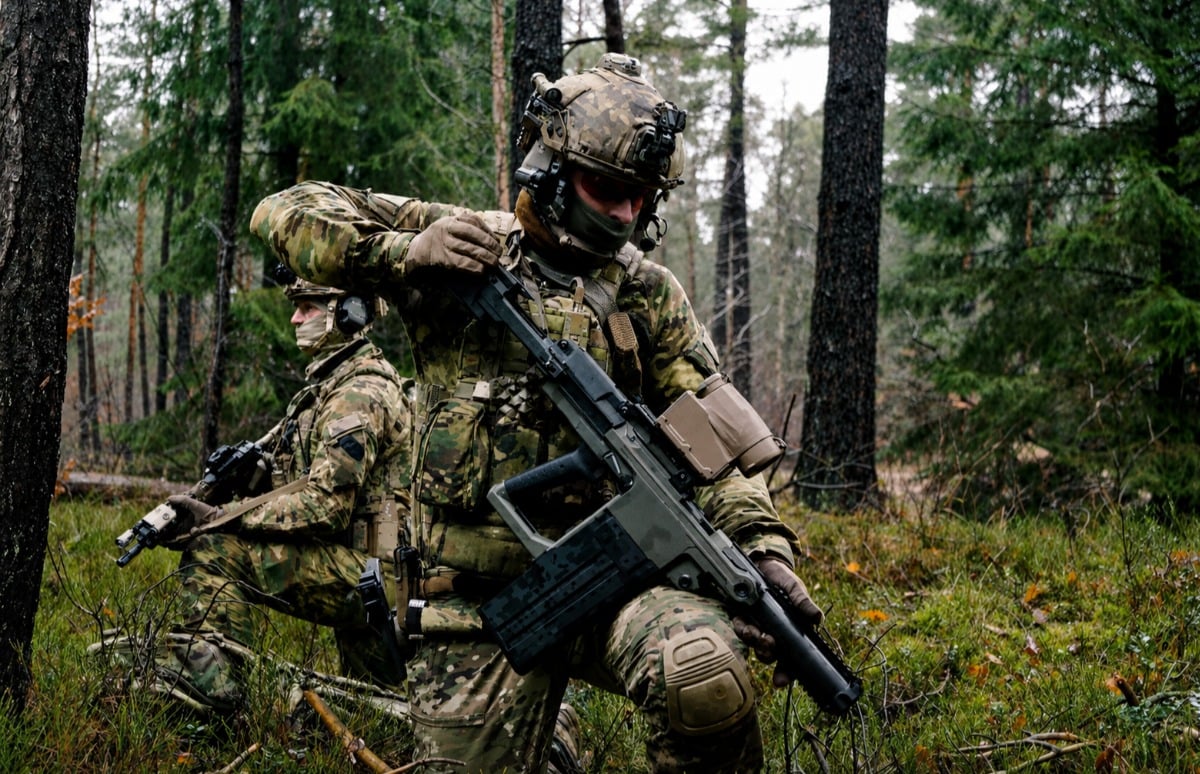
- American Rheinmetall Munitions released a new video showcasing its HAMMR 40mm rifle for the U.S. Army's Precision Grenadier System program.
- HAMMR is built on Rheinmetall's SSW40 platform and pairs a new 40mm medium-velocity cartridge with the Aimpoint FCS15 fire control system.
A single soldier could soon carry a weapon capable of dropping an air-bursting grenade precisely over an enemy hiding behind a wall, then swinging the same weapon skyward to knock a small attack drone out of the air, and American Rheinmetall Munitions just released a new video showing off the rifle it’s betting will do exactly that for the U.S. Army.
The weapon, called HAMMR, short for Highly-Advanced Multi-Mission Rifle, is American Rheinmetall’s entry in the Army’s Precision Grenadier System program, an effort the service launched to close a dangerous gap that has existed at the infantry squad level for years: soldiers pinned down by an enemy fighter hidden behind cover, a barrier, or inside a building have had few good ways to hit that target without exposing themselves to return fire. Traditional grenade launchers like the M203 and M320 that soldiers currently carry lack the range and precision to reliably solve that problem, and the Army has spent years searching for a replacement after a similar earlier effort, a 25mm launcher nicknamed the Punisher, was canceled in 2018 after failing to deliver what troops needed.
HAMMR is built on Rheinmetall’s existing SSW40 platform, a 40mm shoulder-fired weapon the company has been refining for several years, and the company designed the rifle to work as one integrated system rather than bolting together parts that were developed separately and hoping they would work well together. That integrated approach extends to the ammunition itself, since Rheinmetall developed a new 40mm medium-velocity cartridge alongside the rifle and paired both with the Aimpoint FCS15 fire control system, a targeting computer that lets a soldier engage targets at much longer range than older 40mm weapons typically allow.
The medium-velocity round flies a flatter trajectory and reaches its target faster than the low-velocity 40mm grenades currently in the Army’s inventory, which translates directly into a soldier’s ability to hit a target on the first shot rather than needing multiple attempts to walk rounds onto a distant or moving target.
What began as a weapon meant to solve the counter-defilade problem, engaging enemies who take cover behind walls, ridgelines, or other barriers that block a direct line of fire, has grown into a system the Army also wants capable of knocking small drones out of the sky, a threat that has become impossible to ignore as cheap quadcopters and fixed-wing drones have reshaped battlefields from Ukraine to the Middle East over the past several years. Rheinmetall’s design responds to that dual requirement by staying compatible with every 40mm low-velocity round already qualified in the Army’s inventory, which means units fielding HAMMR would not need to replace their existing stockpile of ammunition, only supplement it with the new medium-velocity round when a mission calls for extended range or drone engagement.
American Rheinmetall is not the only company chasing this contract, and the competition has narrowed considerably since the Army first opened the door to new concepts. Barrett Firearms has pushed a competing design called MARS, built around 30mm ammunition rather than Rheinmetall’s 40mm approach, while FN America has continued developing its own contender, a launcher now called the MTL-30 that also fires 30mm rounds and recently secured a two million dollar Army contract for continued risk-reduction work. That split between the 30mm and 40mm camps reflects a genuine engineering tradeoff the Army will eventually have to settle: smaller-caliber rounds generally mean a lighter weapon and more ammunition a soldier can carry, while Rheinmetall’s larger 40mm approach leans on decades of established logistics and a far bigger existing stockpile of compatible ammunition already sitting in Army depots worldwide.