

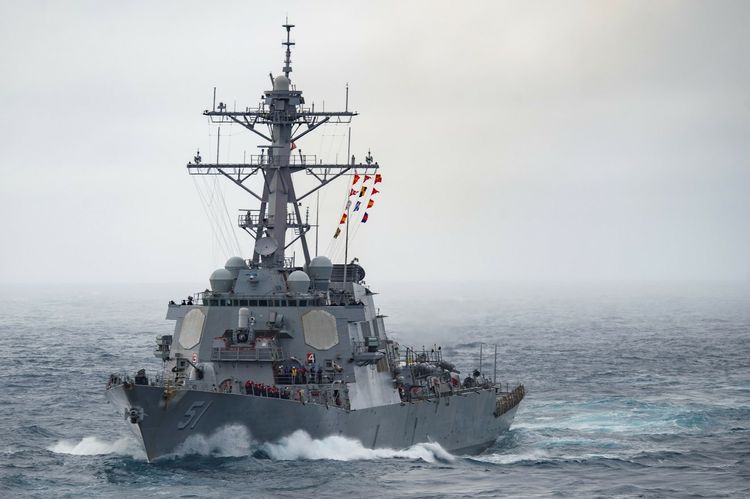
Northrop Grumman will begin production WSN-12 Inertial Navigator for most U.S. combatant vessels

Northrop Grumman has announced on 5 September that the company successfully completed the Critical Design Review (CDR) phase of the U.S. Navy’s WSN-12 Inertial Sensor Module and will begin production of ten pre-production units.

The WSN-12 is poised to become the primary shipboard inertial navigation system for most U.S. combatant vessels and will be installed on all vessels of the DDG, CG, CVN and SSN classes. The system brings new technology and improved accuracy to these platforms.

The Inertial Sensor Module is a primary subsystem of the WSN-12, and includes the inertial sensors, electromechanical equipment supporting them and software to compute the navigation solution. The shipboard inertial navigation system measures, computes and distributes navigation data to all users, including attitude, velocity and position information.

- ADVERTISEMENT - CONTINUE READING BELOW -

“Northrop Grumman has met or exceeded objectives in all aspects of the sensor design and was able to demonstrate performance in the testing of the engineering development models,” said Captain Jon Garcia, NAVSEA IWS6.0.“We are looking forward to successful integration testing this year and receiving the sensor pre-production units next year.”

“Completion of this CDR keeps this program on track to deliver exceptional navigation accuracy to the fleet,” said Todd Leavitt, vice president, maritime systems, Northrop Grumman. “The WSN-12 Inertial Sensor Module provides technology that enables improvements to navigation accuracy and reliability, benefiting all systems that depend upon it.”

Readers who wish to follow our weekly coverage can subscribe to the Weekly Defense Roundup.

If you wish to report a grammatical or factual error in this article, please let us know by using the online form.

Executive Editor
  • In this story
  • USA

Support The Defence Blog

Independent reporting takes resources. Join us on Patreon.

Become a patron

More Like This

U.S. Army Reserve tests Pyka’s autonomous cargo aircraft in live exercise

Pyka's autonomous cargo aircraft DropShip flew a 32 km (20-mile) resupply mission entirely without a human pilot from Gulfport to Diamondhead, Mississippi, then executed...

Mayman Aerospace CEO: autonomous drones must replace helicopters in contested battlespace

At 3 a.m. in a contested forward operating base, a patrol thirty kilometres out is taking casualties. They need blood, plasma, and ammunition, not...

U.S. Army buys more of its toughest Arctic combat vehicle

The U.S. Army awarded BAE Systems Land and Armaments a $35 million contract modification on June 30, 2026, for additional production of the general-purpose...

AEVEX wins $50M deal for GPS-resistant strike drones

AEVEX Corp. secured a $50 million contract from the United States Air Force on June 30, 2026, to continue expanding unmanned mission-support capabilities for...

U.S. Air Force spends $471M to fix tanker parts supply problem

The U.S. Air Force awarded a combined $471 million in contracts to 28 different companies on a single day, spreading the work of exchanging...