

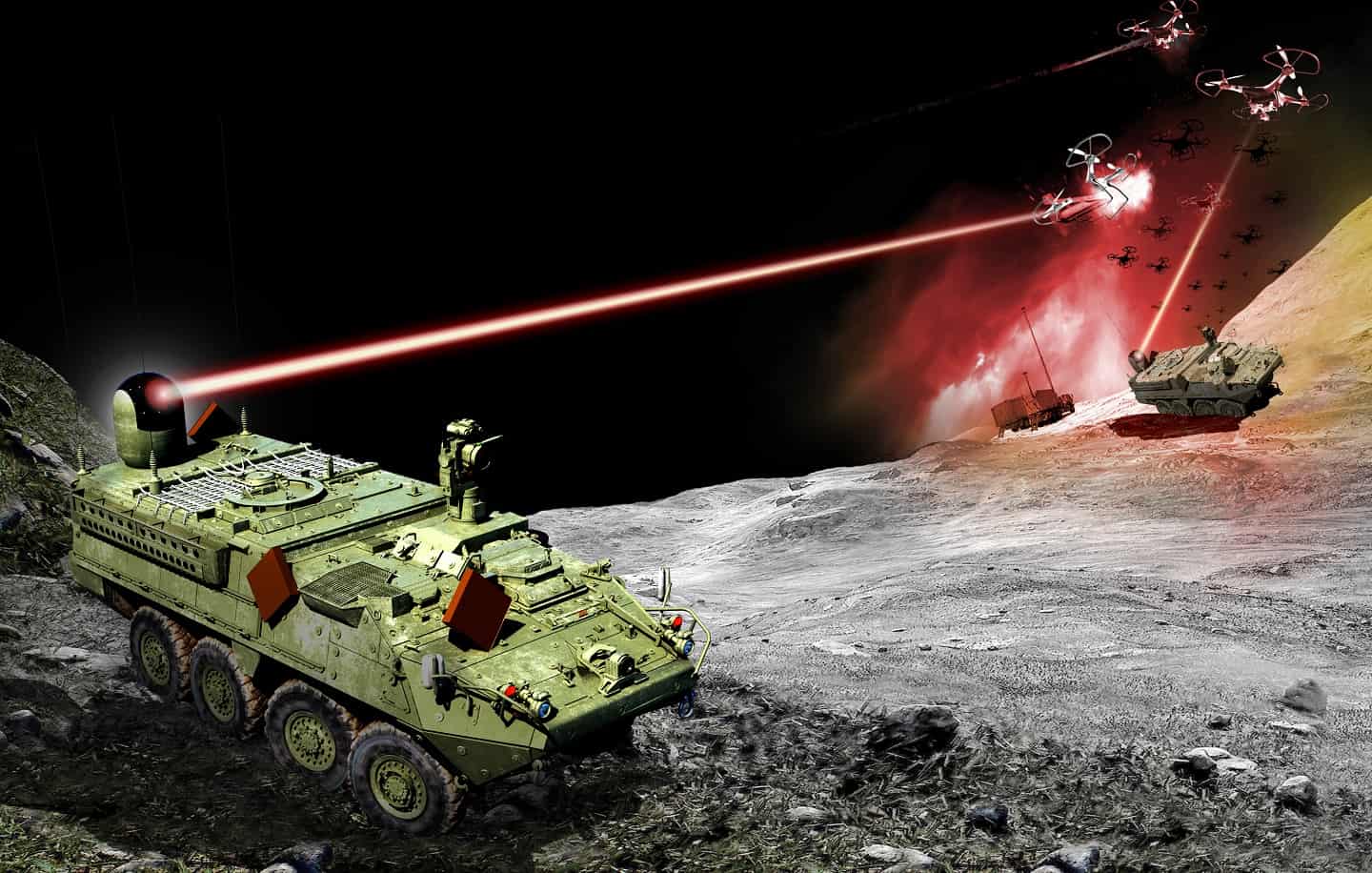
U.S. weapons maker Northrop Grumman Corp has revealed some details of U.S. Army Stryker vehicle high energy laser initiative.
The U.S. Army is planning to receive a modern air defense system designed to protect against a variety of threats, such as small drones, helicopters, and missiles. The initiative includes integrating a directed energy weapon system on a Stryker vehicle as a pathfinding effort toward the U.S. Army M-SHORAD objective to provide more comprehensive protection of frontline combat units.
“Northrop Grumman is eager to leverage its portfolio of innovative, proven technologies and integration expertise to accelerate delivery of next-generation protection to our maneuver forces,” said Dan Verwiel, vice president and general manager, missile defense and protective systems, Northrop Grumman. “Our flexible, open systems approach offers an end-to-end solution for the Army’s growing and ever-changing mission requirements in today’s complex threat environment.”
Under the initiative from the Rapid Capabilities and Critical Technologies Office and a contract from Kord Technologies, Northrop Grumman will build and integrate a suite of advanced sensors; target acquisition and tracking; a 50-kilowatt class laser system; and battle-tested command-and-control on an Army Stryker combat vehicle. The effort will culminate in a competitive performance checkout leading into a range demonstration that informs M-SHORAD requirements.
The directed energy M-SHORAD prototypes are part of the progression of an Army technology maturation initiative known as the Multi-Mission High Energy Laser (MMHEL).
The integrated platform allows early involvement with warfighter users to develop tactics, techniques, procedures and concepts of operations for future high energy laser weapons.
The Army’s future M-SHORAD protection for forward-deployed soldiers includes laser weapon systems as an effective complement to kinetic capabilities in countering rockets, artillery and mortars; unmanned aircraft systems; and other aerial threats.
The M-SHORAD directed energy prototyping initiative is managed by the U.S. Army Rapid Capabilities and Critical Technologies Office, Redstone Arsenal, Alabama.