

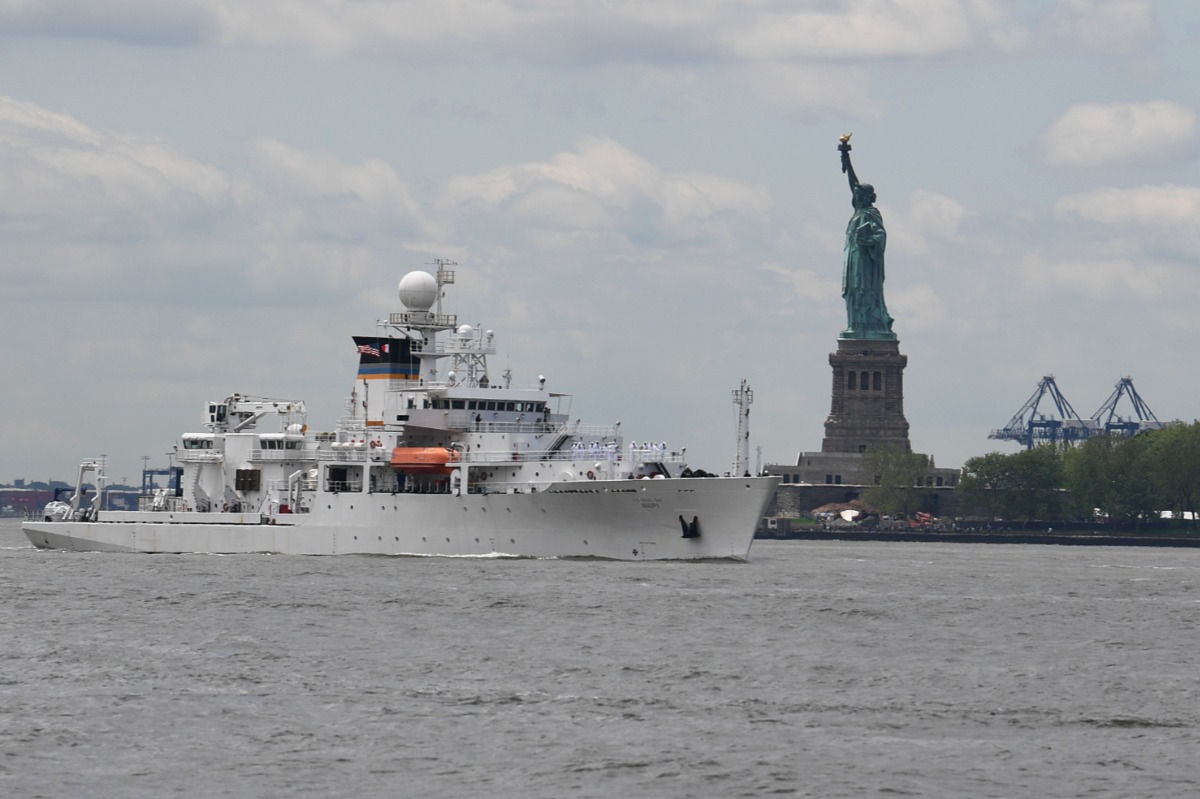
- The U.S. Navy awarded Ocean Ships, Inc. a $1.11 billion contract to operate seven T-AGS oceanographic survey ships through 2032.
- Military Sealift Command issued the contract as a small business set-aside, receiving three competitive proposals via the Government Point of Entry.
The U.S. Navy awarded a contract worth over $1.1 billion on April 27, 2026, to keep seven of its oceanographic survey ships running — vessels that quietly underpin everything from submarine navigation to undersea mapping in waters spanning the globe.
Ocean Ships, Inc., a Houston-based company, landed the contract (N3220526C1224) valued at $1,114,495,567. The deal covers operation and maintenance of seven government-owned Oceanographic Survey vessels — designated T-AGS — over a potential span of five and a half years, running from delivery of the vessels in 2026 through 2032, if all option periods are exercised.
T-AGS ships are workhorses most Americans never hear about. They gather the oceanographic and hydrographic data the Navy depends on: water temperature gradients, salinity profiles, seafloor topography, and acoustic data that shapes how the fleet plans submarine operations and manages undersea warfare. Their work feeds into charts, models, and intelligence products that inform naval planning decades into the future. Seven of them, operated continuously, represent a significant slice of the Navy’s environmental intelligence-gathering capability.
The contract is structured with a 12-month base period and four additional 12-month option periods, plus one final six-month option under Federal Acquisition Regulation 52.217-8 — a standard extension clause that gives the government flexibility to bridge contract gaps if follow-on procurement runs long. Immediate funding comes from working capital funds, with $22,383,823 obligated for fiscal 2026 alone, money that will not expire when the fiscal year closes.
What makes this award notable beyond its size is how it was won. Military Sealift Command — the Norfolk, Virginia-based command that operates the Navy’s civilian-crewed auxiliary fleet — ran the competition as a total small business set-aside. That designation bars large defense contractors from competing, reserving the opportunity for smaller firms. Three proposals came in. Ocean Ships, Inc. won.
Government ship operation and maintenance contracts of this scale — north of a billion dollars — don’t typically fall to small businesses. That Ocean Ships qualified and competed successfully suggests a company with real operational depth, not a beltway newcomer. The contract was solicited through the Government Point of Entry website, the federal procurement portal, making it accessible to any eligible small business willing to take on a fleet-wide vessel operations requirement at this scope.
Military Sealift Command, which oversees the ships, operates one of the more unusual corners of the American military enterprise. Its vessels are crewed primarily by civilian mariners rather than uniformed sailors — a model that lowers operating costs while maintaining a cadre of trained mariners available for national defense. The T-AGS fleet fits neatly into that model: technical, slow-paced relative to combatants, and dependent on persistent scientific rigor rather than combat readiness.
The seven T-AGS ships will operate on a worldwide basis under the contract, meaning Ocean Ships, Inc. will be responsible for maintaining operational readiness of vessels that could be deployed anywhere the Navy needs oceanographic data — the Pacific, the Arctic, the Indian Ocean, or wherever shifting strategic priorities send them. For a small business, that’s a formidable logistical commitment. For the Navy, it’s a cost-effective way to maintain a capability it cannot afford to let degrade.