

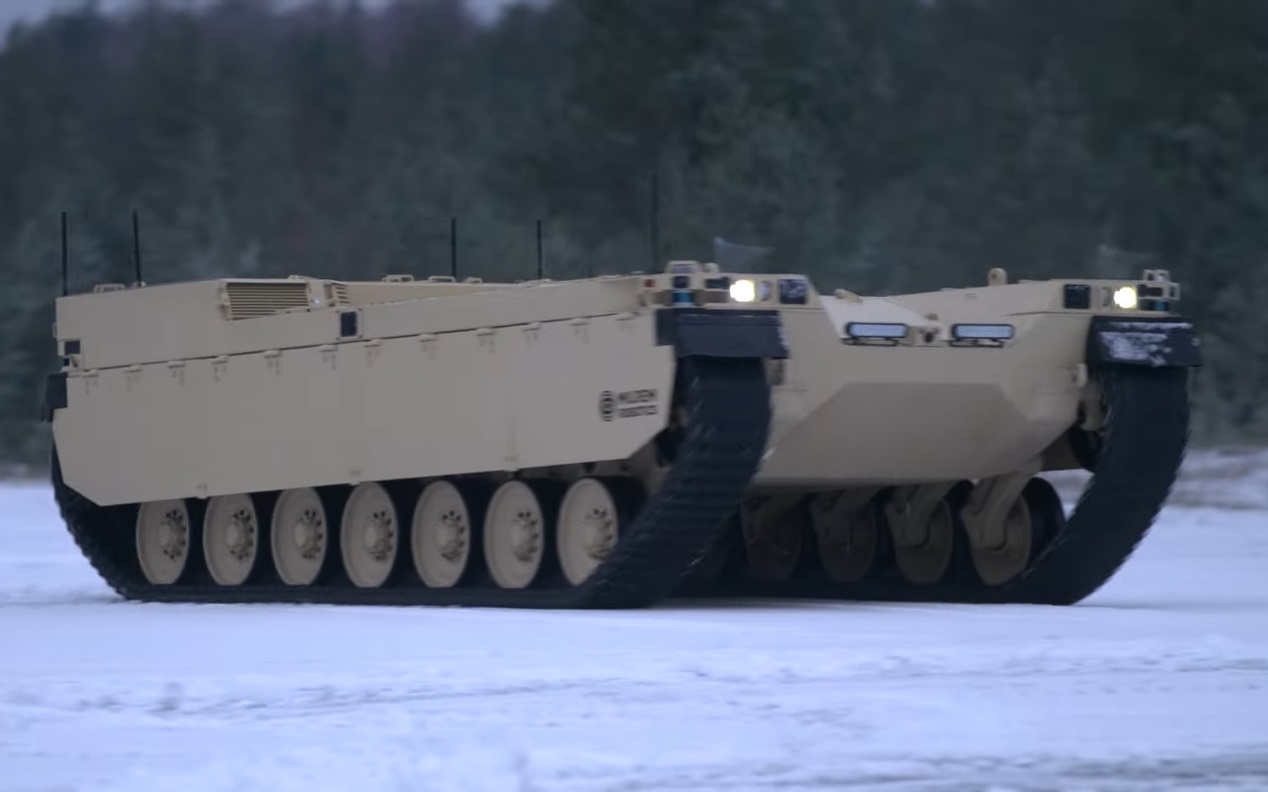
Milrem Robotics, the Estonian-based company known for its THeMIS unmanned ground vehicles, has unveiled new video footage of its new medium-class Type-X Robotic Combat Vehicle.
The short clip released Wednesday showed initial mobility tests of Type-X RCV that designed to support mechanized units.
According to a company news release, the Type-X will become an intelligent wingman to main battle tanks and infantry fighting vehicles capable of taking on the most dangerous tasks and positions, which result in lower lethality risk.
“The Type-X will provide equal or overmatching firepower and tactical usage to a unit equipped with Infantry Fighting vehicles. It provides means to breach enemy defensive positions with minimal risk for own troops and replacing a lost RCV is purely a logistical nuance,” said Kuldar Väärsi, CEO of Milrem Robotics.
The Type-X can be fitted with a cannon up to 50 mm. With up to a 30 mm cannon the RCV is also airdroppable – the C-130J and the KC-390 can carry one Type-X, an A400M two and a C-17 5 of them.
“The vehicle will be equipped with intelligent functions such as follow-me, waypoint navigation, and obstacle detection with Artificial Intelligence being part of the algorithms,” Väärsi said. “Also, Milrem Robotics’ software developers have taken a totally new and innovative approach to allow remote controlled operations on higher speeds.”
The low weight of 12 tons of the Type-X and high power with efficient power management provide a superior terrain capability and its low height of 2.2 m and a rear engine provide low visual and heat signature.
In addition, the Type-X is approximately three to four times lighter and its cost significantly lower than that of a conventional IFV. It has been designed with intelligent predictive maintenance combined with a Health and Usage Monitoring System and Line Replacement Unit principle to ensure a low Through Lifecycle Cost and logistic footprint. Also, its hybrid powertrain and rubber tracks will reduce lifecycle costs significantly.