

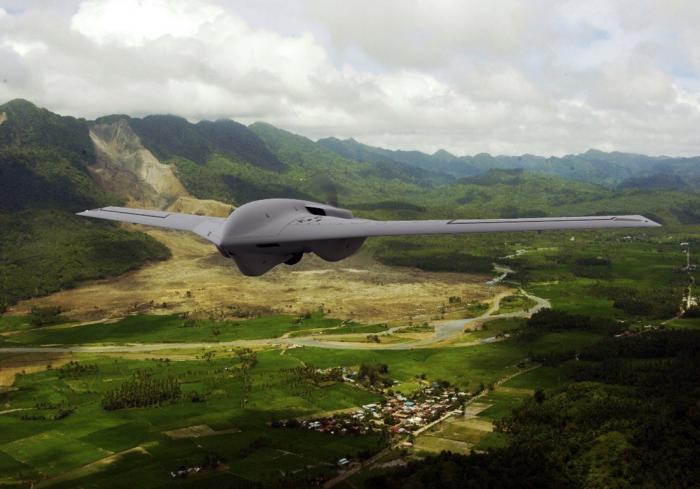
Lockheed Martin integrates new engine for Fury unmanned air vehicle

Fury, the expeditionary, runway-independent unmanned air vehicle (UAV) now has engine updates that will further increase its flight endurance, Lockheed Martin (NYSE: LMT) announced today.

With the integration of the 1803 engine into the platform, engineering tests performed by the company indicate that Fury will be able to stay in the air for 15 continuous hours, making it one of the highest endurance unmanned systems in its class.

“We’ve engineered Fury to bring the flight endurance and other advantages of much larger unmanned aircraft into a compact, effective, category three system,” said Kevin Westfall, director of Unmanned Systems at Lockheed Martin. “Lockheed Martin has invested heavily to mature the incredible capabilities Fury can deliver, and we’re excited to bring this system to customers around the world.”

- ADVERTISEMENT - CONTINUE READING BELOW -

More: AVIC unveils new unmanned armed helicopter at the China Helicopter Expo

Fury is a long-endurance, expeditionary aircraft that leverages its advanced fuel propulsion system, power generation and low signature design to deliver capabilities to Class 3 UAV that were previously only available in larger and more complex systems. It has no landing gear, making it the most advanced truly runway-independent UAV in its class on the market today. The complete Fury launch and recovery element can be set up on unimproved ground, in an areas a small as 200 feet square.

More: USA develops new stealth unmanned aircraft for aerial refueling tanker contest

Leveraging open architecture design, Fury is both adaptable and reconfigurable to serve a multitude of military missions – including intelligence, surveillance, reconnaissance, and cyber-electronic warfare.

For more information about the Fury, visit webpage: www.lockheedmartin.com

Readers who wish to follow our weekly coverage can subscribe to the Weekly Defense Roundup.

If you wish to report a grammatical or factual error in this article, please let us know by using the online form.

Executive Editor
  • In this story
  • USA

Support The Defence Blog

Independent reporting takes resources. Join us on Patreon.

Become a patron

More Like This

Lockheed Martin unveils HIMARS FLEX with double firepower

Lockheed Martin announced the HIMARS FLEX on June 16, a modular evolution of the M142 High Mobility Artillery Rocket System that introduces a dual-pod...

U.S. Army wants to keep buying Javelin missiles for 10 more years

The shoulder-fired missile that Ukrainian soldiers have used to destroy hundreds of Russian tanks is about to become the subject of one of the...

U.S. Navy lab gets Space Force gear to boost satellite testing

The United States Naval Research Laboratory, the scientific and technology development arm of the Navy and Marine Corps, has received a transportable satellite tracking...

REGENT completes the world’s first Seaglider factory in Rhode Island

REGENT Craft, the Rhode Island company building what it calls an entirely new category of maritime transportation, announced June 16 that it has completed...

Brazil orders Stinger missiles to defend against drones and aircraft

Washington has approved Brazil's request to purchase 100 FIM-92K Stinger Block I missiles to enhance the country's short-range air defense capability, in a transaction...

Ukraine develops new Zetros-based howitzer called Marta

Germany and Ukraine signed agreements that include €750 million ($870 million) for 200 Bohdana self-propelled artillery systems on Zetros chassis, and those systems now...