

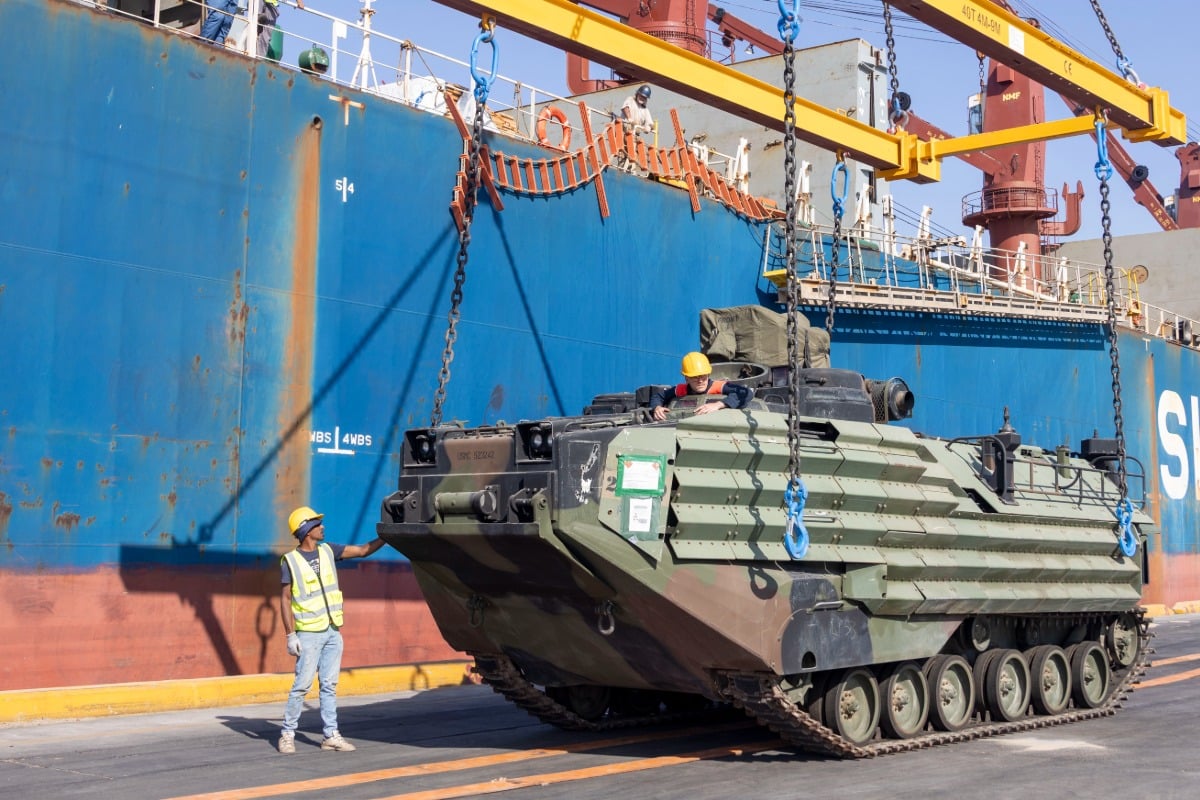
- The U.S. State Department approved a $30.6 million Foreign Military Sale to Italy of seven AAV-7A1 vehicles, three command variants and four recovery variants, on June 5, 2026.
- All seven vehicles will be transferred from existing U.S. Marine Corps stock and include support equipment, camouflage netting kits, technical manuals, and logistics support.
The United States government has approved the sale of seven surplus Marine Corps amphibious assault vehicles to Italy in a $30.6 million deal that will help Rome maintain the ability to put troops ashore from the sea as NATO faces growing pressure to expand its expeditionary capabilities.
The U.S. Department of State notified Congress of the proposed Foreign Military Sale on June 5, 2026. Italy has requested three AAV-7A1 command variants, designated AAVC-7A1, and four AAV-7A1 recovery variants, designated AAVR-7A1. The package also includes support equipment, radar-scattering camouflage netting kits, unclassified technical manuals, and related logistics and program support. All seven vehicles will be transferred directly from existing U.S. Marine Corps stock rather than manufactured new.
The AAV-7A1, formally known as the Assault Amphibious Vehicle, is one of the most recognizable pieces of equipment in the Marine Corps inventory and one of the longest-serving tracked vehicles in any Western military. The platform entered service in 1972, designed to carry a squad of Marines from ship to shore through open water and then continue fighting on land as a protected troop carrier. It can reach speeds of approximately 13 km/h (8 mph) in water and around 72 km/h (45 mph) on land, carries a crew of three and up to 21 combat-equipped troops, and is armed with a 12.7 mm (0.50 caliber) machine gun and a 40 mm (1.57 in) grenade launcher. Despite its age, the AAV-7 has been continuously upgraded and remains in service with the United States, South Korea, Brazil, Thailand, and several other nations, each finding value in a platform that can transition directly from sea to land without requiring a separate beach landing operation.
The two variants Italy is acquiring serve specialized roles that support rather than replace the basic troop-carrying AAV. The command variant, the AAVC-7A1, is configured as a mobile command post, with enhanced communications equipment that allows amphibious force commanders to coordinate a landing operation from a vehicle that moves with the assault wave rather than remaining aboard ship. The recovery variant, the AAVR-7A1, is a maintenance and recovery platform equipped with a crane and recovery gear to retrieve disabled or damaged AAVs during or after an amphibious operation, a capability that becomes critical when vehicles break down in surf zones or on beaches where conventional wheeled recovery equipment cannot operate. Acquiring command and recovery variants alongside basic assault vehicles is a standard pattern for a military building out a complete amphibious capability rather than simply adding transport capacity.
Italy’s interest in maintaining and expanding its amphibious capability reflects its strategic geography as much as any alliance commitment. The Italian peninsula extends deep into the central Mediterranean, with the islands of Sicily and Sardinia providing additional southern reach, and Italy has historically maintained a significant naval and marine infantry force oriented toward the Mediterranean basin and the ability to project power along its coastlines. The San Marco Marine Brigade, Italy’s primary amphibious force, operates AAV-7 vehicles already and has participated in NATO exercises including large-scale amphibious drills in the Mediterranean and Atlantic. The acquisition of additional command and recovery variants suggests Italy is working to fill capability gaps in its existing fleet rather than building from scratch.
The State Department’s notification to Congress is a required procedural step in the Foreign Military Sales process, giving legislators 30 days to object before the sale can formally proceed. Congressional notifications of this type rarely result in holds or objections for sales to established NATO allies, and the relatively modest scale of the transaction makes it unlikely to attract significant political attention. Italy has been a reliable and active NATO member, hosting U.S. military forces at multiple bases including Naval Air Station Sigonella in Sicily and Naval Support Activity Naples, and contributing forces to alliance operations across multiple theaters.