

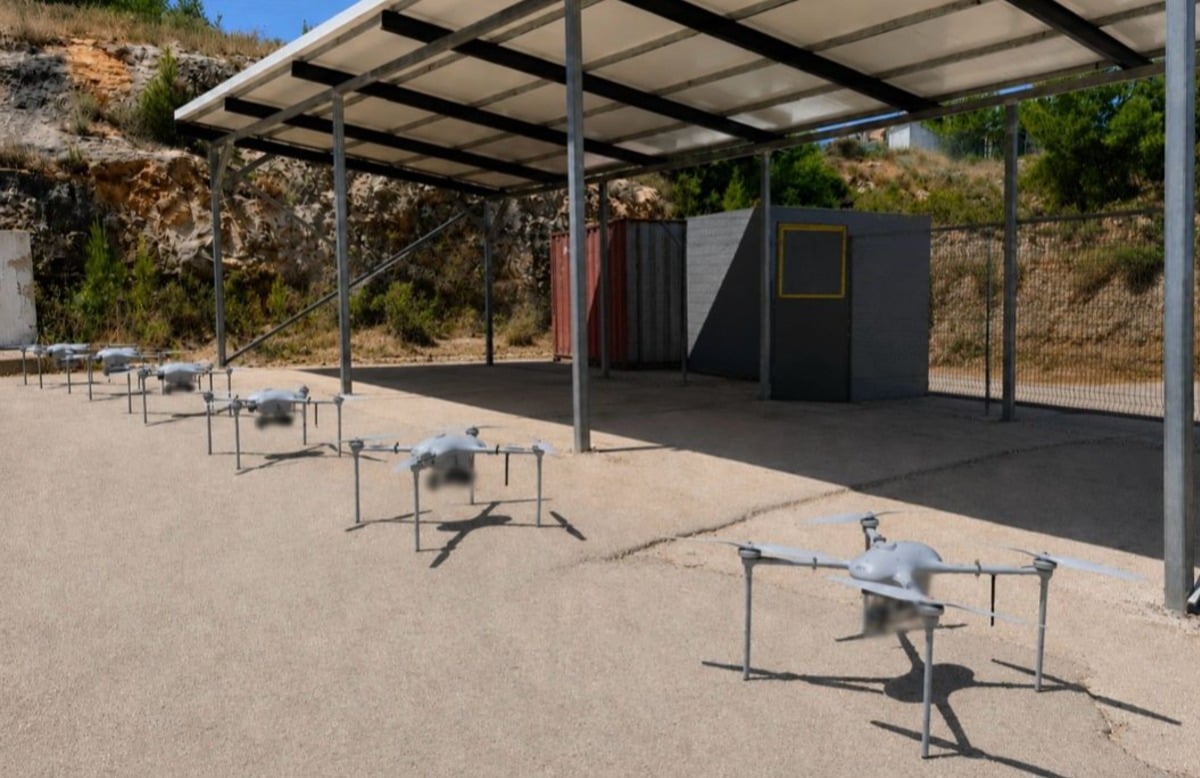
- Aero-Sentinel's G3 drone completed operational training activities with unnamed security organizations over two weeks, with published photos showing blurred external payloads for security reasons.
- The G3 carries payloads up to 3 kg (6.6 lb) and is designed for covert long-range ISR missions; Aero-Sentinel's facility was struck by an Iranian missile in April 2026.
An Israeli drone manufacturer whose production facility was struck by an Iranian ballistic missile just two months ago has announced that its G3 reconnaissance drone platform completed operational readiness and training activities with unnamed security organizations over the past two weeks, with photographs showing the aircraft carrying blurred external payloads that were obscured, apparently for security reasons.
Ofir Avram, chief marketing officer at Aero-Sentinel, posted the announcement, describing the activity as supporting “complex missions and advanced operational capabilities” and noting that the team continues “to contribute to critical missions by delivering reliable, field-proven technology.”
Aero-Sentinel is a small Israeli unmanned systems developer based in Petach Tikva, a city in the Tel Aviv metropolitan area, that has spent over two decades building drones specifically for intelligence collection and covert surveillance rather than strike operations. The company’s design philosophy centers on acoustic stealth: its platforms are engineered to produce minimal noise, allowing them to operate at low altitudes close to targets without triggering the auditory awareness that gives away conventional drones operating in quiet environments. The Defence Blog reported in September 2025 that the company’s G2 Premium model recorded just 14.9 decibels at 1 km (0.6 miles) distance in independent testing, a figure significantly below commercially available drones of comparable size, and that this acoustic performance has driven substantial interest from special operations and internal security units across multiple regions.
The G3 is the company’s most advanced platform and a significant step up from the G2 in operational capability. Where the G2 is optimized for close-range tactical reconnaissance with roughly 80 minutes of endurance, the G3 is designed for longer-distance operations and complex missions requiring heavier sensor or equipment loads. It carries payloads of up to 3 kg (6.6 lb), a capacity that opens the door to electro-optical and infrared sensor packages, communications intelligence equipment, electronic warfare systems, and other mission-specific gear that the lighter G2 cannot accommodate. The platform’s configuration is modular, meaning the payload bay can be reconfigured between missions depending on the task, and the drone’s core design priorities, including low observable characteristics and rapid field deployment, carry over from its smaller sibling.
The blurred payloads visible in Avram’s photographs are the most operationally interesting detail in the announcement. Standard reconnaissance sensor pods do not typically require image obscuring when a company posts promotional training content on social media. The fact that the external loads were digitally obscured before publication suggests either that the payloads themselves are classified or sensitive items whose visual identification could reveal capabilities, programs, or customers that Aero-Sentinel and the operating organization are not ready to disclose publicly, or that the security organizations involved requested the obscuring as a condition of permitting the imagery to be released at all. Neither explanation points toward routine ISR sensor packages, and both point toward capability categories that go beyond standard reconnaissance.
The broader operational history of Aero-Sentinel’s platforms adds significant context for interpreting what “complex missions” might mean in this announcement. Multiple open-source defense sources, including reporting cited by The Defence Blog, have previously linked Aero-Sentinel platforms to Israeli special operations activity inside Iran, with reports from 2025 suggesting that drones with similar acoustic and flight characteristics were used during covert missions conducted on Iranian territory. Aero-Sentinel has never officially confirmed use by specific intelligence or special operations services, and the company states that all sales are conducted within Israeli and international legal frameworks.
The ongoing Iran-Israel conflict has changed the operational tempo for Israeli defense and intelligence capabilities of every kind, and covert drone platforms are no exception. The ability to operate at low acoustic signatures in contested airspace where adversaries are actively listening for approaching aircraft, combined with a payload capacity sufficient to carry electronic intelligence and communications equipment, positions the G3 as a tool for the kind of persistent, patient intelligence collection that feeds targeting decisions, route reconnaissance, and situational awareness in exactly the environments where overt collection is impossible. Whether the unnamed security organizations conducting training with the G3 over the past two weeks are Israeli, American, or from a third country entirely is information Aero-Sentinel has not provided and may never provide. What the blurred photographs confirm is that the payloads are not something the operating organizations want identified. What the training confirms is that the missions continue.