

- iRocket won a multi-million Army contract on June 8, 2026, to produce M151 AUR prototypes converting Hydra-70 rockets into laser-guided counter-drone munitions.
- The company's Factory ONE of the Future targets production of one propellant every five minutes for its customers, projecting up to 97,000 units annually for its customers at its new facility.
As U.S. forces confront a growing wave of low-cost drone attacks that have exposed a fundamental flaw in how America stocks and prices its air defense arsenal, the Army has tapped a rocket technology startup to help scale a more affordable answer: a laser-guided version of one of the most proven rockets in the American inventory.
Innovative Rocket Technologies Inc., known as iRocket, announced on June 8, that the Army Program Executive Office Fires selected it alongside other vendors for the Hydra-70 Guided Rocket Components multi-million dollar contract. The program tasks iRocket with producing guided components that convert the Hydra-70 unguided 70 mm (2.75 in) rocket into a laser-guided precision munition specifically designed to engage low-cost aerial threats at a price point that makes sustained counter-drone operations economically viable. The award comes as U.S. forces are engaged in ongoing operations in the Iran conflict, where the cost disparity between American interceptors and enemy drones has become one of the defining operational problems of the campaign.
The economic case behind the program is not complicated, but it has taken years of painful experience to force institutional action on it. The HELLFIRE missile, the Army and Marine Corps’ primary air-launched precision strike weapon, costs between $150,000 and $200,000 per round. The drones it is increasingly being called upon to destroy, whether Iranian-supplied loitering munitions in the Middle East or commercially derived platforms modified for military attack, typically cost hundreds to a few thousand dollars each. Every HELLFIRE expended against a cheap drone represents a cost exchange ratio of fifty to several hundred to one, and those missiles come from finite stockpiles that industrial production lines cannot replenish anywhere near as fast as modern combat consumes them. Ukraine’s experience since 2022, where both sides have burned through munitions at rates that surprised Western planners, gave the U.S. military a preview of what sustained high-intensity conflict does to carefully managed inventories. The Iran conflict has made that preview operational reality for American forces directly.
The Hydra-70 belongs to the long-running U.S. 2.75-inch rocket family and has become one of the most widely used 70 mm rocket systems in the American inventory. Fired from helicopters, fixed-wing aircraft, and some ground-based launchers, the rocket is produced in large numbers and remains a common unguided munition for U.S. and allied forces. In its standard form, the Hydra-70 is built for area effects rather than precision strikes. Adding laser guidance changes that role: a guided 70 mm rocket can home in on a laser-designated target, giving it the accuracy needed to engage small unmanned aircraft that would be difficult to hit with an unguided rocket. The result is a munition that costs less than a HELLFIRE while offering a precision option for targets where the use of larger missiles may be difficult to sustain.
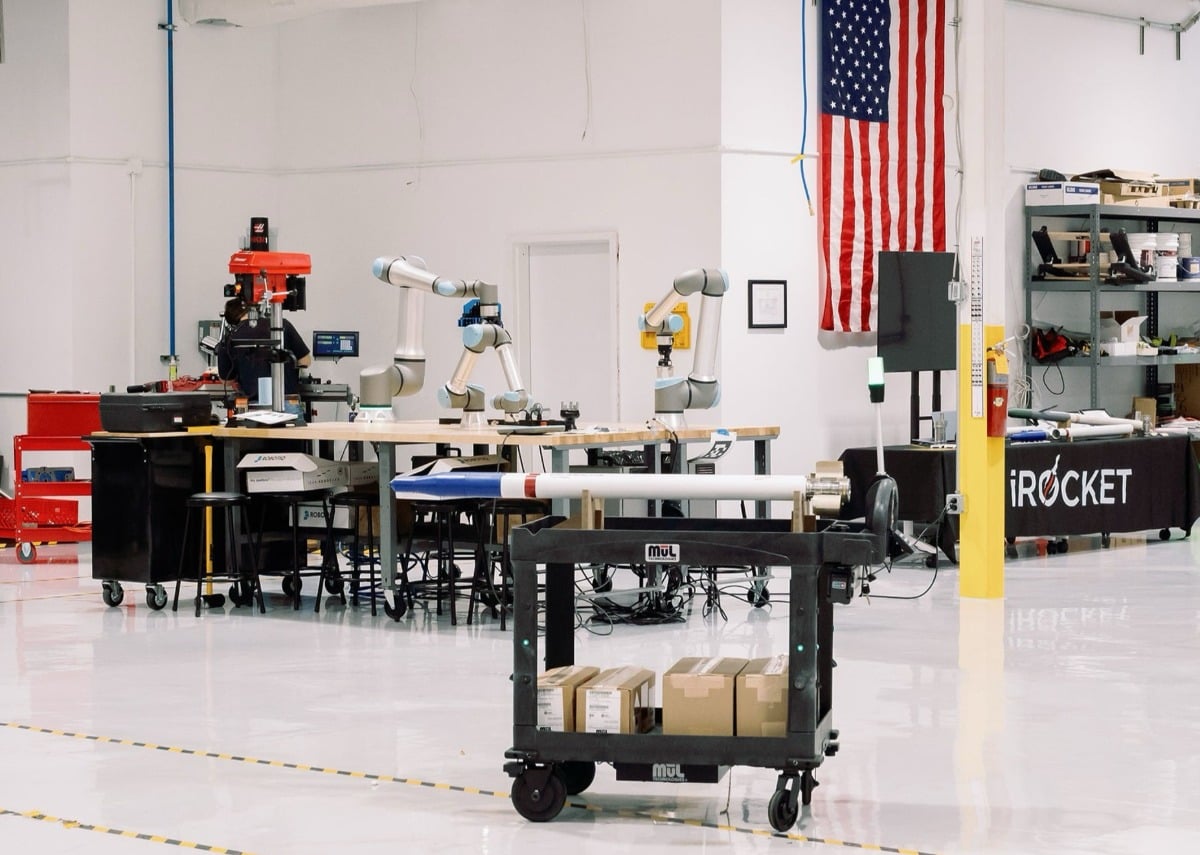
iRocket is not approaching this as a conventional add-kit program bolted onto an existing low-rate manufacturing line. The company’s Factory ONE of the Future concept applies automation, robotics, and digitally integrated production systems to the manufacturing process from the ground up, targeting a production cadence of one propellant unit every five minutes for its customers. At that rate, the facility projects annual output of up to 97,000 units for its customers, a figure designed to make a meaningful dent in the counter-drone munitions gap rather than simply demonstrate proof of concept. That production ambition directly addresses what Army planners and Department of War officials have identified as one of the most critical vulnerabilities in the U.S. defense industrial base: the inability to generate precision munitions in the volumes that sustained modern conflict requires, at a pace that keeps pace with consumption rather than always running behind it.
“This award reflects a vital shift in how modern conflicts are being fought and won,” said Asad Malik, CEO of iRocket. “Our forces are facing increasingly asymmetric threats, where low-cost drones are being deployed at scale, and the traditional response model is no longer sustainable. At iRocket, we are focused on changing that equation, delivering precision-guided rocket capabilities that are not only effective, but affordable and produced at the speed and volume today’s operational environment demands.”
The manufacturing philosophy behind the Factory ONE of the Future model extends beyond throughput. Malik framed the production design explicitly around supply chain resilience and surge capacity, the ability to ramp output rapidly when operational demand spikes rather than being constrained by fixed manufacturing cycles.
“Through our Factory ONE of the Future approach, we are rethinking how munitions are built, enabling a more agile, resilient supply chain that ensures war-fighters have access to the systems they need, when and where they need them. Our new facility is designed to produce one propellant every five minutes, putting us on track to manufacture up to 97,000 units annually.”
The broader counter-UAS munitions market is moving in the same direction simultaneously, with multiple programs across the Army, Air Force, and Navy seeking affordable guided munitions for drone engagement. The iRocket contract is one data point in a larger procurement pattern that reflects a strategic reassessment of how the U.S. military equips itself for the drone-saturated battlefields that every recent conflict has produced.