

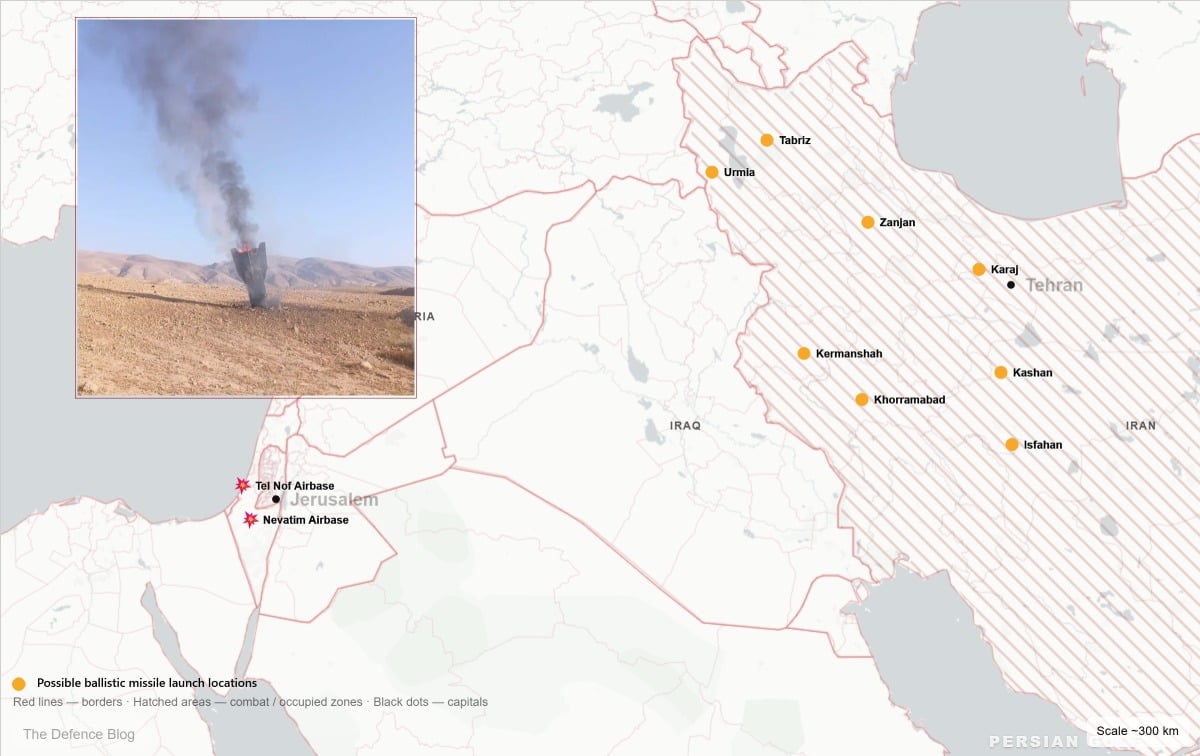
- Iran launched ballistic missiles at Israel on June 8, 2026, from multiple sites including Urmia, Tabriz, Zanjan, Karaj, Kashan, Isfahan, Kermanshah, and Khorramabad.
- Iran's Revolutionary Guard claimed the strikes targeted Nevatim and Tel Nof air bases; the IDF said it intercepted all incoming missiles with no casualties reported.
Iran fired waves of ballistic missiles at Israel on June 8, 2026, targeting two of the country’s most important air bases in the most serious Iranian attack since a ceasefire was reached on April 8, while Yemen’s Iran-backed Houthi rebels joined the assault and announced a full blockade of Israeli shipping in the Red Sea. The strikes came on the 100th day of the Iran-Israel war, triggered by Israeli attacks on Beirut’s southern suburbs on June 7 that prompted an initial Iranian missile barrage the same night, setting off the chain of events that brought missiles over central and northern Israel the following morning.
Iran’s Revolutionary Guard framed the attack as Operation Nasr, meaning Victory, claiming to have targeted two Israeli military bases: Nevatim and Tel Nof. Nevatim, located in the Negev desert roughly 70 km (43 miles) southeast of Tel Aviv, serves as the primary base for Israel’s F-35I Adir stealth fighter fleet, the most advanced aircraft in the Israeli inventory. Tel Nof, approximately 30 km (19 miles) south of Tel Aviv, hosts squadrons of F-16I Sufa fighters and serves as one of Israel’s central air operations hubs. According to reports from open-source trackers and regional monitoring channels, Iran launched ballistic missiles from multiple locations across the country, including Urmia, Tabriz, and Zanjan in the northwest, Karaj and Kashan in the center, Isfahan in central Iran, and Kermanshah and Khorramabad in the west. The geographic spread of launch sites across that many provinces suggests Iran deliberately dispersed its launch operations to complicate efforts to locate and suppress the missile batteries before or during the salvo. The IDF said it intercepted all Iranian missiles launched at Israel that morning, though a fragment from an intercepted missile caused damage to several homes in a West Bank settlement, with no injuries reported. A second wave of Iranian missiles followed later in the morning, which Israeli authorities also said were intercepted.
Sirens sounded continuously across central and northern Israel, including in the Tel Aviv area, as Israeli air defenses worked to track and intercept the incoming ballistic missiles. Missiles were visible in the sky over the West Bank city of Hebron, and missile alert sirens sounded in neighboring Jordan as intercepted debris tracked across the region. Hospitals in Israel moved patients to underground facilities. Schools shut down. Ben Gurion Airport in Tel Aviv remained open but Israeli officials held active discussions about restricting the terminal to 2,500 passengers at any given time as a precautionary measure, though no decision had been taken as of the morning’s events.
The Houthi movement, the Iranian-backed armed group that controls most of northern Yemen and has been launching missiles and drones at Israel since the Gaza conflict began in late 2023, entered the June 8 exchange by firing a single missile at central Israel, which the IDF said it intercepted. The Houthis also announced what they described as a “complete and total ban on Israeli maritime navigation in the Red Sea,” declaring all Israeli-linked vessels legitimate military targets. The Red Sea corridor, through which a significant fraction of global container shipping normally passes before transiting the Suez Canal into the Mediterranean, has already been severely disrupted by Houthi attacks since November 2023, and a formal renewed blockade declaration adds legal and commercial risk calculations on top of the physical threat. The Bab el-Mandab Strait, the narrow chokepoint at the southern entrance to the Red Sea connecting it to the Gulf of Aden, is the geographic bottleneck that makes Houthi threats to this corridor strategically consequential for global shipping.
The diplomatic backdrop adds a layer of complexity that makes the June 8 events harder to read in isolation. President Donald Trump, according to the Times of Israel’s live coverage, had urged Israeli Prime Minister Benjamin Netanyahu to hold off on retaliating against Iran’s missile fire from the night of June 7, warning that further escalation could derail ongoing nuclear negotiations with Tehran that Trump described as being “very close” to a deal. The tension between Washington’s desire for a nuclear agreement and the military exchange now underway has been a persistent feature of the conflict since it began, and June 8 places that tension in sharp relief.
The April 8 ceasefire that June 8’s events have now shattered was fragile from the start. Both sides had continued lower-level operations throughout the supposed ceasefire period, with Israeli strikes on Hezbollah infrastructure in Beirut and Iranian proxy activity across the region maintaining pressure below the threshold of full resumption. The June 7 Iranian missile barrage on northern Israel, reportedly in response to an Israeli strike on Hezbollah in Beirut, set off the chain that made June 8 the most intense single day since the ceasefire was announced.