

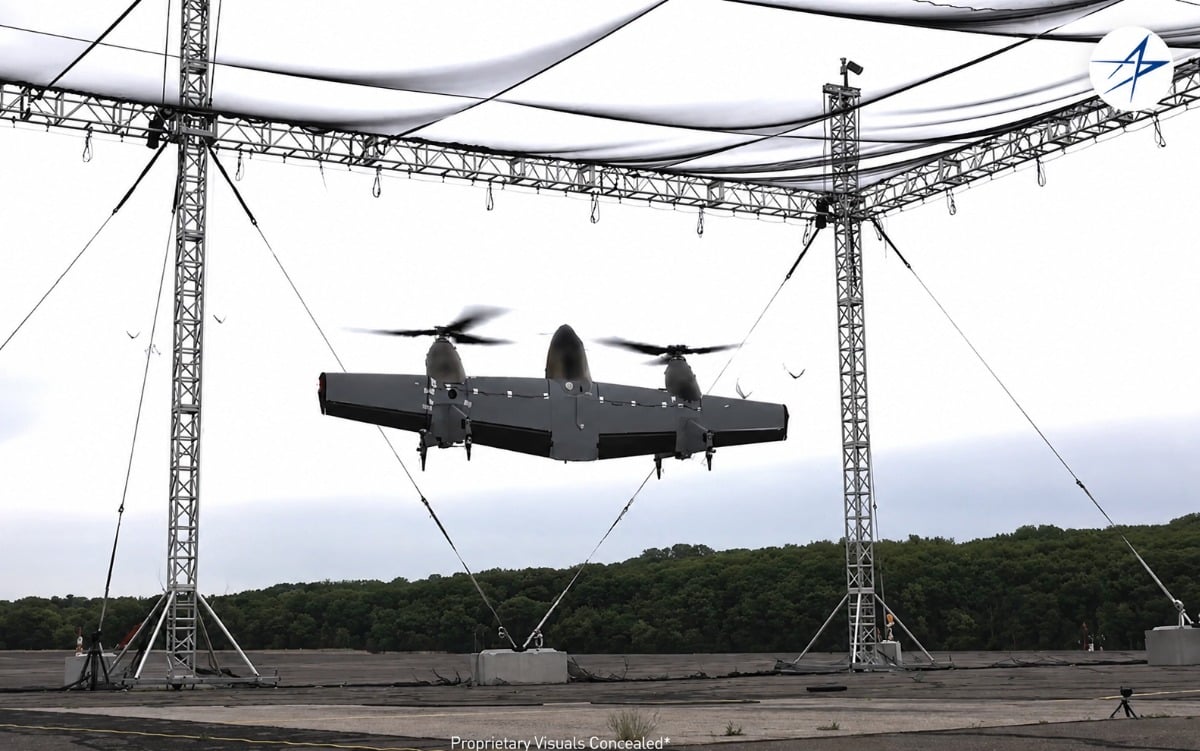
- Lockheed Martin announced on July 22, 2026 that Nomad 100 drone completed initial ground and flight testing under DARPA's EVADE program.
- The Nomad 100 uses a rotor blown wing design for runway-free takeoff and landing, with DARPA's MATRIX autonomy system powering all five EVADE aircraft.
Sikorsky, the Lockheed Martin subsidiary best known for the Black Hawk helicopter, announced Wednesday at the Farnborough International Airshow that its Nomad 100 uncrewed aircraft has completed initial ground and flight testing under DARPA’s Early VTOL Aircraft Demonstration program, known as EVADE, a fast-track Pentagon research effort designed to push new vertical takeoff aircraft from concept to real-world demonstration far faster than traditional development programs allow.
Most fixed-wing unmanned aircraft need a runway, or at minimum a length of flat, clear ground, to take off and land, a requirement that becomes a serious liability on a battlefield where the enemy can target or destroy prepared airstrips, or in remote and maritime environments where no runway exists at all. Helicopters solve that problem by taking off and landing vertically, but they trade away the speed, range and fuel efficiency that fixed-wing aircraft offer once airborne.
Sikorsky’s answer is what the company calls a rotor blown wing architecture, a design that uses twin prop-rotors to lift the aircraft straight up like a helicopter, then transitions into forward flight where the same rotors blow air across a fixed wing to generate lift more efficiently, similar to how a conventional airplane cruises. The result is an aircraft that can launch from a ship deck, an unimproved forward operating base, or rough terrain with no prepared surface at all, then cruise at fixed-wing speed and range once it transitions to wing-borne flight, all without needing a human pilot aboard.
Rich Benton, vice president and general manager at Sikorsky, tied the completed test phase directly to a broader push toward autonomous systems that can work alongside piloted aircraft rather than simply replacing them.
“Nomad 100’s ongoing flight testing reflects our commitment to advancing autonomous technology while delivering safe and reliable mission capabilities that equip customers to fill critical operational gaps,” Benton said, adding that: “Nomad will serve as part of a crewed-uncrewed team complementing missions anywhere from austere forward operating bases to ship decks and unimproved landing zones”.
The program grew out of an earlier DARPA effort called ANCILLARY, which explored ship-based vertical takeoff aircraft designs, and EVADE deliberately prioritizes speed over polish, pushing multiple competing aircraft designs into flight testing quickly so engineers can identify problems and iterate rather than spending years perfecting a design before it ever leaves the ground. DARPA selected Sikorsky’s proprietary MATRIX autonomous flight control technology to power all five different aircraft platforms competing under the EVADE program, giving the agency a common autonomy backbone to evaluate across multiple airframe designs from different manufacturers rather than testing each aircraft’s flight software in isolation.
The Nomad 100 itself is a roughly 330 lb (150 kg) aircraft classified as a Group 3 drone, a military size category that also includes retired platforms like the Army’s RQ-7 Shadow, and it represents the smallest member of what Sikorsky envisions as an entire family of Nomad aircraft scaling up in size and capability. The company has described larger Nomad variants that would grow to roughly the size of the MQ-1C Gray Eagle, a larger armed reconnaissance drone already in Army service, and eventually up to a footprint comparable to the S-70 Black Hawk medium-lift helicopter itself, suggesting Sikorsky sees a path toward uncrewed aircraft capable of hauling meaningful cargo or equipment loads using the same core rotor blown wing design that powers the much smaller Nomad 100. That scalability matters strategically because it lets the company pitch a single underlying technology to multiple different military and civilian customers, from small reconnaissance drones the Army might use for scouting missions to potentially much larger logistics aircraft capable of resupplying troops in contested areas without needing a runway anywhere near the delivery point.
Nomad also marks Sikorsky’s formal entry into the broader uncrewed aircraft systems market, a space the company has approached more cautiously than some competitors while it worked to adapt decades of helicopter and rotorcraft engineering into a design built specifically for autonomous operation. The MATRIX autonomy system powering Nomad already has a real operational track record behind it, having logged more than 1,000 flight hours and over 500 successful tests and demonstrations across more than 20 different aircraft platforms, and Sikorsky has trained more than 100 operators from both the Department of War and firefighting agencies on the technology, reflecting how the same underlying autonomy software has already found uses well beyond a single military program. MATRIX also powers two of Sikorsky’s other autonomous platforms, the S-70UAS U-Hawk, a fully autonomous variant of the Black Hawk airframe, and a hybrid electric demonstrator aircraft the company has used to test new propulsion approaches for future uncrewed designs.
With initial flight testing complete, Sikorsky said the Nomad 100 will next move into a more demanding flight test campaign at a government facility, one designed to replicate the full range of missions the aircraft is ultimately meant to perform, from reconnaissance and light attack support to logistics runs into locations no conventional aircraft could reach.