


China’s aerospace industry is laying the groundwork for a new generation of strategic transport aircraft designed to expand the People’s Liberation Army’s global reach.
A recently published technical paper describes the conceptual design and performance requirements of a future heavy-lift cargo plane featuring a blended-wing-body (BWB) configuration — a radical departure from the conventional designs of existing platforms like the Y-20.
The paper outlines the aircraft’s ambitious design goals, emphasizing its ability to transport heavier payloads over longer distances while operating from austere runways.
At its core, the new airlifter is envisioned to carry up to 120 tons of cargo with a maximum takeoff weight approaching 470 tons, surpassing China’s current heavy transport fleet. It is also expected to achieve a range of 6,500 kilometers while carrying its full payload, allowing direct intercontinental missions without refueling.
The conceptual design adopts a blended-wing-body layout, merging the fuselage and wing into a single lifting surface. This design increases internal volume for cargo while improving aerodynamic efficiency.
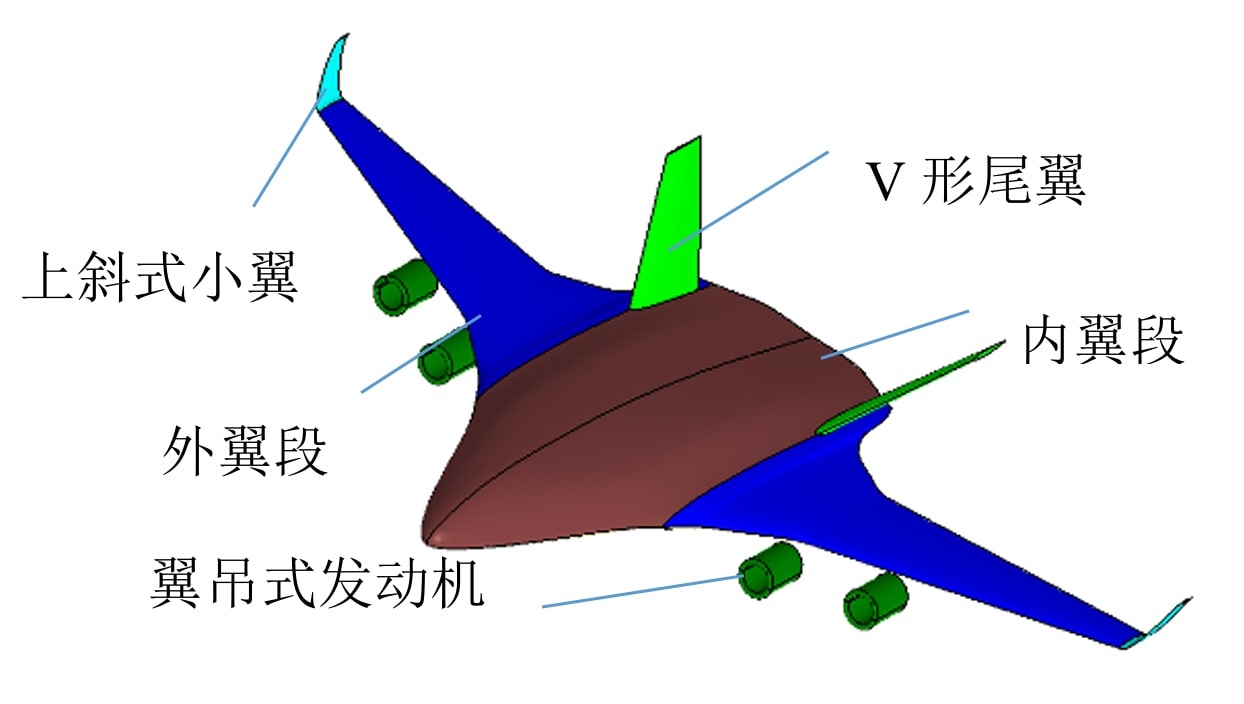
Key structural features include a V-shaped tail, swept outer wing sections, and wing-mounted engines positioned to optimize airflow and reduce drag. The paper also proposes upward-angled winglets and a revised tailplane arrangement aimed at enhancing stability and control across flight regimes.

Engine thrust in the baseline configuration is estimated at 370 kN, though optimization studies suggest powerplants in the 350–369 kN range could deliver better fuel efficiency. Even with a larger airframe, projected cruise Mach numbers reach 0.85, faster than current large transport aircraft like the U.S. C-5A or Ukraine’s An-124.
The aircraft is designed to take off from a 2,600-meter semi-prepared runway while carrying its full payload, enabling deployment from remote airfields. At lower payload weights, it would be capable of high-altitude operations — including takeoffs from 4,000 meters above sea level — a crucial capability for missions in Tibet or Central Asia.
Internal cargo bay dimensions reflect a focus on transporting heavy armored vehicles, missile launchers, and mechanized infantry units. Requirements include a minimum cargo hold height of 5 meters, a length exceeding 21 meters, and a floor area of more than 170 square meters. This volume would allow the aircraft to transport up to 117 vehicles or over 300 troops, depending on mission configuration.
The design also anticipates strategic airdrop missions. The paper specifies a requirement for stable 3g maneuverability during airborne delivery, as well as precision control during high-altitude extraction operations. Rapid climb rates, controlled descents, and horizontal acceleration requirements are all included in the design’s performance matrix.
Comparative tables in the study place the BWB design against the C-5A and An-124, showing superior range, cruise speed, and aerodynamic efficiency. Its wing loading and thrust-to-weight ratios were refined through multiple optimization rounds, labeled “Pareto solutions,” which balanced lift, payload, and fuel consumption.
In one scenario, the aircraft’s maximum takeoff weight rises to 471.8 tons with a slightly reduced static margin for stability, while another configuration trades payload for improved climb performance and shorter runway requirements. All versions meet core mission objectives, including short-field operations, heavy airdrop, and long-range deployment.
If developed, this next-generation airlifter would mark a major step in China’s ability to project power and sustain expeditionary operations. Its range, payload, and austere field performance would support rapid deployment of heavy ground forces across the Indo-Pacific and beyond, extending Beijing’s strategic logistics capabilities into regions previously beyond its reach.
While the program remains at the conceptual stage, the research indicates that China is exploring ambitious pathways to match or surpass Western heavy-lift aircraft.