

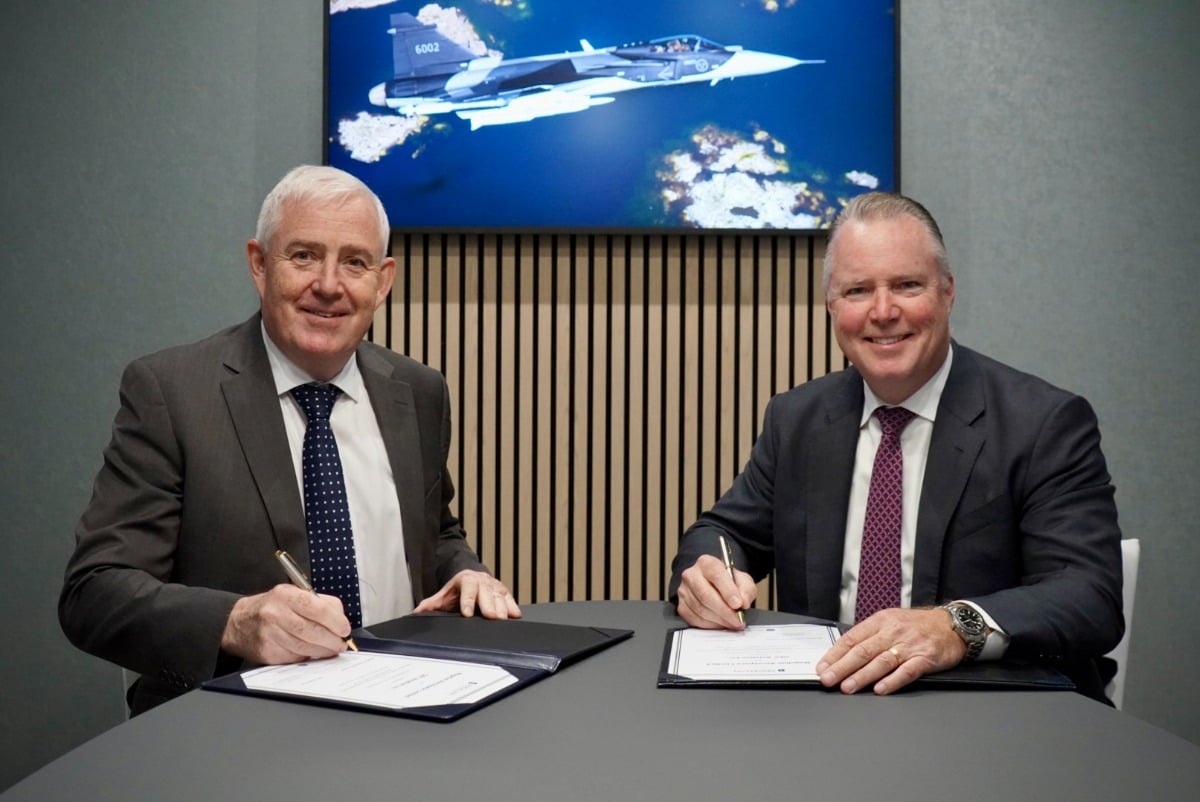
- GE Aerospace and Magellan Aerospace signed an MOU on July 22, 2026 to establish F414 engine maintenance capability in Canada for the Gripen E fighter.
- The agreement is contingent on whether Canada selects the Saab Gripen E as part of its still-unresolved Royal Canadian Air Force fighter fleet decision.
GE Aerospace and Magellan Aerospace Corporation announced Wednesday they have signed a memorandum of understanding to establish maintenance, repair and overhaul capabilities in Canada for the F414-GE-39E engine that powers the Saab JAS 39 Gripen E fighter, an agreement the companies explicitly tied to whether the Canadian government actually decides to buy the Gripen for the Royal Canadian Air Force.
That condition matters because Canada’s fighter fleet decision has been dragging on for well over a year. Prime Minister Mark Carney ordered a formal review of the country’s planned purchase of 88 Lockheed Martin F-35A jets back in March 2025, a deal originally worth roughly C$19 billion signed in early 2023, citing concerns about over-reliance on American defense suppliers as trade tensions between Ottawa and Washington escalated under President Trump. The review was supposed to wrap up by September 2025. It hasn’t, and reporting throughout 2026 has pointed toward Canada settling on some version of a mixed fleet, with figures floated ranging from roughly 30 F-35As paired with 60 Gripen Es to a larger three-tier force that could include upwards of 140 aircraft combining F-35s for stealth missions, Gripen Es for everyday air defense, and Saab’s GlobalEye surveillance planes. No final decision has been announced, and reports suggest Ottawa may not make one until after the U.S. midterm elections in November 2026, a delay aimed at avoiding further friction with Washington while the choice plays out.
Saab’s pitch to Canada has leaned heavily on industrial benefits rather than pure performance, offering full local manufacturing, complete technology transfer, source code access for the jet’s mission systems, and independent Canadian control over upgrades and maintenance, an approach the company has framed as building genuine sovereign capability rather than simply buying another country’s hardware off the shelf. That framing lines up directly with Carney’s own Defense Industrial Strategy, unveiled in February 2026, which calls for nearly C$500 billion in defense investment over the next decade and explicitly favors a build, partner, buy approach that prioritizes keeping as much of that money and expertise inside Canada as possible. Not every internal assessment has favored Saab’s aircraft on capability grounds. Data that surfaced from Canada’s evaluation process showed the F-35 scoring dramatically higher than the Gripen across major operational categories, and the Royal Canadian Air Force has reportedly remained unconvinced the Gripen fully meets its requirements, meaning the industrial argument is doing real work to keep the Swedish jet in contention despite that gap.
The engine deal itself builds on a relationship GE Aerospace and Magellan describe as spanning six decades across both military and commercial programs. Under the agreement, GE Aerospace would train Magellan’s workforce and license the company as Canada’s domestic center of excellence for F414 engine sustainment, with the maintenance, repair and overhaul work taking place at Magellan’s facility in Mississauga, Ontario. That would give Canada in-country access to keep its Gripen fleet’s engines running rather than shipping them elsewhere for major service work, a capability that matters operationally since an aircraft grounded waiting on overseas engine repairs is an aircraft that can’t fly training missions or respond to an actual crisis.
Paul Ferraro, Vice President of Defense Engines & Services at GE Aerospace, framed the agreement as an extension of that long-running partnership.
“Today’s MOU signing builds on a six-decade relationship between GE Aerospace and Magellan that spans both military and commercial engines and will ensure the Royal Canadian Air Force has access to engine sustainment services in country to ensure readiness of the F414 engines,” Ferraro said.
Haydn Martin, Magellan’s Vice President of Business Development, Marketing, and Contracts, tied the deal directly to Canada’s broader push for domestic defense capability.
“This MOU reflects our shared intent to build enduring sovereign aerospace capabilities in Canada,” Martin said.
“Should the Saab JAS 39 Gripen E aircraft be selected, Magellan Aerospace will be ready to provide world-class engine maintenance, repair and overhaul services that enhance operational readiness for the Royal Canadian Air Force while maintaining highly skilled Canadian jobs, developing advanced technical expertise, and strengthening Canada’s long-term defence industrial capacity,” Martin said.
The F414 itself is a well-established engine with a substantial combat and training record behind it. More than 1,600 units have been delivered to eight nations, and the engine family has logged over five million flight hours, with GE Aerospace citing on-condition maintenance rather than fixed scheduled overhauls, a design approach that services the engine based on its actual measured wear rather than a predetermined calendar, helping keep the aircraft available for missions more often. The F414-GE-39E variant specifically powers the single-engine Gripen E, a lighter, cheaper-to-operate 4.5-generation fighter that Saab has positioned as a more affordable complement to the F-35 rather than a like-for-like replacement, built around lower operating costs and the kind of dispersed, austere-airfield operations that fit Sweden’s own defense doctrine and that Canadian planners have suggested could suit Arctic patrol needs.
For now, this remains a conditional agreement about a jet Canada hasn’t committed to buying, built around a maintenance capability that only becomes real if Ottawa’s still-unresolved fighter review lands on the Gripen. But the fact that GE Aerospace, an American company, is willing to help build sovereign Canadian engine sustainment capability for a Swedish fighter competing directly against an American one says something about how far Canada’s defense procurement politics have shifted since the trade tensions of the past two years began, and how much industrial promises, not just aircraft performance, are now shaping one of the most consequential military purchases in Canada’s recent history.