

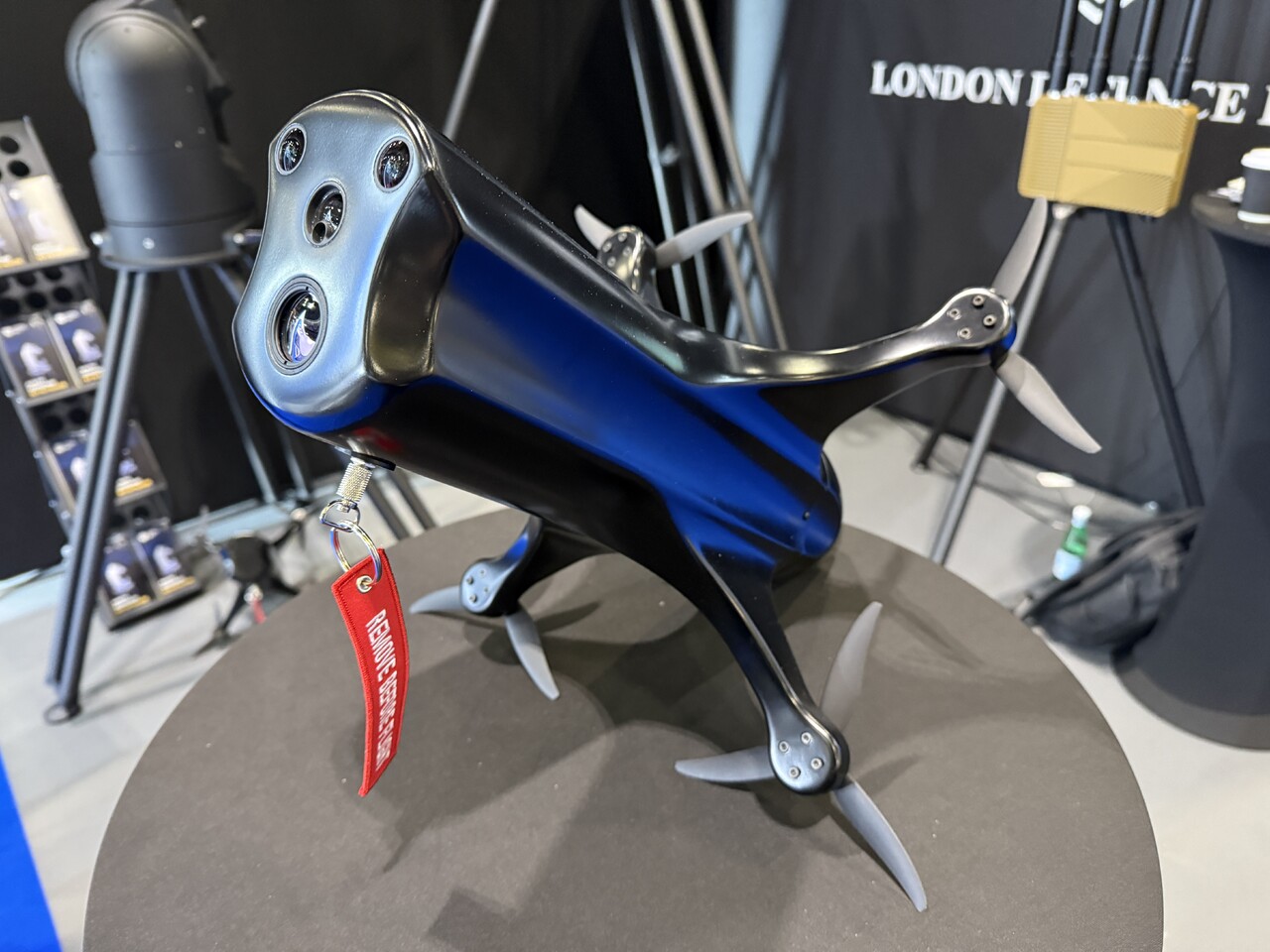
London Defence R&D has developed an innovative solution to one of the fastest-evolving challenges on modern battlefields — the threat of hostile drones. Its new Baby Raptor interception drone combines a futuristic design reminiscent of a spacecraft or high-speed supercar with a practical industrial build aimed at bringing down operational costs in air defense.
Unlike high-value interceptor missiles and manned aircraft that cost hundreds of thousands or even millions of dollars per mission, Baby Raptor is designed as a low-cost, fully autonomous interceptor capable of neutralizing aerial threats.
As noted by the company, Baby Raptor is built for “fully autonomous takeoff, detection and engagement.”
Founder Aytekin Guclu explained that the drone “can track targets moving at speeds up to 250+ km/h and uses a multi-sensor suite — two daylight cameras, a thermal camera and inertial/ancillary sensors — with AI software for search, detection, lock-on and tracking.” He emphasized that neutralization is “achieved kinetically through controlled physical interception rather than explosives,” a design choice that “enhances safety and ensures the system is strictly defensive.”
The drone’s production method reflects the company’s focus on simplicity and scalability. According to London Defence R&D, the Baby Raptor is optimized for HP industrial 3D printers, with the airframe printed in two parts during a single cycle and assembled in under an hour. This streamlined process, the company says, allows for regional manufacturing, rapid replenishment, and reduced reliance on complex global supply chains.

“Rising costs are forcing operators toward more affordable counter-drone options,” Guclu said. “This is not just an economic argument — it is strategic. When defence becomes unaffordable, vulnerabilities open. A low-cost, effective kinetic interceptor helps close that gap while keeping the focus on defence rather than force projection.”
The company also emphasized the importance of localized production. “Democratising production reduces the risk of supply chain disruption becoming a tactical weakness,” Guclu said, adding that the ability to manufacture locally becomes a “force multiplier” in contested logistics environments.
Baby Raptor’s sensor and AI package allows it to operate across a range of environments and threat types. The company says the combination of daylight and thermal imaging, supported by AI-driven detection and tracking, provides adaptability and resilience.
“The goal is not to build the most expensive system, but the most effective and scalable one,” Guclu said.
The system’s non-explosive interception approach is a central element of its design philosophy. In a statement, London Defence R&D said the kinetic method reduces risks to civilians and infrastructure while maintaining the focus on defense operations rather than offensive capability.
London Defence R&D positions Baby Raptor as both a technological and strategic innovation — a response to the growing cost of air defense and the increasing sophistication of aerial threats.
“Our priority remains defensive interception: providing those who protect borders, critical infrastructure and civilians with effective, affordable tools,” Guclu concluded. “The threat is real and accelerating Baby Raptor is our answer, designed for tactical effectiveness and strategic accessibility.”