

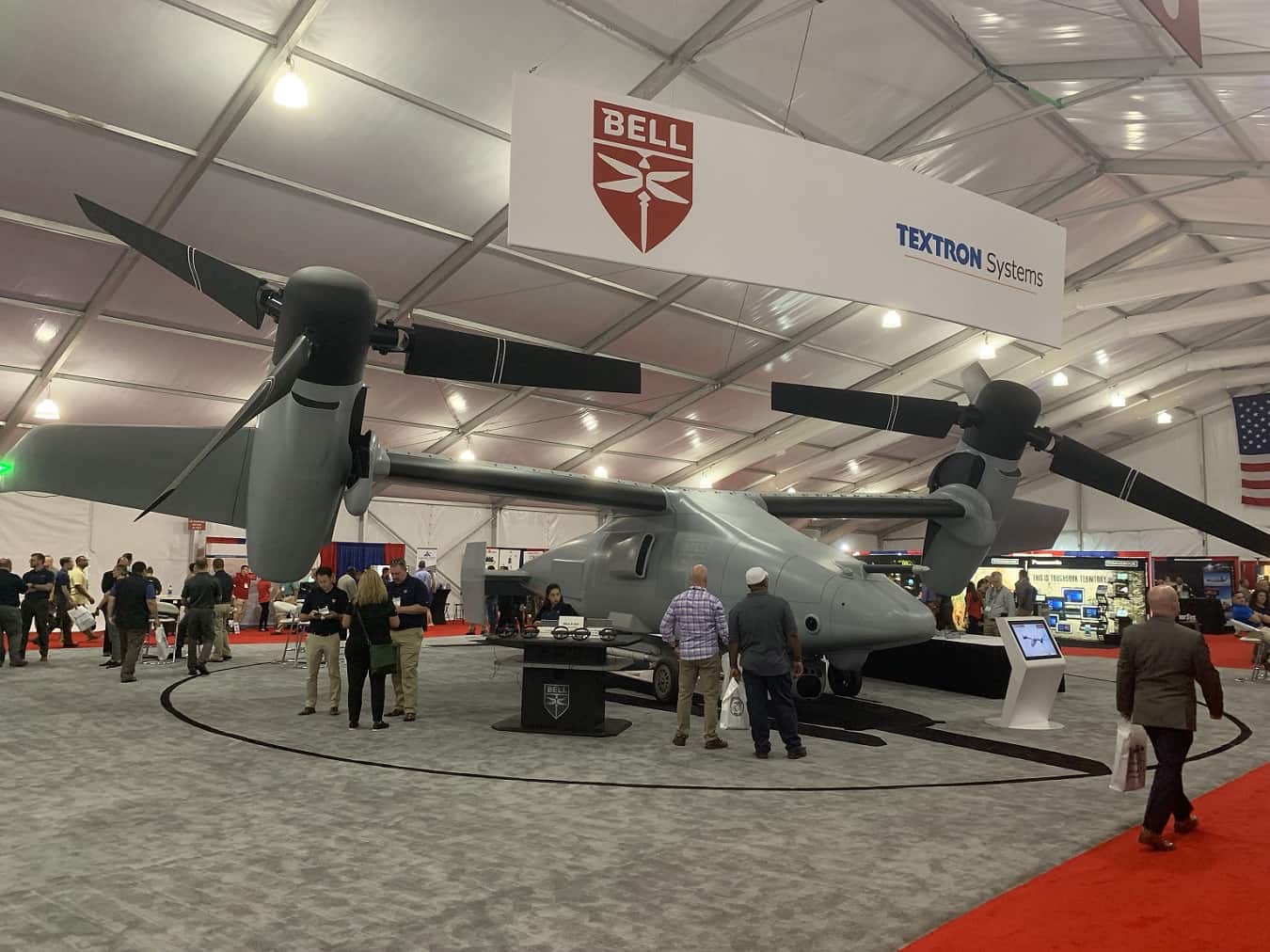
Bell, part of American conglomerate Textron, showcased mock-up of V-247 Vigilant tiltrotor unmanned aerial system during the 2019 Modern Day Marine Expo at Marine Corps Base Quantico.
Previously, the company has already shown its new tiltrotor, but it still continues to be of interest to the visitors for a number of reasons: it revolutionary and one of the world’s largest unmanned aircraft.
The Bell V-247 is combining the vertical lift capability of a helicopter with the speed and range of a conventional fixed-wing aircraft. The revolutionary UAS is designed to provide unmatched long-endurance persistent expeditionary and surveillance capability and lethal reach, as well as runway independence to operate successfully in maritime environments and locations without secure runway availability.
The Vigilant tiltrotor unmanned aerial vehicle satisfies the comprehensive spectrum of capabilities outlined in the 2016 Marine Corps Aviation Plan, and could be available for production as early as 2023.
The Bell V-247 Vigilant is designed to combine unparalleled capability with unprecedented flexibility to execute a wide array of mission sets, including electronic warfare, ISR (Intelligence, Surveillance and Reconnaissance), escort, C4 (Command, Control, Communications, and Computers), persistent fire missions and tactical distribution. The UAS is expected to accomplish all of this with the benefits of extended endurance through plug-and-play mission packages.
The Bell V-247 Vigilant offers a dynamic profile that is uniquely suited to complete highly versatile operations and support missions. It is designed to provide extended range flying from land or ship, matchless expeditionary capabilities and to remain on-station with heightened loiter times for extended periods. With its signature blade fold wing stow design, it will fit inside a DDG hangar space, and two can be loaded on a C-17 aircraft. The open architecture of the modular payload system enhances flexibility for aircraft customization by mission type.
The bays on the Bell V-247 Vigilant are designed to carry high definition sensors, fuel, sonar buoys, light detection and ranging (LiDAR) modules, 360-degree surface radar modules, an MK-50 torpedo or Hellfire or JAGM missiles optimally. Regardless of the need, the Bell V-247 Vigilant easily integrates into priority mission sets to complete multiple airborne requirements.