

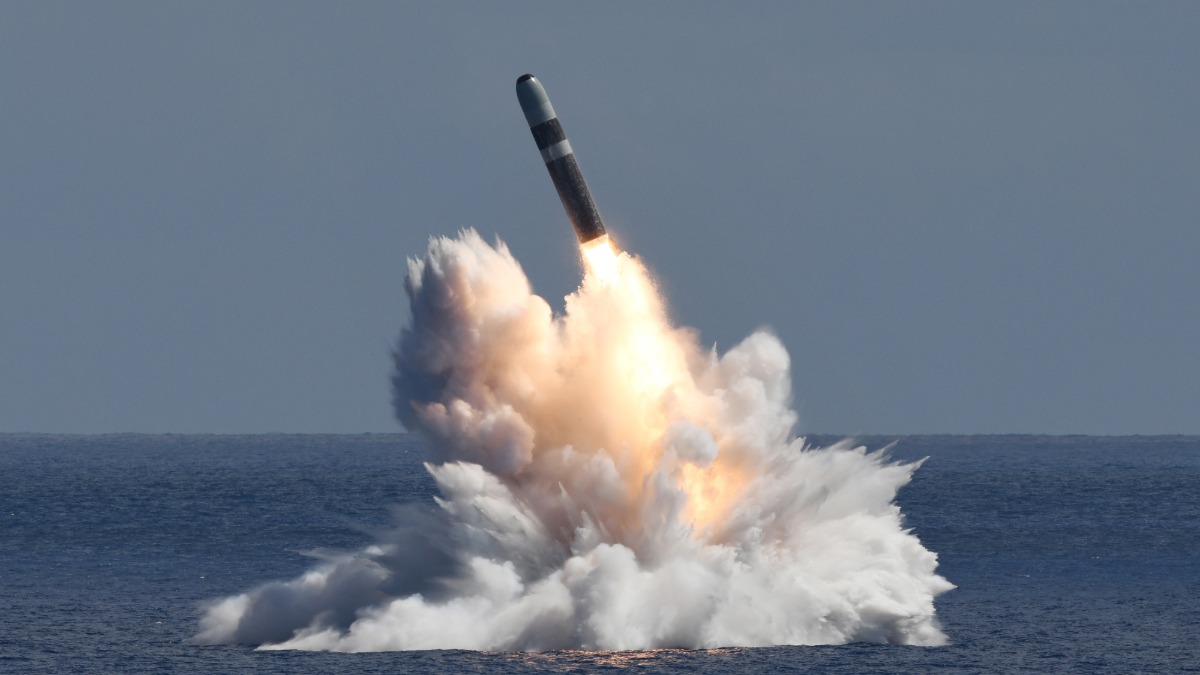
- BAE Systems received a $45.5 million contract modification to support the U.S. Trident II D5 program through September 30, 2026, covering systems engineering, test, and safety work.
- The award also benefits a Foreign Military Sale to the United Kingdom, reflecting the shared U.S.-UK Trident II strategic deterrent architecture.
BAE Systems just picked up another slice of one of the most sensitive defense programs in existence. The Rockville, Maryland-based contractor has been awarded a $45.5 million contract modification — the 51st modification to an existing contract — to continue providing engineering and technical support for the U.S. Trident II D5 Strategic Weapon Systems Program, the Attack Weapon System Program, and the Nuclear Weapon Security Program. The deal also carries weight beyond American shores: it directly benefits a Foreign Military Sale to the United Kingdom, cementing the transatlantic nuclear partnership that has underpinned Western deterrence for decades.
Work runs across a sprawling geographic footprint. The bulk of the effort — 49 percent — stays at BAE Systems’ Rockville headquarters, with 18 percent performed in Washington, D.C., where the Navy’s Strategic Systems Programs office is based. The remaining work fans out to Cape Canaveral, Florida; Frederick, Maryland; Silverdale, Washington; Saint Mary’s and King’s Bay, Georgia; York, Pennsylvania; Fort Walton Beach, Florida; Rochester in the United Kingdom; Conway, South Carolina; and a collection of smaller locations accounting for roughly eight percent of the total. Completion is expected by September 30, 2026. The contract was awarded as a sole-source acquisition — no competitive bids, no open market. PAE Strategic Systems Programs in Washington, D.C., is the contracting activity.
Tasks under the modification cover four core technical disciplines: systems engineering and integration, test engineering, data analysis, and safety engineering. That scope is deliberately broad because the Trident II program touches every layer of the weapon system — from the missile itself to the fire control, navigation, and launch interfaces aboard the submarine. Keeping those layers synchronized, current, and safe is a continuous engineering effort, not a one-time fix.
The Trident II D5 is the weapon that gives America’s ballistic missile submarine force its bite. Built by Lockheed Martin, this three-stage, solid-fueled submarine-launched ballistic missile can reach targets more than 7,000 kilometers away and carry multiple independently targetable warheads against separate objectives in a single launch. It flies from the Ohio-class submarines that currently patrol the world’s oceans as the sea-based leg of the U.S. nuclear triad, and it will carry over to the next-generation Columbia-class boats when they begin entering service. The United Kingdom relies on the same missile for its own deterrent, launched from Vanguard-class submarines, with Dreadnought-class boats slated to take over that role in the coming decade. What the U.S. and UK share isn’t just a missile — it’s a common logistics chain, engineering baseline, and strategic architecture going back to the 1963 Polaris Sales Agreement.
That shared architecture is exactly what makes BAE Systems’ work on this program so consequential. The systems engineering and integration role isn’t glamorous — it doesn’t involve building new missiles or testing launches. It’s the unglamorous connective tissue: making sure subsystems talk to each other correctly, verifying that changes to one component don’t break something else, and catching safety risks before they become operational problems. Test engineering feeds data back into that process, validating performance at each step. Safety engineering ensures that a weapon designed to survive the harshest operational environments — ocean depths, shock, vibration, extreme temperature swings — continues to meet its exacting standards throughout its service life.
The sole-source nature of the award reflects how tightly held this work is. BAE Systems has been embedded in the Trident program for decades, building the institutional knowledge and security clearances that make competitive procurement essentially impractical for this kind of sensitive systems support. The company has held variants of this contract continuously, with modifications regularly exercising new options or expanding scope as the program evolves. The November 2024 award of a separate $122.8 million contract for D5 Life Extension 2 support showed the depth of the relationship — this latest modification continues that same thread under the existing contract vehicle.
The timing slots into a period of accelerating Trident modernization on both sides of the Atlantic. The U.S. and UK navies are preparing to launch Trident II D5 Increment 8 in October 2026 — an upgrade targeting the shipboard navigation subsystem across Ohio and Columbia in the U.S. fleet and Vanguard and Dreadnought in the UK. A September 2025 test launch from an Ohio-class submarine off Florida validated the latest Life Extension configuration. Lockheed Martin separately received a $647 million contract to build new D5 missiles, and General Dynamics Mission Systems was awarded $255 million to modernize the weapon’s fire control system for Columbia-class compatibility. BAE Systems’ engineering support role sits in the middle of all of it — the technical glue holding a multi-decade, multi-billion-dollar deterrent modernization together.