

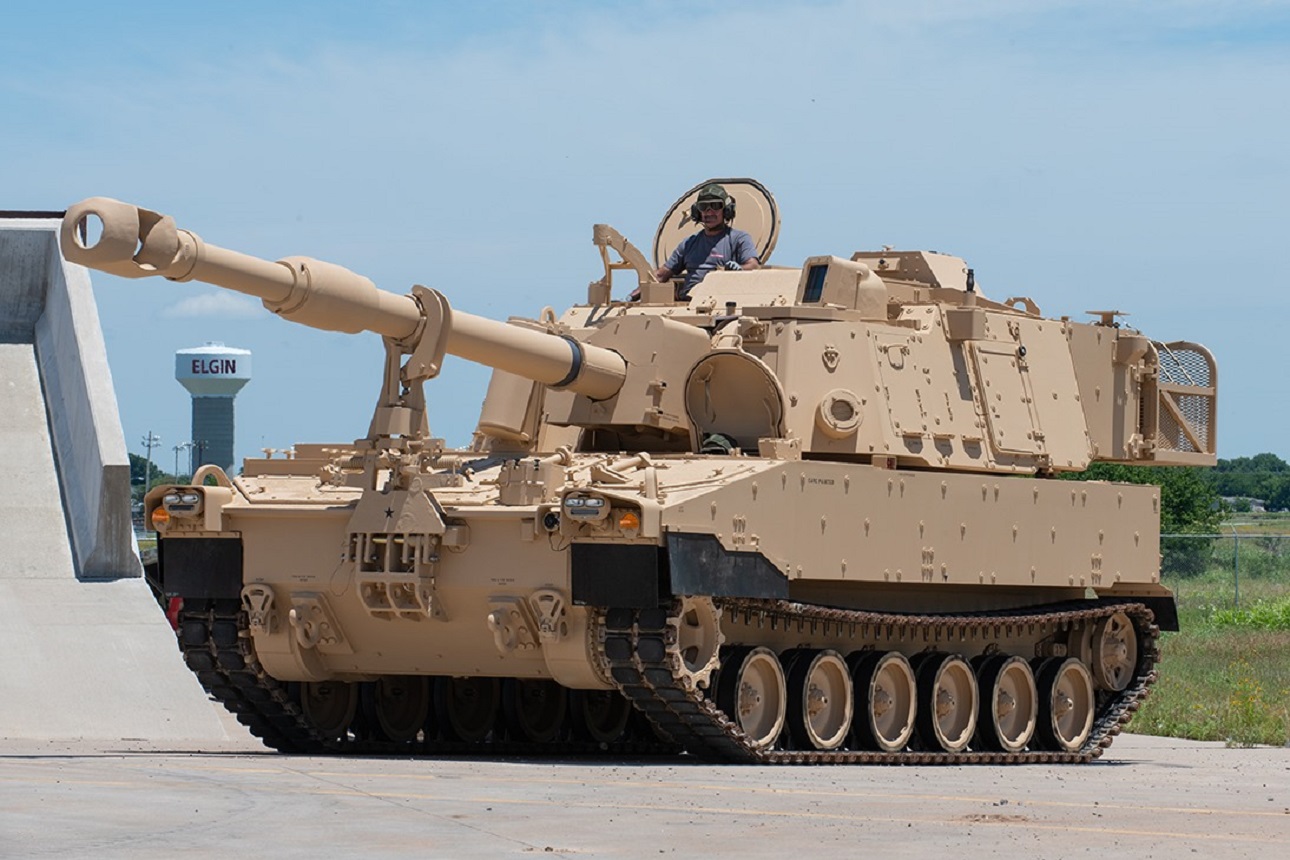
The publication Inside Defense reported that the U.S. unit of Britain’s biggest defense company BAE Systems is expected to get the green light to start full-rate production of advanced self-propelled howitzers in January.
The Inside Defense states, citing U.S. Army spokesman Sam Tricomo, that BAE Systems will start full-rate production following a contract award last week to extend low-rate initial production intended to bridge the production gap.
“We are excited about the opportunity to continue bringing new howitzers and increased survivability to our soldiers,” said Jeremy Tondreault, vice president and general manager of BAE Systems Combat Vehicles. “The M109A7 positions the Army to execute its current mission with confidence and support its future needs and requirements as long range precision fires evolve.”
The award exercises options on an existing low-rate production contract and includes the completion of an additional 60 M992A3 Carrier, Ammunition, Tracked (CAT) vehicles to accompany the M109A7.
The M109A7 and the CAT vehicle sets provide increased commonality across the ABCT, and have significant built-in growth potential in terms of electrical power and weight carrying capacity. The vehicle design includes a new chassis, engine, transmission, suspension, steering system, a new high voltage architecture and improved survivability, while the vehicle’s cannon remains the same as that of an M109A6 Paladin.
The M109A7 is supported by the Army as a vital technology enhancement program to maintain the combat capability of its ABCTs. It will solve long-term readiness and modernization needs of the M109 family of vehicles through a critical redesign and production plan that leverages the most advanced technology available today. This state-of-the-art “digital backbone” and power generation capability provides a more robust, survivable, and responsive indirect fire support capability for ABCT Soldiers. The M109A7 is a significant upgrade over the M109A6 as it restores space, weight, and power cooling, while providing significant growth potential for emerging technologies.
The initial contract was awarded in 2017. This most recent order brings the total number of vehicle sets — M109A7 howitzers and M992A3 ammunition carriers — to 156, and the total contract value to $1.16 billion.
Work on the M109A7 will take place at several facilities within the Company’s combat vehicles manufacturing network including: Aiken, South Carolina; Elgin, Oklahoma; Sterling Heights, Michigan; and, York, Pennsylvania.