

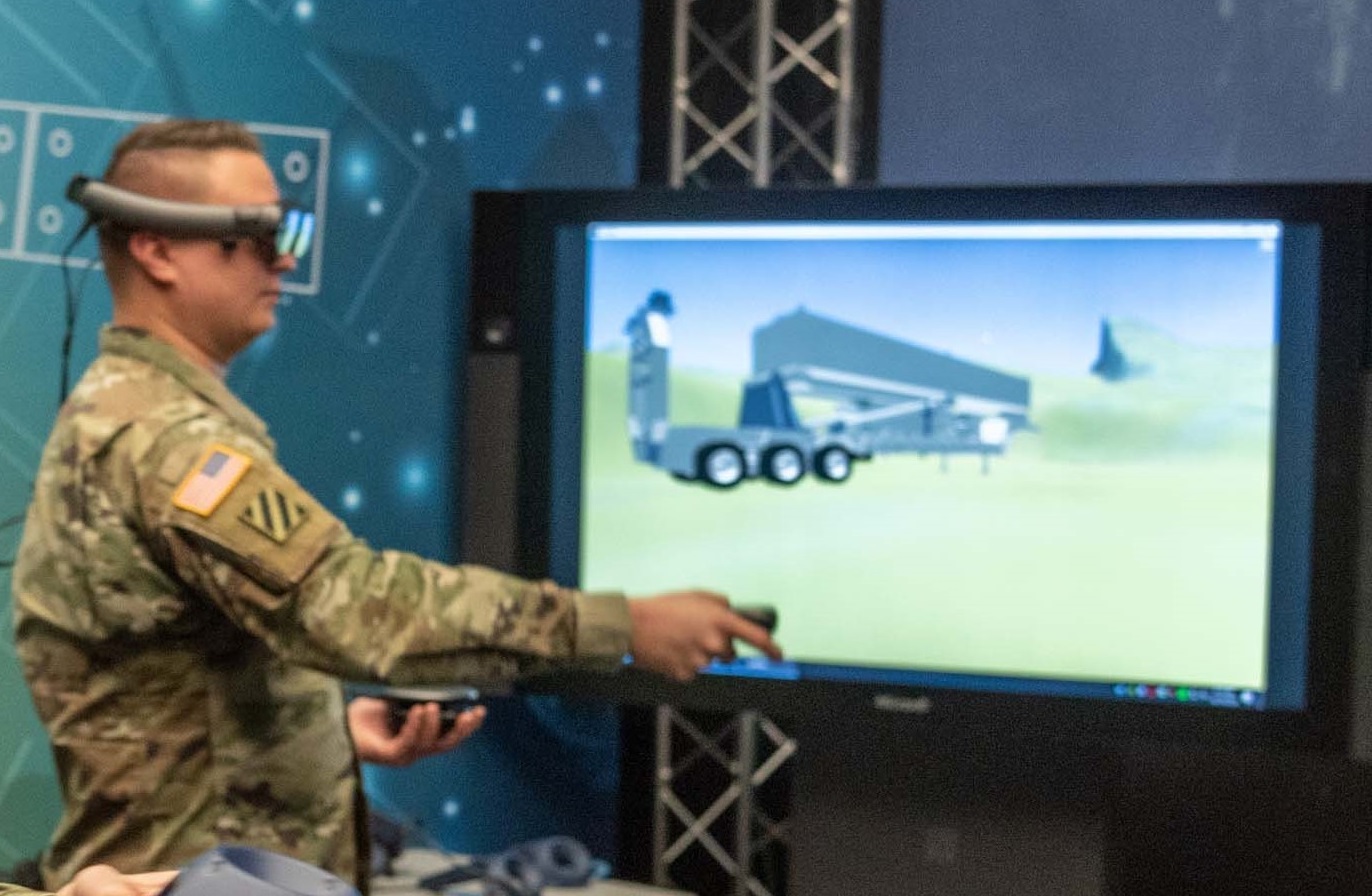
The U.S. Army has released some footage that shows a new 40-foot Transporter Erector Launcher (TEL) vehicle fitted with launch tubes for new hypersonic missiles.
Using virtual reality, Soldiers from Fort Sill, Okla. are getting a rare look at components of the Army’s new prototype Long Range Hypersonic Weapon (LRHW) and influencing how the system is designed.
Through a mix of virtual reality, augmented reality and mixed reality technologies, Soldiers last month were able to walk around and “touch” the Army’s new prototype LRHW system as an interactive, true-to-scale, three-dimensional model.
Inside the mixed reality lab, known as the Collaborative Human Immersive Laboratory, or CHIL, the Soldiers could view the equipment from any angle, at any distance and manipulate it as needed in order to better understand its operation and recommend improvements.
“We were able to stand as a group around an area called ‘the cave,’ which allowed all of us to see, in 3D, through special eyewear, the Transporter Erector Launcher and missile as one,” said LTC Aaron Bright, the chief of the Operational Training Division of the Directorate of Training and Doctrine at Fort Sill. “I was able to grab pieces of the LRHW with my hands and move them weightlessly to the side to get a better look at another part, and to better understand how the system as a whole works. The kinds of things that would take hours with a crane, and several more hours with tools, we were doing on our own in seconds.”
While hypersonics is often considered a futuristic, complex technology, the input received focused on seemingly low-tech items that are critical to Soldiers’ operational experience, such as generator placement and access, excess equipment that could be removed to save weight, generator exhaust routing, and specific locations for skid plates.
As the prototype is built, this early Soldier feedback will help identify any quick-fix flaws and offer ways to improve the operational capacity. The system consists of a 40-foot Transporter Erector Launcher (TEL) with missiles and a Battery Operations Center (BOC). The truck and trailer combination, and the BOC, are all taken from existing Army stock, and are in the process of being modified to create new equipment that’s never been used in this way before.
“You can apply virtual reality and augmented reality to almost any concept the Army or other component has and gain vital feedback,” said 1st Sergeant Michael Weaver, with the 1-31st Field Artillery Battalion, 434th Field Artillery Brigade at the Fort Sill Fires Center of Excellence. “Identifying potential issues early on in the development process is crucial because it is easier and cheaper to adjust design during the concept phase as opposed to production.”
The Army Rapid Capabilities and Critical Technologies Office (RCCTO) is charged with delivering the prototype LRHW to a battery no later than fiscal year 2023. The LRHW will introduce a new class of ultrafast, maneuverable, long-range missiles that will launch from mobile ground platforms. The prototype includes hypersonic missiles with a Common Hypersonic Glide Body (CHGB), the TEL and BOC.
This aggressive prototyping schedule, which pushes the Army’s initial hypersonic capability delivery ahead by two years, can’t wait until the hardware is modified and integrated for Soldier feedback. Virtual reality fills the void by enabling Soldier touch points on an early and regular basis.
“We have a very tight timeline with the LRHW,” said COL Ian Humphrey, integration project manager for the RCCTO’s Army Hypersonic Project Office. “We have to make it safe and we must meet very hard requirements. Although the LRHW is a prototype, the Soldier feedback we get here provides operational input early in the process. This is not only to help inform the LRHW, but also aid in the development of the Army’s hypersonics program of record.”
The mixed reality CHIL enables real-time collaboration through equipment including virtual reality headsets, 3D glasses, holograms, and handheld controllers. The facility is owned by Lockheed Martin, which is under contract to deliver the All Up Round plus Canister (AUR+C), which includes the missile stack, the Common Hypersonic Glide Body, and canister. The company also serves as the LRHW prototype system integrator.
Soldiers will be involved throughout the process and as more integrated and modified hardware becomes available, they’ll get a chance to walk around the real system. Plans are also in the works to create a CHILNET, which would allow remote sites to utilize the simulations and interact in real-time from multiple locations.