

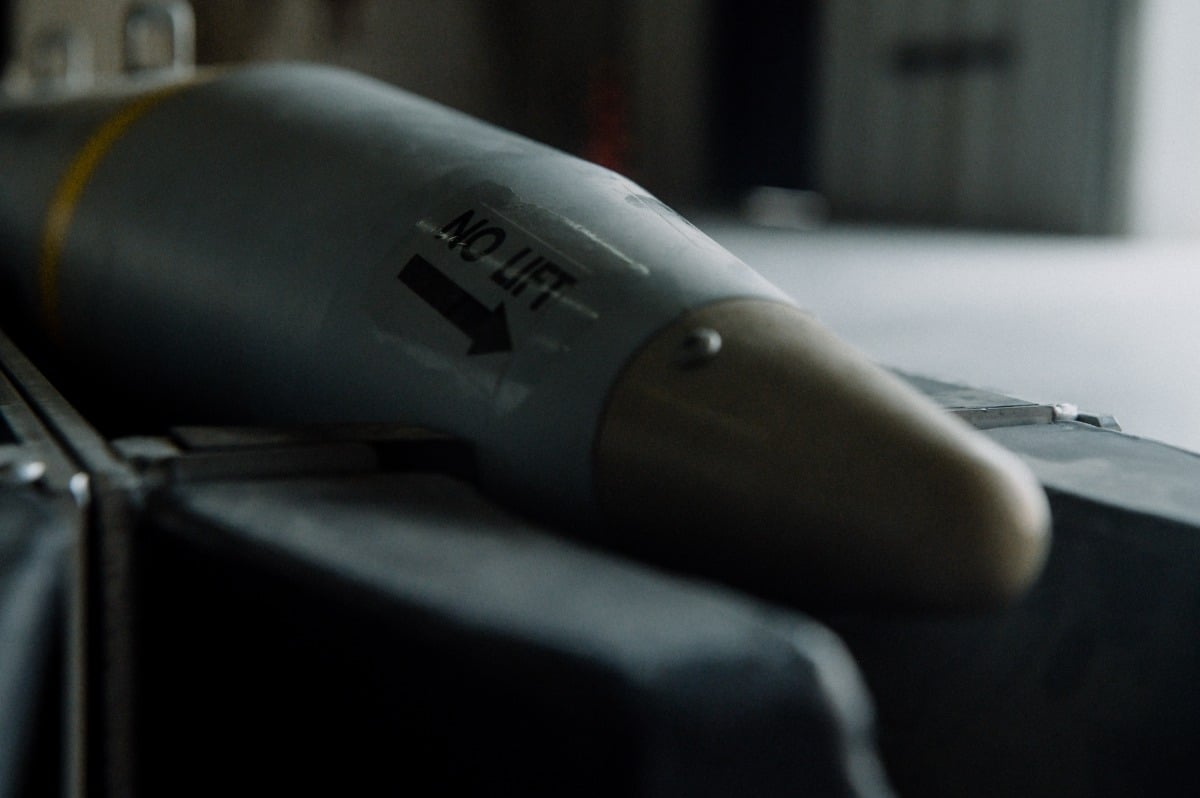
- General Dynamics-OTS Inc. of Lincoln, Nebraska, received a $33,911,620 Army contract to produce low collateral bomb cases, with one bid received.
- The Army Contracting Command at Rock Island Arsenal, Illinois, is managing the contract, estimated for completion by July 26, 2029.
A defense manufacturer in the middle of Nebraska farm country has landed a $33.9 million contract to build the outer shells of bombs engineered to kill fewer bystanders, a niche corner of American weapons-making that reflects one of the hardest problems in modern warfare: how to strike an enemy hiding among civilians without leveling the block around him.
General Dynamics-OTS Inc., a defense manufacturing subsidiary of aerospace and defense giant General Dynamics based in Lincoln, Nebraska, has been awarded a $33,911,620 firm-fixed-price contract to produce what the Department of War calls low collateral bomb cases, according to the contract announcement. A contract locks in the total cost upfront regardless of how the manufacturer’s expenses shift during production, putting the financial risk of any cost overruns on the company rather than the taxpayer. The Army solicited the work through a single internet posting and received only one bid, General Dynamics-OTS itself, a detail the contract notice discloses without further explanation and one that reflects how few American companies build this specific category of precision munitions hardware.
The term bomb case refers to the outer steel body of an air-dropped bomb, the casing that holds the explosive fill and determines how the weapon fragments on impact. What makes this particular contract notable is the phrase attached to it: low collateral. The U.S. military has spent nearly two decades developing bombs engineered to do less damage rather than more, a counterintuitive idea born directly out of the wars in Iraq and Afghanistan. The most well known example is the BLU-126/B, a 500-pound-class bomb body developed by the Navy’s Naval Air Systems Command that looks and flies identically to a standard high-explosive bomb but carries a fraction of the explosive charge, with the missing weight replaced by inert filler material so the bomb’s flight characteristics and guidance compatibility stay unchanged, according to NAVAIR’s own program documentation. The goal was never to make a weaker weapon for its own sake. It was to give pilots and commanders a tool that could destroy a specific building, vehicle, or group of fighters without the blast radius and fragmentation pattern that would kill or injure the people standing next door.
That distinction matters enormously in the kind of fighting American forces have done for most of this century. In dense urban environments, where insurgents or enemy fighters often operate within yards of homes, schools, or civilians who have nothing to do with the conflict, a standard high-explosive bomb can accomplish the mission while also causing casualties and destruction that undermine the broader strategic goal, whether that goal is winning local support or simply avoiding an international incident. NAVAIR has documented cases from as early as 2007, when Marine Corps F/A-18 fighter jets dropped low collateral damage bombs on insurgents planting roadside bombs in Iraq, demonstrating the concept could deliver a lethal strike while sparing the surrounding roadway and buildings from major damage. Nearly two decades later, that same design logic remains relevant enough for the Army to keep buying the hardware that makes it possible, even as the character of American military operations has shifted toward preparing for potential conflicts against better-armed nation-state adversaries rather than counterinsurgency alone.
Work under the new contract carries no fixed location or funding stream yet. Instead, the Army will determine both where the work happens and how it gets paid for as individual task orders are issued against the larger agreement, a structure known in defense contracting as an indefinite-delivery arrangement that lets the service order varying quantities over time without renegotiating the base contract each time. The contract runs through an estimated completion date of July 26, 2029, giving General Dynamics-OTS roughly three years to fulfill whatever volume of bomb cases the Army eventually orders. The Army Contracting Command at Rock Island Arsenal in Illinois, the historic military installation on the Mississippi River that has managed Army weapons and ammunition procurement since the Civil War era, is overseeing the deal under contract number W519TC-26-D-A026.
The Pentagon rarely announces how many bomb cases are actually ordered under contracts structured this way, and this notice is no exception, leaving unanswered exactly how many of these reduced-damage weapons will end up in American arsenals or where they might eventually be used. What is confirmed is that the Army is still investing in the capability to strike precisely and destroy narrowly, a quiet acknowledgment that even in an era increasingly focused on great-power competition, the ability to kill an enemy without killing everyone around him remains a capability worth paying for.