

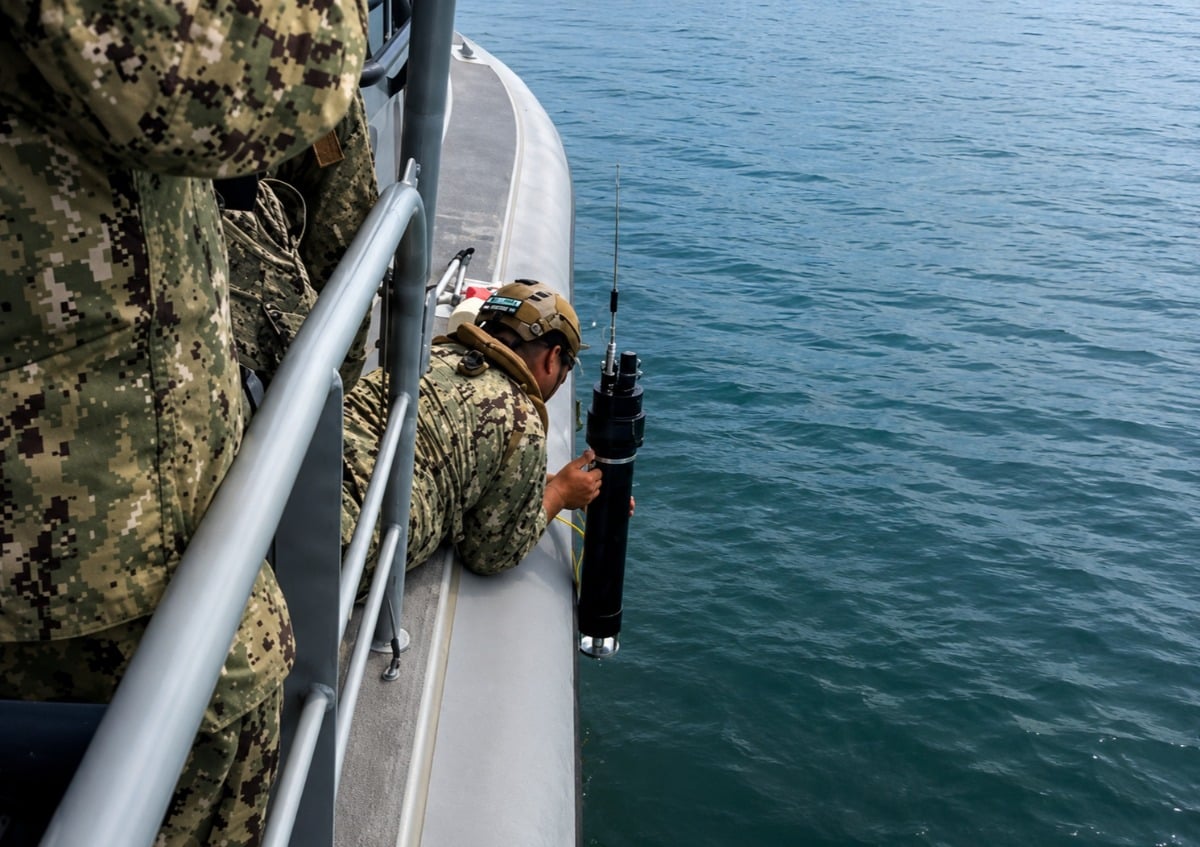
- The U.S. Army, Navy and Space Force tested the maritime variant of the Hammer of the Gods electronic warfare system for the first time in mid-July 2026.
- The test occurred during Project Convergence Capstone 6, supported by U.S. Space Forces Pacific and Naval Base San Diego, focusing on counter-PNT capabilities.
The U.S. Army, Navy and Space Force have tested an electronic warfare system at sea for the first time, and its name alone tells you what kind of punch the Pentagon expects it to pack.
The joint services put a maritime version of a system called Hammer of the Gods through its paces in mid-July 2026 during Project Convergence Capstone 6, a large-scale experimentation event at Fort Irwin, California, according to a report by Sgt. Sar Paw of the Army’s 5th Mobile Public Affairs Detachment.
Hammer of the Gods is not a weapon in the traditional sense of something that fires a projectile. It is an emitter, a piece of hardware that broadcasts electromagnetic signals, built to deliver an expanded suite of command-and-control capabilities alongside a wider set of electronic warfare functions from a highly deployable, low-signature platform. Electronic warfare covers the broad category of military operations that use the electromagnetic spectrum, the invisible range of radio waves, radar, and satellite signals that modern militaries depend on, either to disrupt an adversary’s systems or to protect friendly ones from being disrupted in turn. Because Hammer of the Gods keeps a low electromagnetic signature, meaning it does not broadcast in a way that makes it easy for an enemy to detect and target, it can push forward into contested areas and deliver what the Army describes as multi-domain effects at the forward edge of operations, essentially projecting electronic warfare capability into the thick of a fight rather than staying safely in the rear.
Ground-based versions of the system have already logged two years of exercises and demonstrations across the joint force, giving military planners a growing body of experience in how to fold Hammer of the Gods into the way American forces think about operating in the electromagnetic spectrum. The maritime variant tested during Capstone 6 marked the technology’s first appearance at sea, a milestone that matters because a system designed and proven on land does not automatically translate to the harsher, more complex environment of shipboard operations, where saltwater corrosion, motion, and radar clutter from the surrounding ocean all complicate electronic warfare in ways a desert test site simply cannot replicate.
That maritime debut only happened because of direct cooperation between U.S. Space Forces Pacific and Naval Base San Diego, the naval installation in California that supports much of the Navy’s Pacific Fleet operations, an arrangement organizers designed from the outset to fold in learning objectives from both U.S. Army Space and Missile Defense Command and U.S. Space Forces Pacific simultaneously. That kind of coordination reflects a deliberate shift underway across the Department of War, which has spent recent years pushing its individual services to design and test new technology jointly from the earliest stages rather than developing capabilities in isolation and trying to integrate them later.
Lt. Col. Darrin Hall, Chief of Modeling, Simulation and Integration for U.S. Space Forces Pacific, framed the broader purpose behind that kind of joint testing.
“Joint experimentation is how we prepare for future fights,” said Lt. Col. Darrin Hall, Chief, Modeling, Simulation and Integration (S7/8), U.S. Space Forces Pacific. “By integrating space, cyber and conventional forces into realistic scenarios, we strengthen our ability to operate as one joint team in contested environments.”
The specific capability at the center of this experiment carries direct consequences for how modern militaries fight. A significant focus of the maritime test involved evaluating counter-PNT, meaning the ability to disrupt an adversary’s Positioning, Navigation, and Timing systems, the same technology behind GPS that underpins everything from basic troop navigation to the guidance systems on precision-guided missiles and artillery shells. Hall described why protecting and disrupting that capability matters so much on a modern battlefield.
“This experiment proved that counter-PNT capabilities can be deployed, controlled and recovered in real-world maritime operations while extending operational reach through resilient mesh networking. It demonstrates the value of joint collaboration in advancing operational readiness,” Hall said.
Hall went further in explaining just how central PNT has become to nearly every aspect of contemporary warfare.
“Positioning, Navigation and Timing is the foundation of modern military operations. Understanding how to protect and operate through PNT disruption ensures our forces can continue to shoot, move and communicate effectively,” Hall said. “Counter-PNT effects enhances lethality by impacting the backbone for pinpoint targeting via long range artillery, guided missiles, and cruise munitions. Without PNT data, modern weapon precision drops sharply, resulting in delayed missions, missed objectives, or severe collateral damage.”
That vulnerability is not theoretical. Recent conflicts, including the ongoing war in Ukraine, have repeatedly demonstrated how heavily modern militaries depend on GPS and other PNT services, with both Russian and Ukrainian forces jamming and spoofing satellite navigation signals to disrupt drones, artillery targeting, and precision munitions on both sides of the front line. When those signals get disrupted or denied entirely, the ripple effects extend well beyond a single lost drone or missed artillery strike, degrading communications, navigation, and overall mission effectiveness across an entire force at once.
Capstone 6 gave commanders a chance to study exactly the kind of PNT disruption problem Hall described in a setting close to what forces might actually encounter at sea, using the experiment to refine how the joint force shapes the electromagnetic environment and builds resilience against the kind of navigation and timing attacks that have already reshaped fighting in Ukraine.
For a joint force increasingly aware that GPS and satellite timing can be jammed, spoofed, or knocked out entirely the moment a real fight begins, proving that a system built to fight through exactly that kind of disruption can survive its first trip to sea is not a footnote. It is a rehearsal for a fight where knowing your own position, and denying that same knowledge to the enemy, may decide who wins before a single shot gets fired.