

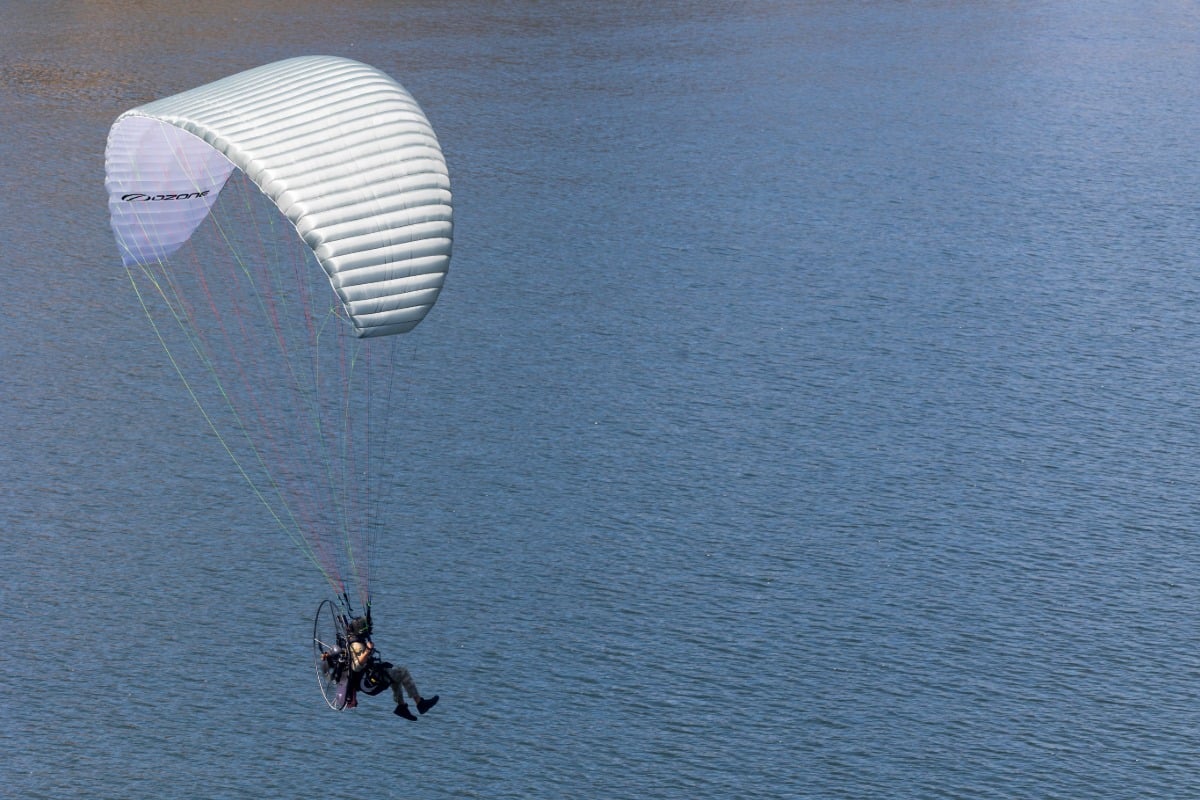
- The North Carolina Air National Guard is seeking two backpack-mounted powered paragliding flight systems under solicitation W50S87-26-Q-5004.
- The extended bid deadline is July 31, 2026, with delivery planned for New London, North Carolina, pending available government funding.
A North Carolina Air National Guard unit, part of the U.S. military’s part-time reserve force, wants to give its people the ability to quietly fly themselves into places a helicopter would get shot down trying to reach, and the shopping list it just published reads less like a defense contract and more like gear for an extreme sport that somehow ended up on a battlefield.
The North Carolina National Guard’s procurement office issued a solicitation this month seeking backpack-mounted powered flight systems, essentially motorized paragliders that let a single service member launch on foot, fly under their own power and land again without needing a runway, helicopter or parachute drop aircraft. The National Guard Bureau notice, tied to the 145th Airlift Wing at Charlotte Air National Guard Base, set an original deadline of July 24, 2026, then extended it to July 31, 2026 to give the government time to add specifications for a parachute component that had been left out of the original paperwork, according to the amendment attached to the solicitation. A powered paraglider, sometimes called a paramotor or known by the acronym PPG, straps a small engine and propeller to a pilot’s back, who then launches by running a few steps under an inflated fabric wing and climbs into the sky the same way a hang glider does, just with an engine doing the work a strong headwind would otherwise provide.
This is not some quirky one-off purchase, since powered paragliders have quietly become a serious tool for militaries around the world precisely because they are almost impossible to detect, generating minimal radar signature, minimal heat signature and barely more engine noise than a lawn mower, advantages that matter enormously to anyone trying to slip into contested territory without announcing their arrival. U.S. Marine Corps special operators publicly demonstrated paragliding infiltration capabilities at a showcase event in Tampa in 2024, flying in as part of a scenario that involved hunting down a swarm of enemy drones, according to reporting from The War Zone. That same low observability cuts both ways, though, since Hamas militants used powered paragliders to launch their October 2023 attack on southern Israel, a stark demonstration of how effective the technology can be for anyone trying to cross a defended border undetected, a fact that has only accelerated Western militaries’ own interest in fielding the capability themselves.
The specifications the North Carolina Guard laid out read like a wish list built by someone who has actually flown one of these systems into a real mission. Each set must include two distinct paraglider wings, a smaller one sized between 23 and 25 square meters (248 to 269 square feet) built for solo flight without heavy gear, and a larger wing between 26 and 28 square meters (280 to 301 square feet) certified to safely lift a pilot carrying a minimum 80-pound (36-kilogram) rucksack, a distinction that matters because a wing sized for a light pilot can become dangerously unstable once loaded down with a full combat kit. Every visible component, from the canopy to the harness to the motor frame, has to come in a muted tactical color like gray, olive drab or coyote brown with no large commercial logos, though the solicitation specifically exempts the reserve parachute from that same visual discipline since it stays packed away unless something goes badly wrong.
The engine has to deliver power equivalent to at least a 185cc motor and maintain safe climb rates at altitudes between 8,000 and 10,000 feet (2,438 to 3,048 meters), a real engineering challenge since thinner high-altitude air gives a propeller much less to bite into. Pilots need an integrated engine shutoff, a right-hand throttle, and a propeller sized around 140 centimeters (55 inches), while the harness must be adjustable, sized at minimum Large, and built with integrated spine protection similar to an airbag system in case of a hard landing. An extended fuel tank has to support cross-country flights ranging from 30 to 100 miles (48 to 161 kilometers), and every system needs a steerable reserve parachute rated to handle a combined weight of at least 170 kilograms (375 pounds) for tandem or heavy payload situations, plus an automatic water flotation device that deploys the moment the pilot hits open water, a detail that hints at potential use in maritime interdiction or over-water infiltration scenarios the notice itself never spells out.
Training makes up a substantial share of the requirement as well, with the solicitation calling for roughly 21 days of flight instruction for two personnel covering everything from basic Visual Flight Rules ground school to cross-country navigation exercises culminating in a 100-mile self-sustained flight, short takeoff and landing techniques, tactical formation flying, emergency water survival training described in the document as wet silk training, and night operations conducted with night vision goggles. A separate 10-day course would certify two maintenance technicians to service the specific flight system and engine once delivered. The government is treating the whole package as a commercial acquisition set aside for small businesses, meaning only companies below a 1,350-employee threshold under the aircraft manufacturing industry classification are eligible to bid, and the notice makes clear that funding is not yet secured, warning bidders that no award will happen unless money actually becomes available and reserving the government’s right to cancel the requirement outright at any time.
What the solicitation does not reveal is which specific personnel within the 145th Airlift Wing would actually fly these systems or what missions they are meant to support, leaving open whether this capability is destined for a specialized unit within the wing’s broader structure or represents a new mission set entirely. What is clear from the document itself is that a Guard unit built around flying massive C-17 cargo jets is now also shopping for the smallest, quietest flying machine the U.S. military has ever fielded, a reminder that modern warfare increasingly comes down to the space between a roaring transport plane and a single soldier who needs to disappear into the sky without anyone noticing at all.