

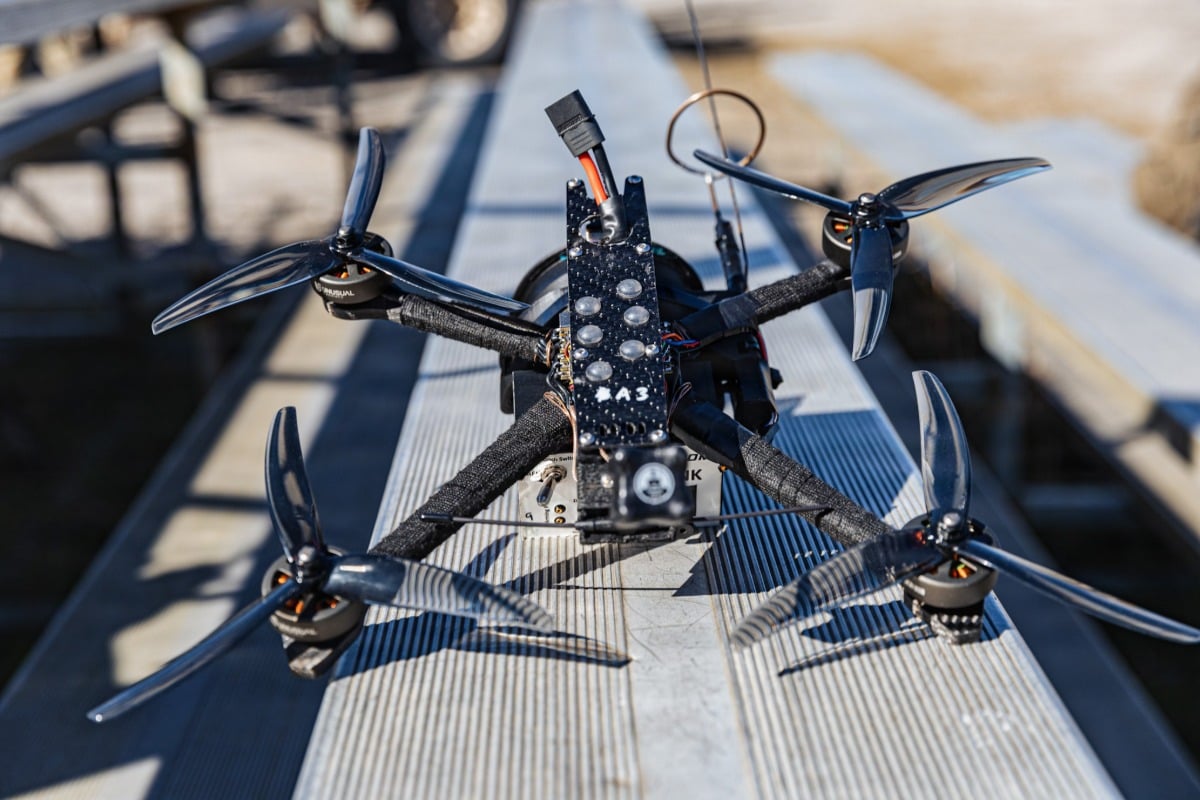
- The U.S. Army awarded Siemens Government Technologies a $79,988,134 contract to build drone motor stator assemblies at Anniston Army Depot in Alabama.
- Work runs through August 9, 2027, funded by fiscal year 2025 Army aircraft procurement money, with Army Contracting Command at Detroit Arsenal overseeing the award.
An electric motor smaller than a coffee mug might decide whether America’s drone army flies during the next crisis, and the U.S. Army has placed a nearly $80 million bet on building that motor at home instead of buying it from a country Pentagon planners increasingly view as an adversary.
The Department of War announced this week that it awarded Siemens Government Technologies, the federally focused U.S. arm of the German industrial giant Siemens, a firm-fixed-price contract worth $79,988,134, essentially $80 million, to build a secure, government-controlled factory capable of producing electric motor stator assemblies for unmanned aircraft systems, the technical term for drones. A stator is the stationary part of an electric motor that generates the magnetic field needed to spin the rotor, and it sits at the center of every brushless drone motor flying today. Without a reliable domestic source for that single component, the Army’s entire small drone fleet remains hostage to a supply chain that runs through Beijing.
Eleven companies competed for the work after the Army solicited bids online, and Siemens Government Technologies came out on top. The company will build the manufacturing line at Anniston Army Depot in Anniston, Alabama, a sprawling 25 square mile Army facility so synonymous with heavy armor that troops and depot workers have nicknamed it the Tank Rebuild Center of the World, according to the Encyclopedia of Alabama. Anniston has spent more than seven decades rebuilding M1 Abrams tanks, artillery pieces and armored bridging vehicles rather than small electronics, which makes this contract a notable pivot toward the kind of precision component manufacturing the Army has typically outsourced overseas. The Army funded the award entirely out of fiscal year 2025 aircraft procurement money, and the work carries an estimated completion date of August 9, 2027. The contracting activity overseeing the deal is Army Contracting Command at Detroit Arsenal in Michigan.
The urgency behind this contract only makes sense once you understand how badly the United States has fallen behind on the raw materials that power drones. China controls roughly 98 percent of global rare earth magnet manufacturing, according to Goldman Sachs, and those magnets are what make a brushless drone motor spin in the first place. Each small drone motor typically contains somewhere between 5 and 15 grams (0.18 to 0.53 ounces) of neodymium magnet material, and nearly all of that supply currently flows out of Chinese refineries and processing plants. The dependency runs far deeper than motors alone. At least 80,000 components spread across 1,900 different U.S. weapons systems rely on Chinese-sourced rare earths, a figure drawn from Pentagon supply chain analyses and cited widely in industry reporting, touching everything from guidance systems to sensors to nearly every airframe the Department of War fields.
That vulnerability turned into a live demonstration of Chinese leverage in October 2024, when a single phone call from a Chinese government office to a battery supplier in Dongguan cut off the power source for Skydio, then America’s largest drone manufacturer, grounding the company’s production overnight, as reported by Stars and Stripes. Beijing has since shown it can apply the same pressure to infrared sensors, rare earth magnets and motors, giving Chinese officials an off switch for a meaningful slice of American drone production whenever they choose to flip it. Those export restrictions were paused for a year under a trade truce between Washington and Beijing, but the underlying leverage never went away, and the clock on that pause keeps running.
Tobyhanna Army Depot in Pennsylvania activated its own domestic brushless motor assembly line on June 30, targeting production of 480,000 motors a year, a scale no American supplier could have matched twelve months earlier, according to a Tech Times report. Even that milestone came with an asterisk attached, since the neodymium magnets feeding into those Tobyhanna-built motors remain roughly 90 percent Chinese-sourced, meaning the final assembly happens on American soil while the critical raw material still travels from the same overseas suppliers the Army is trying to escape. Congress has taken notice of that gap. Representatives John Moolenaar, a Michigan Republican, and Ro Khanna, a California Democrat, introduced the Magnets Value Chain Support Act of 2026, legislation that would create tax credits along the rare earth processing and magnet manufacturing chain, though the bill does not currently mandate domestic sourcing outright.
Whether that experience translates smoothly into precision motor manufacturing for combat drones remains an open question, since the company is now being asked to stand up an entirely new production capability rather than service existing infrastructure. The Department of War’s contract announcement does not specify how many stator assemblies the new line is expected to produce annually, which drone platforms will ultimately use them, or whether Anniston’s output will rely on domestically sourced magnets or continue drawing on the same Chinese supply chain that still feeds Tobyhanna’s motors.