

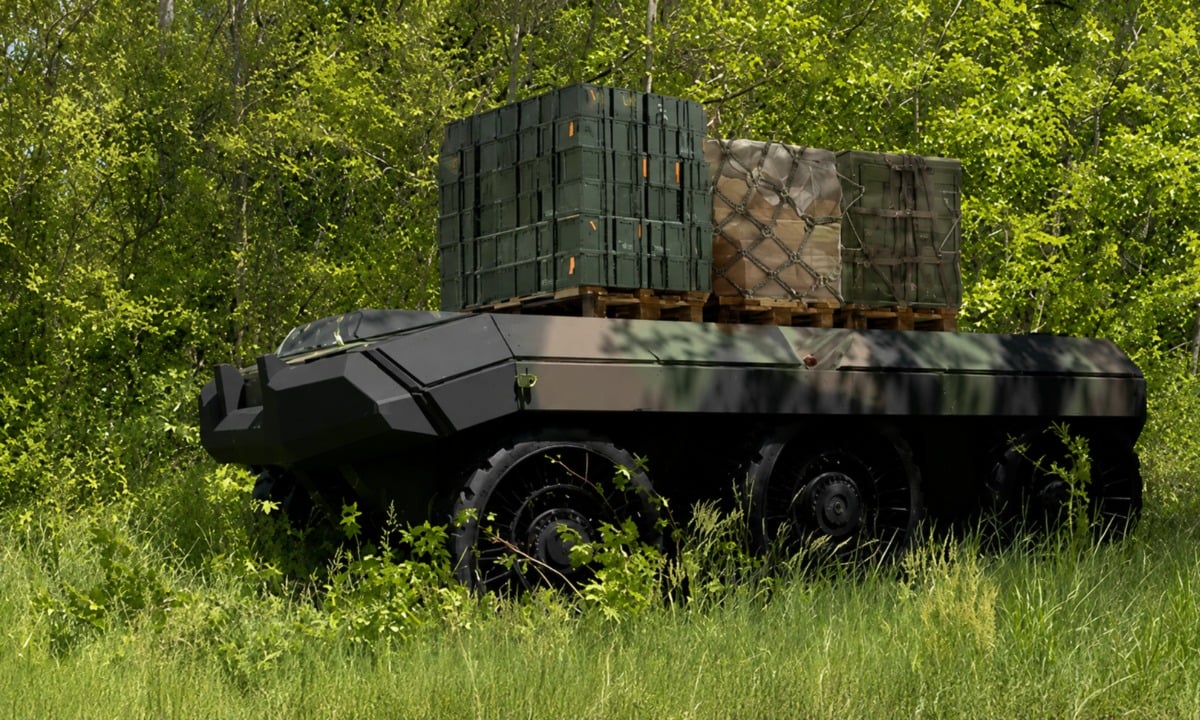
- BLADE was selected as one of five industry partners for the U.S. Army's Project Sustainment contract on July 23, 2026, offering its Dire WOLF vehicle.
- The Dire WOLF is a six-wheeled diesel-electric hybrid unmanned ground vehicle built to automate supply distribution in contested combat environments.
HDT Robotics, doing business as BLADE, announced Wednesday it has been selected as one of five industry partners for the U.S. Army’s Project Sustainment initiative, a program run through the National Advanced Mobility Consortium that focuses on automating how supplies reach troops in combat zones where the enemy is actively trying to disrupt that resupply chain.
The Army calls this problem contested logistics, and it’s become one of the service’s central planning concerns as it prepares for the possibility of large-scale combat against a well-armed adversary rather than the counterinsurgency operations that shaped the past two decades of American warfare. Federal law formally defines a contested logistics environment as one where an adversary directly targets logistics operations, facilities and activities, whether inside the United States, overseas, or while supplies are actually in transit between locations. That threat looks very different from anything American forces faced fighting insurgents in Iraq or Afghanistan, since a peer adversary with long-range missiles, drones and electronic warfare capability can strike a supply convoy or depot from far beyond visual range, turning the simple act of moving fuel, ammunition or medical supplies into one of the most dangerous jobs on a modern battlefield.
BLADE’s answer to that problem is the Dire WOLF, a six-wheeled diesel-electric hybrid robotic vehicle the company is putting forward for the contract, built as a rugged variant of its existing WOLF-X robotic combat vehicle. The Dire WOLF is designed to move cargo across both long and short distances without a driver exposed behind the wheel, and it draws on more than two decades of unmanned ground vehicle engineering BLADE has built up through earlier programs. That track record includes the company’s Hunter WOLF, a smaller sibling vehicle already in active service with the Army’s 10th Mountain Division, the Marine Corps, Australian defense forces and Ukraine’s military, which can carry roughly 2,800 lb (1,270 kg) of cargo more than 200 miles (322 km) off-road without refueling while climbing grades as steep as 60 degrees, giving a sense of the kind of rough terrain performance the larger Dire WOLF is expected to build on for this new Army program.
To handle the specific demands of moving heavier loads across genuinely hostile terrain, BLADE built the Dire WOLF around several features aimed squarely at survivability rather than just raw hauling capacity. The vehicle uses pivot-steering that lets it turn in place rather than requiring a wide turning radius, a feature that matters when navigating tight forest trails or urban rubble where a conventional vehicle would get stuck, and it’s engineered to climb steep slopes, cross wide gaps and scale vertical steps up to 2 ft (0.6 m) tall, the kind of obstacles that would stop a standard wheeled truck cold. Perhaps the most distinctive engineering choice is the Dire WOLF’s use of non-pneumatic Michelin Tweel tires, a tire design that eliminates air pressure entirely by using a flexible polyurethane spoke structure instead of a traditional inflated rubber tire, meaning the vehicle simply cannot get a flat regardless of how much shrapnel, debris or gunfire it drives through, a meaningful advantage for a resupply vehicle expected to operate in exactly the kind of contested terrain where tire punctures would otherwise strand a convoy in the open.
Tom Van Doren, President of Robotics at BLADE, framed the contract as an extension of the company’s existing family of unmanned ground vehicles rather than a standalone new effort.
“We’re excited to partner with the Army, NAMC, Michelin and Carnegie Robotics on this critical program,” Van Doren said, adding that: “The Dire WOLF joins the Hunter WOLF and WOLF-X pack to directly reduce risk to the warfighter. By leveraging advanced autonomy and proven UGV performance, we are ensuring that essential supplies reach soldiers at the tactical edge, safely and reliably.”
Project Sustainment itself runs through the National Advanced Mobility Consortium’s Detroit Arsenal Innovation agreement, a streamlined Army contracting mechanism established in September 2023 and administered by the Army Ground Vehicle Systems Center, designed specifically to fund research, development and prototyping faster than traditional acquisition processes typically allow. That structure gives the Army a way to bring newer, smaller robotics companies like BLADE into competition alongside established defense contractors, spreading development risk across five separate industry partners working the same underlying problem rather than betting everything on a single vendor’s design.
The Army’s own leadership has described the broader effort to modernize sustainment around this kind of autonomous distribution as central to how the service plans to fight and resupply forces spread across large, dangerous distances in a future large-scale conflict, an approach that treats moving supplies safely as just as critical to winning a fight as any weapon system carried by the troops those supplies are meant to reach.