

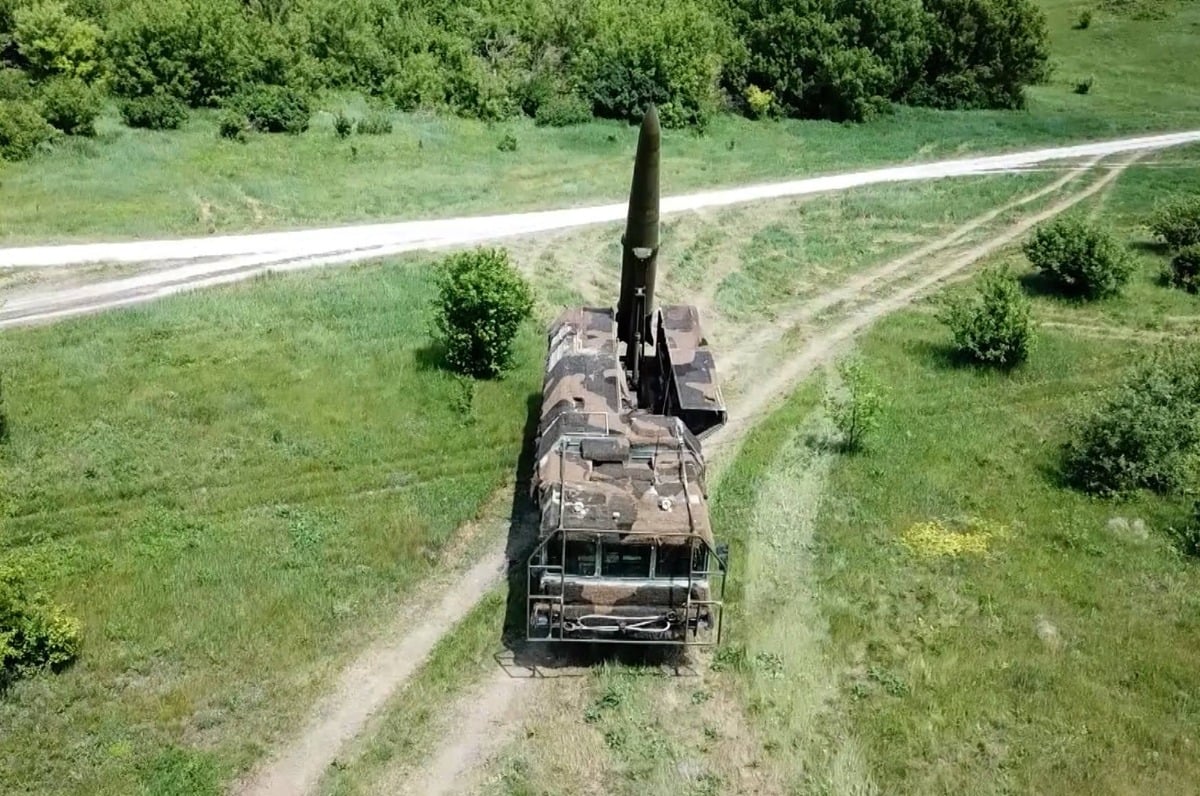
- Ukraine's Commissioner for Sanctions Policy Vladyslav Vlasiuk publicly called claims that electronic warfare can deflect ballistic missiles irresponsible and unrealistic.
- Ukraine's Air Force reported five Iskander-family ballistic missiles struck targets on July 16, while three were intercepted the same night.
A Ukrainian government official just told the country’s electronic warfare industry to stop overselling itself, and the missiles falling on Kyiv this month are the reason why. Vladyslav Vlasiuk, Ukraine’s Commissioner for Sanctions Policy, posted a blunt public rebuke this week aimed at claims that Ukrainian jamming technology can reliably knock Russian ballistic missiles off course.
“The claim that ballistic missiles can supposedly be deflected using electronic warfare is simply irresponsible,” Vlasiuk wrote. “It is clearly far from reality and only creates false expectations.”
His post responded directly to a claim from Yaroslav Filimonov, CEO of Kvertus, one of Ukraine’s most prominent electronic warfare manufacturers, a company that builds jamming systems designed to sever the radio and satellite links drones and missiles depend on to reach their targets. Filimonov stated that Ukraine can now deflect ballistic missiles using electronic warfare, a category of weapon distinct from the drones and cruise missiles that fly like conventional aircraft, since a ballistic missile launches on a steep, rocket-powered arc and comes down on its target at extremely high speed, giving air defenses only seconds to react.
“Ukraine is now able to deflect ballistic missiles using electronic warfare,” Filimonov said. “This should reduce the number of strikes on the country’s territory.”
Filimonov has offered a more measured version of that claim elsewhere, telling the outlet RBC-Ukraine separately that electronic warfare can influence a ballistic missile’s accuracy by disrupting the satellite signals it uses to navigate, but that such systems remain a supplementary tool rather than a decisive or defining factor against missile strikes, a distinction considerably narrower than the standalone claim in this week’s promotional material.
A separate Ukrainian electronic warfare team known as Night Watch, whose public-facing operator goes by the nom de guerre Alchemist, made an even bolder claim in a statement circulating early, asserting the group had disrupted Russia’s RS-26 Oreshnik intermediate-range ballistic missile during a strike on May 24. The group described adapting the same jamming technique it developed against Russia’s Kinzhal aeroballistic missile and increasing its transmission power to achieve what it called a comparable effect.

“By applying the counter-Kinzhal methodology and increasing the power of its equipment, Night Watch achieved a similar result. One target was deflected and missed, while the other either hit or fell during flight with a very significant deviation over temporarily occupied territory,” the group’s statement said. “The flight trajectory of these missiles is best suited for jamming them, because the line-of-sight zone is maintained throughout the entire flight.”
No independent source, Ukrainian or otherwise, has verified that account of the Oreshnik test, and the claim remains unconfirmed.
Skepticism has come from an unusual direction: an anonymous but closely watched Telegram account describing itself as a Polkovnik GSH (General Staff colonel), widely believed within Ukraine’s military commentary circles to have direct ties to army leadership, has repeatedly challenged claims that electronic warfare can meaningfully defeat ballistic missiles at all. Citing Ukraine’s own Air Force reporting on a Russian strike against Kyiv, the account noted a stark result from July 11.
“All 6 ballistic missiles that Russia used to attack Kyiv overnight reached their targets. None of them were shot down,” the account wrote, citing the Air Force.
The account’s technical argument centers on how Russia’s Kinzhal, Iskander, and the missile fired by the S-400 air defense system all share the same satellite navigation hardware, a module called Kometa, paired with an internal guidance system built around a high-precision laser gyroscope that can steer the missile independently even if outside signals are jammed or spoofed. Once a missile transitions to relying purely on that internal, self-contained navigation in its terminal phase, the account argued, no external jamming signal can influence its flight path at all, a claim that directly contradicts the idea that electronic warfare alone can reliably push a ballistic missile off target.
Fabian Hoffmann, a missile researcher who publishes the newsletter Missile Matters, has examined whether Ukrainian jamming can realistically defeat ballistic missiles and noted that earlier reporting from the Kyiv Independent described one Ukrainian electronic warfare project claiming to have downed 58 of 59 Kinzhal missiles, though Hoffmann cautioned that “downed” likely overstates what actually happens, since jamming a missile’s guidance typically degrades its accuracy enough to make it militarily ineffective rather than physically destroying it in flight.
Ukraine’s own daily Air Force reports from the past two weeks offer a real-world check on all these competing claims. On the night of July 16, Russia launched a combined strike that Ukrainian forces say included five Iskander-M and S-400-derived ballistic missiles that struck their targets across 15 locations, alongside three additional Iskanders that were intercepted or suppressed. A separate strike on July 14 recorded one confirmed ballistic missile impact among dozens of drones downed the same night. Those figures show neither the total failure the skeptics describe nor the reliable deflection Kvertus and Night Watch have publicly claimed, but a mixed record where some missiles get through and others apparently do not, with no side yet offering data detailed enough to say definitively why.
What Vlasiuk’s rebuke ultimately signals is less a technical verdict than a warning about managing expectations in a country where every marketing claim from a defense contractor gets read by ordinary residents as a promise about whether their apartment building survives the next air raid siren. Until Ukraine’s military publishes verified, missile-by-missile data on what electronic warfare actually accomplished during any specific strike, the gap between what companies say their systems can do and what residents can actually count on when the sirens start will keep being litigated in public, one contested Twitter thread at a time.