

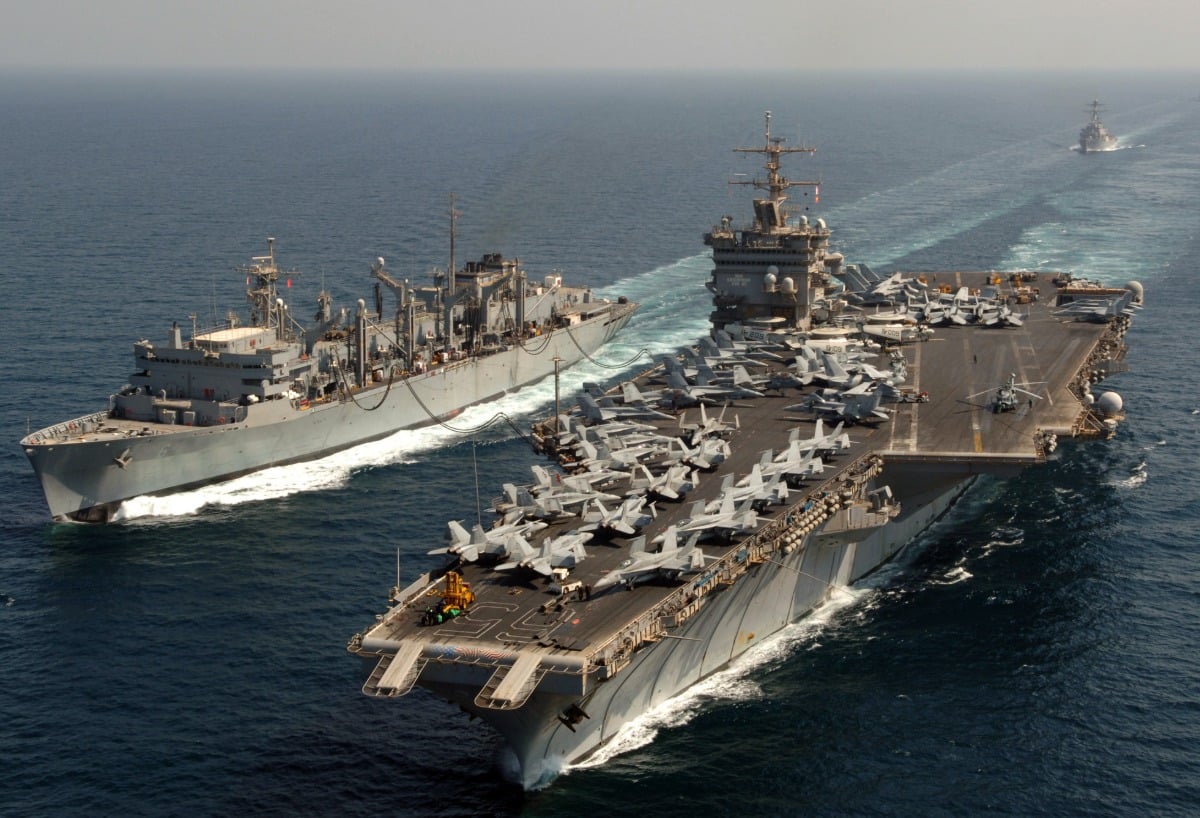
- The Navy awarded NorthStar Maritime Dismantlement Services $418.5 million to dismantle the former USS Enterprise, the first nuclear-powered aircraft carrier.
- Work will take place in Mobile, Alabama, and is expected to be completed by September 2030, following a re-competed contract after a 2026 court-ordered protest.
The world’s first nuclear-powered aircraft carrier is finally getting torn apart, and this time the Navy is paying more than $118 million less than it originally planned to spend doing it.
The U.S. Navy awarded NorthStar Maritime Dismantlement Services, based in Vernon, Vermont, a $418.5 million contract to completely dismantle, recycle, and dispose of the former USS Enterprise, the legendary carrier known throughout its 51-year career as the Big E, with the work set to take place in Mobile, Alabama, and finish by September 2030.
Commissioned in 1961, Enterprise was the only aircraft carrier the Navy ever built with eight separate nuclear reactors, a design choice that gave the ship enormous power but also made it uniquely complicated to eventually take apart. The carrier spent more than five decades at the center of American naval history, standing watch during the Cuban Missile Crisis blockade, flying combat missions over Vietnam, supporting operations during the fall of Saigon, and later deploying repeatedly in the post-9/11 era for Operation Enduring Freedom and Operation Iraqi Freedom. In 1964, Enterprise joined the nuclear-powered destroyer USS Bainbridge and cruiser USS Long Beach to circumnavigate the entire globe without a single refueling stop, a feat called Operation Sea Orbit that showcased exactly what nuclear propulsion could do for a warship that never needed to worry about running out of fuel mid-ocean.
The Navy decommissioned Enterprise in 2012 and finished removing its nuclear fuel by 2017, but the ship then sat largely untouched at Newport News Shipbuilding in Virginia for years while officials debated the safest and most cost-effective way to dismantle a vessel unlike anything else in the fleet. Enthusiasts had pushed to preserve Enterprise as a museum ship, an honor the American Nuclear Society formally recognized in 2021 by naming the carrier a Nuclear Historic Landmark, but the Navy ultimately concluded a museum conversion was impractical because the ship’s eight reactors are too deeply integrated into its structure to safely remove while keeping the rest of the vessel intact for public display.
NorthStar originally won the dismantlement job back in June 2025 through a competitive bidding process, with an initial contract worth $536.7 million, partnering with Modern American Recycling and Radiological Services in Mobile to handle the physical teardown while Waste Control Specialists in Andrews, Texas, took on disposal of the low-level radioactive and mixed hazardous waste at a federally licensed site. That award quickly ran into trouble. A rival bidder protested the decision, arguing that a malfunction on the government’s own procurement website had blocked their proposal from being submitted until several hours after the deadline, a technical failure entirely outside the bidder’s control. The U.S. Court of Federal Claims agreed with that argument in February 2026 and ordered the Navy to reopen the entire award process rather than let the original contract stand.
NorthStar won the contract again, but this time at $418,497,668, roughly 22 percent lower than its original winning bid, a gap that likely reflects either sharper competitive pressure the second time around or refinements NorthStar made to its cost estimates after spending months preparing for work it briefly thought it had already secured. The Navy structured the deal as a firm-fixed-price contract, meaning NorthStar agreed to complete the entire job for that set amount regardless of how its actual costs shake out, a structure that shifts financial risk onto the contractor rather than the government if expenses run higher than expected. Fiscal 2025 Navy operations and maintenance funds cover $415,497,668 of the total, obligated immediately at the time of award, and the contract states the procurement ran through the government’s Procurement Integrated Enterprise Environment solicitation system, the same digital platform whose malfunction triggered the original protest in the first place.
Once work begins in Mobile, every piece of Enterprise will eventually be processed in one of two ways. Ordinary steel and non-hazardous material will be recycled through standard channels, while anything classified as hazardous, including low-level radioactive waste left over from the ship’s decommissioned reactor plants, will be carefully packaged and shipped to licensed facilities equipped to handle that kind of material safely. Naval News has reported that roughly 35,000 tons of steel salvaged from the old Enterprise is expected to be recycled directly into the construction of its successor, the future USS Enterprise, a new Gerald R. Ford-class carrier designated CVN-80 that will carry the historic name forward into its ninth generation of service.
The Navy has explicitly framed the Enterprise dismantlement as a test case for how it will eventually retire an entire generation of Nimitz-class carriers, ten vessels currently serving in the fleet that will need this exact same process once they reach the end of their own service lives, starting with USS Nimitz itself, which is now reportedly on what officials expect to be its final active deployment. Every lesson NorthStar’s team learns cutting apart the Big E, every cost overrun avoided or safety protocol refined, becomes the blueprint the Navy will lean on when it eventually has to figure out what to do with a dozen more retired reactors it can no longer simply tow out to sea and sink.